
How Do You Get a Loan You Can Actually Afford

Unsecured personal-loan originations reached a record 7.2 million in the third quarter of 2025, according to TransUnion. But more borrowing doesn't mean every offer is worth accepting. If you're asking how do you get a loan, the useful answer starts with what you can repay, not how quickly someone will say yes.
Table of Contents
- What Getting a Consumer Loan Really Means
- Which Consumer Loan Fits the Expense
- Documents and Basics Lenders Expect
- How to Submit a Loan Request
- How to Compare Offers Before You Sign
- What to Do After a Denial or Thin Credit
- Decide Whether to Accept and Fund
What Getting a Consumer Loan Really Means
You apply, the lender assesses your ability and willingness to repay, and it may issue a written offer. You sign only after the disclosed terms pass a total-cost check, not because the payment looks manageable.
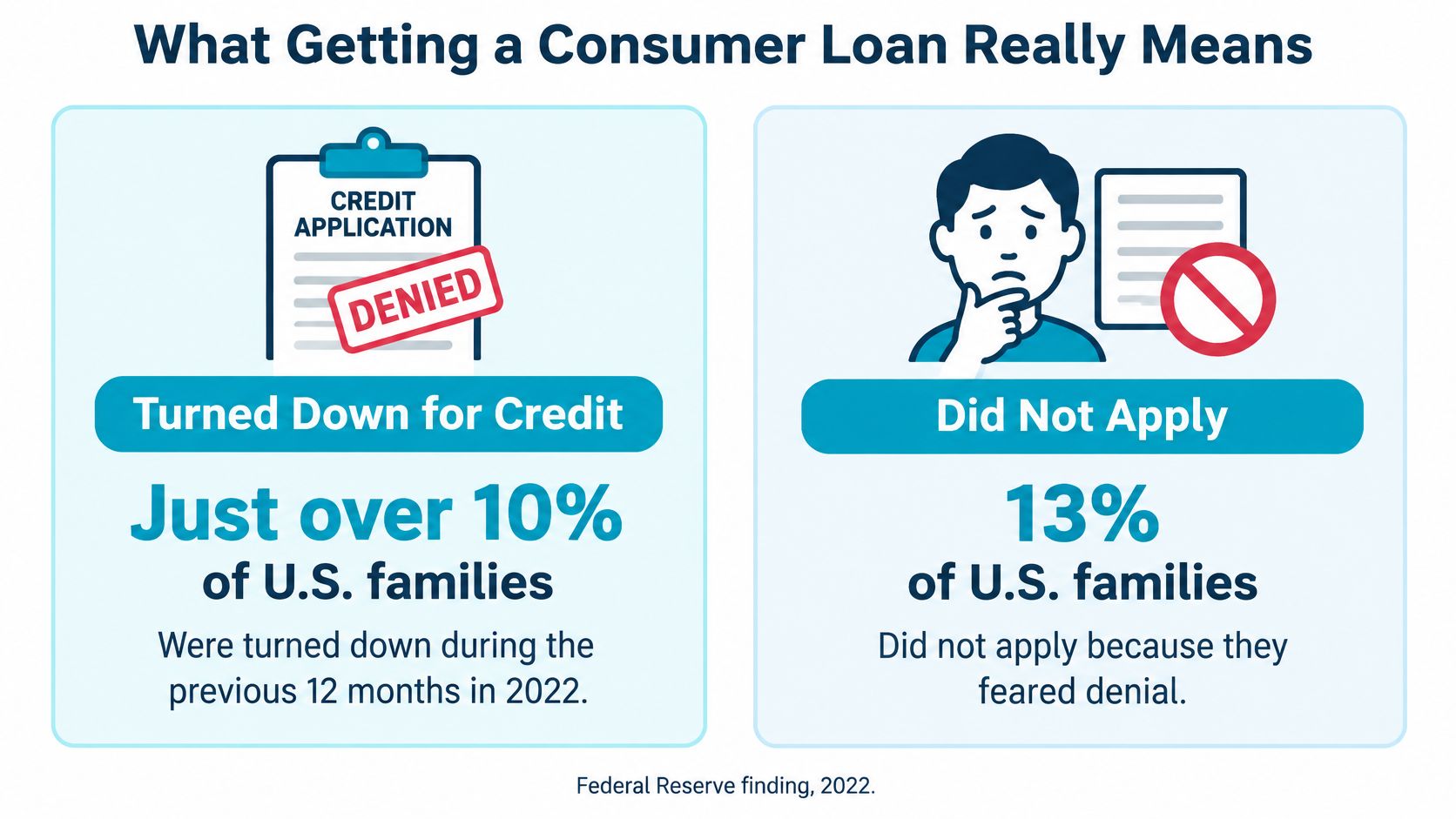
Approval isn't automatic. In 2022, just over 10% of U.S. families said they had been turned down for credit during the previous twelve months, while 13% said they hadn't applied because they feared rejection, according to the Federal Reserve's Survey of Consumer Finances.
Start with the expense, not the available limit
Say your car needs a repair so you can keep getting to work. Your starting point is the repair estimate and the payment your budget can support, not the largest amount advertised.
The practical sequence is straightforward:
- Set the purpose and payment. Leave room for housing, food, transportation, existing debts, and ordinary unexpected expenses.
- Provide accurate information. Report your income, employment, identity, and existing obligations.
- Let the lender assess risk. It evaluates whether you can repay and how you've handled credit.
- Compare written offers. Look at the full obligation rather than a fast response.
- Sign deliberately. Accept only when the costs and responsibilities are clear.
The lender, not a marketplace that connects you with lenders, decides approval, pricing, and conditions. It may offer less than requested, require a co-signer or collateral, charge a higher rate, or decline.
An unsecured personal loan relies primarily on creditworthiness and income. A secured loan adds an asset, such as a vehicle, that the lender can pursue under the agreement if you don't repay.
Practical rule: An affordable approval is more useful than the fastest approval.
Choose the product that fits the expense before entering a requested amount. A short repayment deadline and a vehicle-backed obligation solve different problems, even if both put cash in your account.
Which Consumer Loan Fits the Expense
Consumer loan types compared
| Loan type | Typical use | Collateral | Repayment shape | What lenders weigh |
|---|---|---|---|---|
| Unsecured personal loan | Major purchases, weddings, medical bills, debt consolidation | None | Fixed payments and a set term from the lender | Credit history and income |
| Installment loan | A planned payoff of one balance | Usually none for unsecured consumer products | Fixed schedule set by the lender | Income and credit |
| Payday or short-term cash loan | Cash gap between paychecks | None | Often a short repayment window or the next payday | Income and bank account, sometimes more than score |
| Title loan | Accessing vehicle equity when credit is weak | Vehicle equity | Lender-set schedule; vehicle can be lost if unpaid | Collateral can outweigh the score |
| Emergency or signature loan | Urgent rent, repair, or medical bills | Typically none | Installments or a short-term deadline set by the lender | Some lenders consider more than a traditional score |
Match the repayment structure to the need
An unsecured personal loan can suit an expense you need to repay gradually. For debt consolidation, compare the proposed obligation with the debts you'd replace. Moving balances into a new account isn't a saving unless the costs and repayment plan improve.
An installment loan describes a repayment structure, not a completely separate category. A personal loan can also be an installment loan because you repay it through scheduled payments over a set term. Our explanation of installment loans versus revolving loans can help if you're comparing a fixed payoff schedule with reusable credit.
A payday or short-term cash loan needs a different test: can you pay the amount due and still cover the expenses that arrive with your next paycheck? If repayment would immediately force you to borrow again, speed hasn't solved the cash shortage.
Weigh collateral and urgent-loan labels carefully
A title loan uses vehicle equity to support the request. That may create an option for someone with weak credit, but it also puts transportation at risk. Consider what losing the vehicle would mean for employment, childcare, and everyday travel before pledging it.
Emergency loan and signature loan labels don't establish a standard price or repayment period. Read the actual agreement to learn whether the offer involves installments, a short deadline, or conditions that make it unsuitable for your bill.
For perspective, the average U.S. personal-loan balance was $19,014 in 2024, down 2% from 2023, according to Experian. That's a description of existing borrowing, not a recommended request or an amount you should expect to receive.
Circle the row that best matches your expense, then write your maximum affordable payment beside it. If none fits without stretching your budget, consider negotiating a payment arrangement with the biller before adding a separate loan.
Documents and Basics Lenders Expect
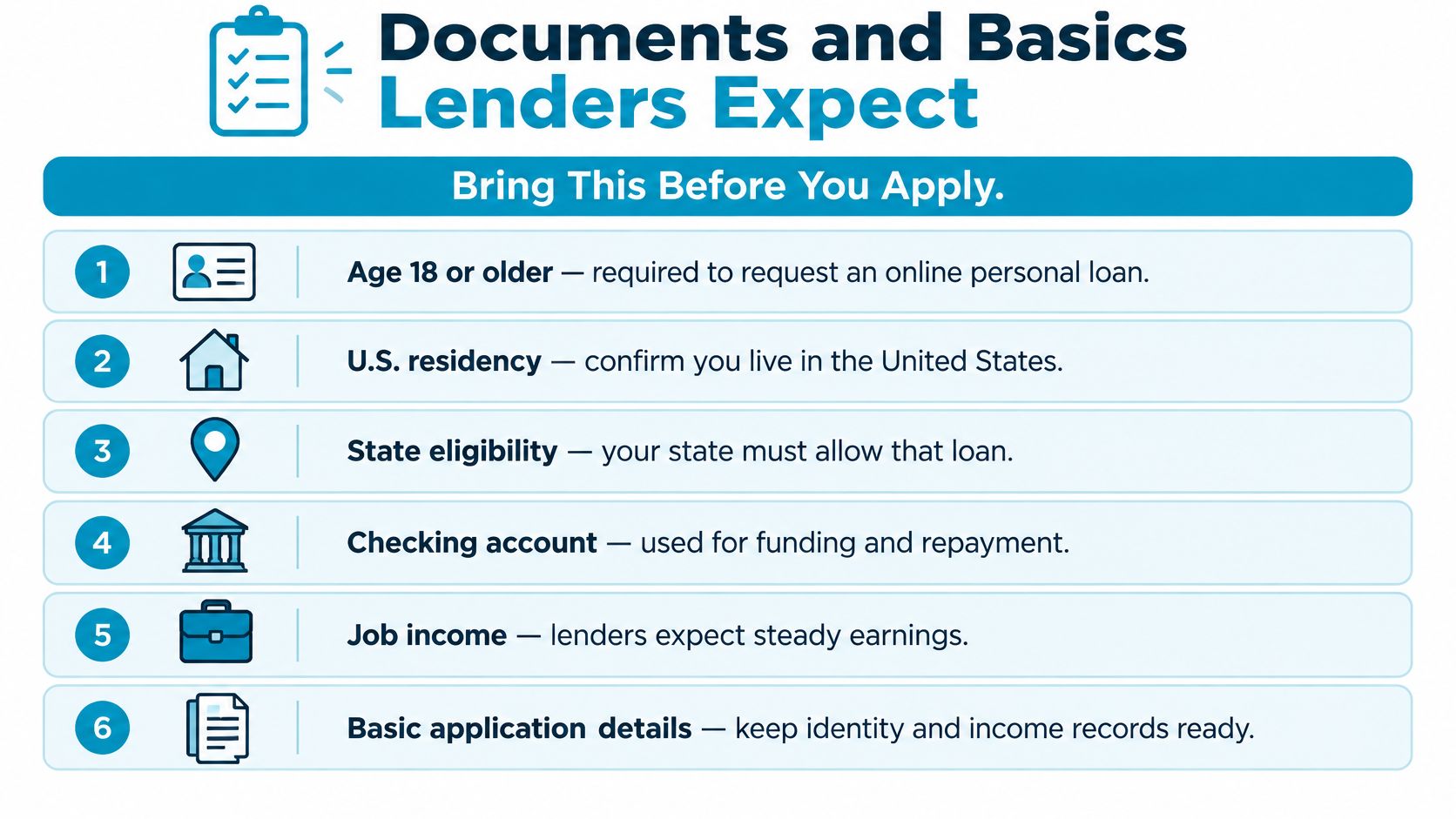
Before opening a form, check eligibility. Our basic online-request requirements include being at least 18, being a United States resident, having a checking account, and being employed with regular income and a known pay frequency. You must not live in a state where the loan you're requesting is illegal.
Our process also requires a Social Security number to verify identity. Meeting these starting conditions lets you request consideration; it doesn't establish that a lender will approve you.
Build a consistent application packet
Gather the information before you start entering it. A tidy packet makes it easier to answer follow-up questions without guessing.
- Government photo identification. Keep your legal name, address, and identification details available.
- Income evidence. Gather recent pay stubs or equivalent records showing what you receive and when.
- Employment information. Have your employer's name and your pay frequency ready.
- Housing payment. Record your current rent or mortgage payment accurately.
- Bank-account details. Confirm the routing number, account number, and account ownership.
- Existing obligations. List required debt payments and other recurring commitments.
Make the numbers consistent, but don't change accurate records merely to make them look identical. A pay stub showing gross wages and a bank statement showing take-home deposits measure different things. Label them correctly and be ready to explain deductions or timing differences.
If your address recently changed, keep documentation that connects the old and new addresses. Avoid submitting cropped, unreadable, or incomplete records when the lender requests a full document.
Handle unusual income and added borrowers
For irregular or self-employed income, organize bank deposits, invoices, and other income records so a lender can distinguish recurring earnings from transfers or occasional receipts. These records may help explain your finances, but they don't override a lender's eligibility rules.
A co-signer isn't just a reference. The lender reviews that person's credit, and the agreement can make them responsible for repayment if you don't pay.
For a title-backed request, you need a vehicle you can legally pledge and the ownership information the lender requires. Income alone won't make an unavailable or prohibited product eligible.
Keep this packet in a secure folder rather than sending sensitive records through unsolicited messages. With the facts assembled, completing a request becomes careful data entry instead of a search for missing information.
How to Submit a Loan Request
The broad process is request a loan, agree to terms, and receive funds. The important decisions happen between those stages, especially when a marketplace response sends you to an independent lender.
Move from request to lender review
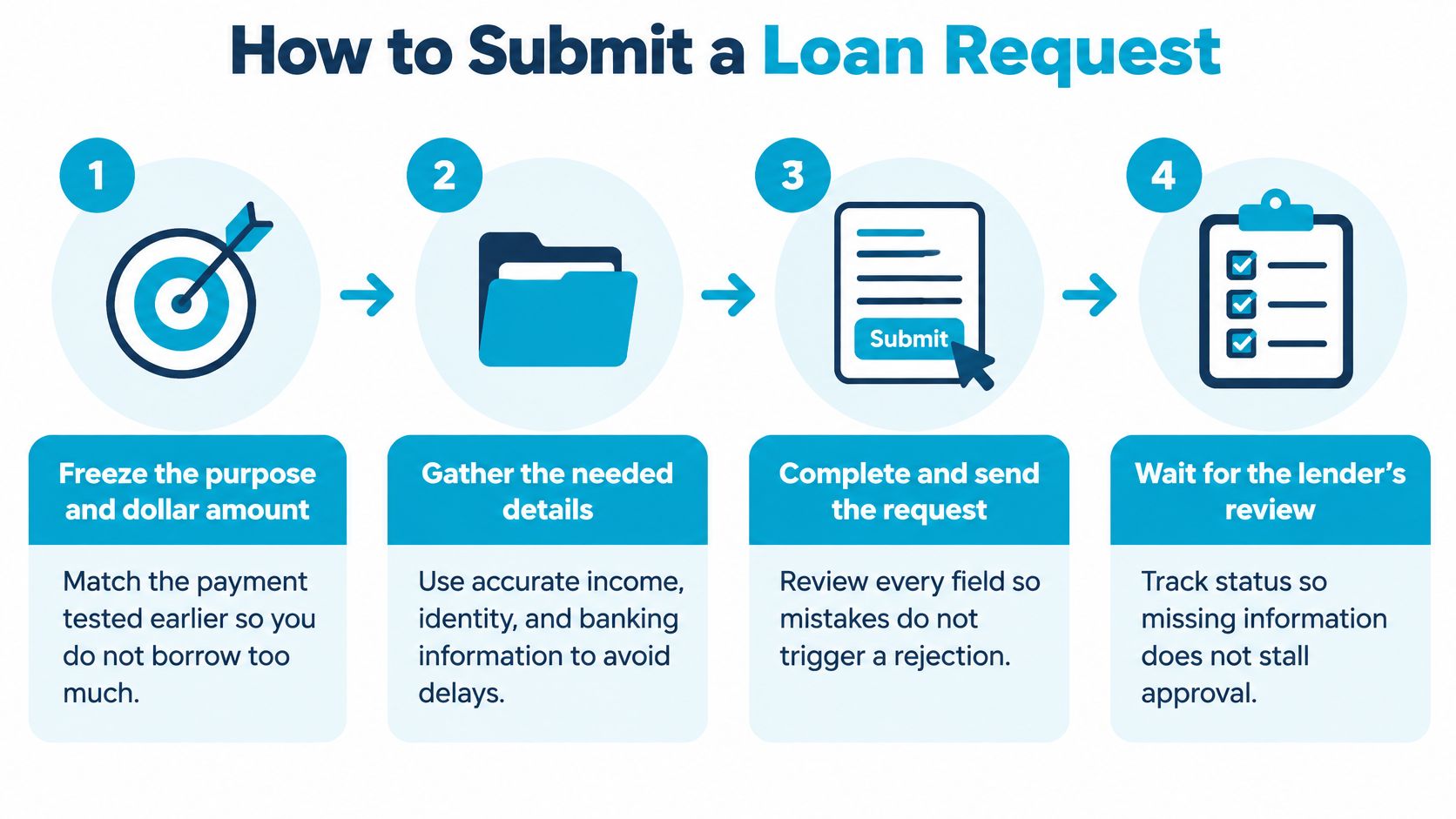
Fix the purpose and requested amount. Use the actual expense and your tested payment limit. Reasons may include debt consolidation, emergency costs, auto repair, medical bills, rent or mortgage, a wedding, or another major purchase. Don't increase the request just because a form permits it.
Complete a secure request form carefully. Our online form takes minutes and asks for the amount, personal information, and where funds should be deposited. A single marketplace intake can reduce separate data entry, but review its consent language so you understand how your information will be shared.
Treat a quick response as preliminary. A response within minutes may indicate a potential lender connection or next step. It isn't approval, a binding price, or a promise that money is on its way. Save the response and identify which lender is asking you to continue.
Follow the lender's instructions. A participating lender may redirect you to its website and request additional identity or income documents. Some lenders may require faxed materials. Verify the destination before sending sensitive records, and don't assume the original form supplied everything the lender needs.
Keep control of the final application
Allow the checks to finish. Credit, identity, income, or fraud review can change the result. A match or prequalification may still lead to a revised offer or a decline. Keep checking for requests for information rather than repeatedly submitting the same request.
Read available written terms before proceeding. Where prequalification provides an offer preview, review it before authorizing a final full application. Final disclosures may arrive later in the process, but read them before accepting the agreement. Ask the lender to explain any difference between the preliminary terms and the final offer.
Shop without sending indiscriminate full applications. Use prequalification that is clearly identified as a soft inquiry when available. Before authorizing a full application, check whether it involves a hard credit inquiry. Credit inquiries and newly opened debt can affect subsequent underwriting, so keep track of what you've authorized.
The Federal Trade Commission's advance-fee loan guidance explains that legitimate lenders check credit and application information before making a firm offer. A guaranteed-approval claim is therefore a warning sign, particularly when someone asks you to pay to secure the promised loan.
Sending information is permission to evaluate a request, not confirmation that you'll receive a loan.
At the offer stage, keep the lender's name, agreement, and proposed payment schedule together. Don't rush from a successful match directly to an electronic signature.
How to Compare Offers Before You Sign
A fast approval and a low monthly payment are both incomplete answers. A better comparison is total repayment, APR, and whether the funded amount still covers the expense. Start with the amount financed, finance charge, APR, and payment schedule, including the number of payments. For covered closed-end credit, these are generally required before credit is extended under the Truth in Lending Act, as explained by the Congressional Research Service's TILA overview.
APR expresses yearly borrowing cost, including interest and covered fees. The finance charge expresses the dollar cost of credit. Neither number replaces checking the cash you'll receive and everything you'll repay.
Calculate the cost of a smaller payment
Consider this hypothetical example, assuming equal payments and no additional charges:
- Shorter offer. Financing $5,000 with payments of $150 for 36 months means $5,400 repaid and a $400 borrowing cost.
- Longer offer. Financing the same $5,000 with payments of $130 for 48 months means $6,240 repaid and a $1,240 borrowing cost.
The smaller payment frees up $20 a month and costs $840 more overall. Lenders may spread repayment across terms ranging from 61 days to 84 months, so the payment count matters as much as the payment size.
Scheduled payment × payment count = scheduled total repayment. If the agreement has unequal payments or a larger final payment, add the actual scheduled amounts instead. A loan calculator handles that arithmetic quickly; whatever you use, reconcile the result against the lender's disclosed payment schedule.
Don't automatically subtract an origination fee from the amount financed again. Origination, documentation, and other fees may apply, and the disclosed amount financed may already account for prepaid finance charges. Ask for the net deposit amount and reconcile it with the principal and itemized deductions so you don't count a fee twice.
Build a side-by-side worksheet
What to compare on two loan offers
| Item | Where it appears | What to compare |
|---|---|---|
| APR | TILA disclosure before credit is extended | Yearly cost including covered fees, not the stated rate alone |
| Amount financed | TILA disclosure | Credit provided on your behalf; reconcile with net cash received |
| Finance charge | TILA disclosure | Total dollar cost of credit |
| Payment and number of payments | Payment schedule | Payment size versus how many times you pay |
| Total repayment | Your worksheet from payment amounts and count | Which offer costs less overall |
| Late, renewal, or date-change fees | Loan agreement | Charges triggered by missed payments or changed terms |
| Prepayment | Loan agreement | Whether early payoff saves interest or adds a fee |
| Funding conditions | Lender terms | Documents or conditions required before deposit |
Copy each offer into separate worksheet columns. Add the net deposit, debit dates, and collateral requirements beneath the comparison items. Funding speed varies among lenders, and some require faxed application materials or other documents before releasing proceeds, so note every condition attached to the deposit.
An approval for less than you requested changes the comparison too. Write down what the smaller funded amount pays for before weighing its cost against a larger offer.
Check that automatic withdrawals fit your pay cycle. A manageable payment can still cause an overdraft if it leaves before your wages arrive. List obligations that may not appear on a conventional credit report, including buy-now-pay-later payments.
Decision test: A payment is affordable only if you can make it without postponing essentials or taking another loan.
The lender provides APR, fees, and other terms in its agreement. Its own application review determines approval and pricing; a marketplace response doesn't set those terms.
What to Do After a Denial or Thin Credit
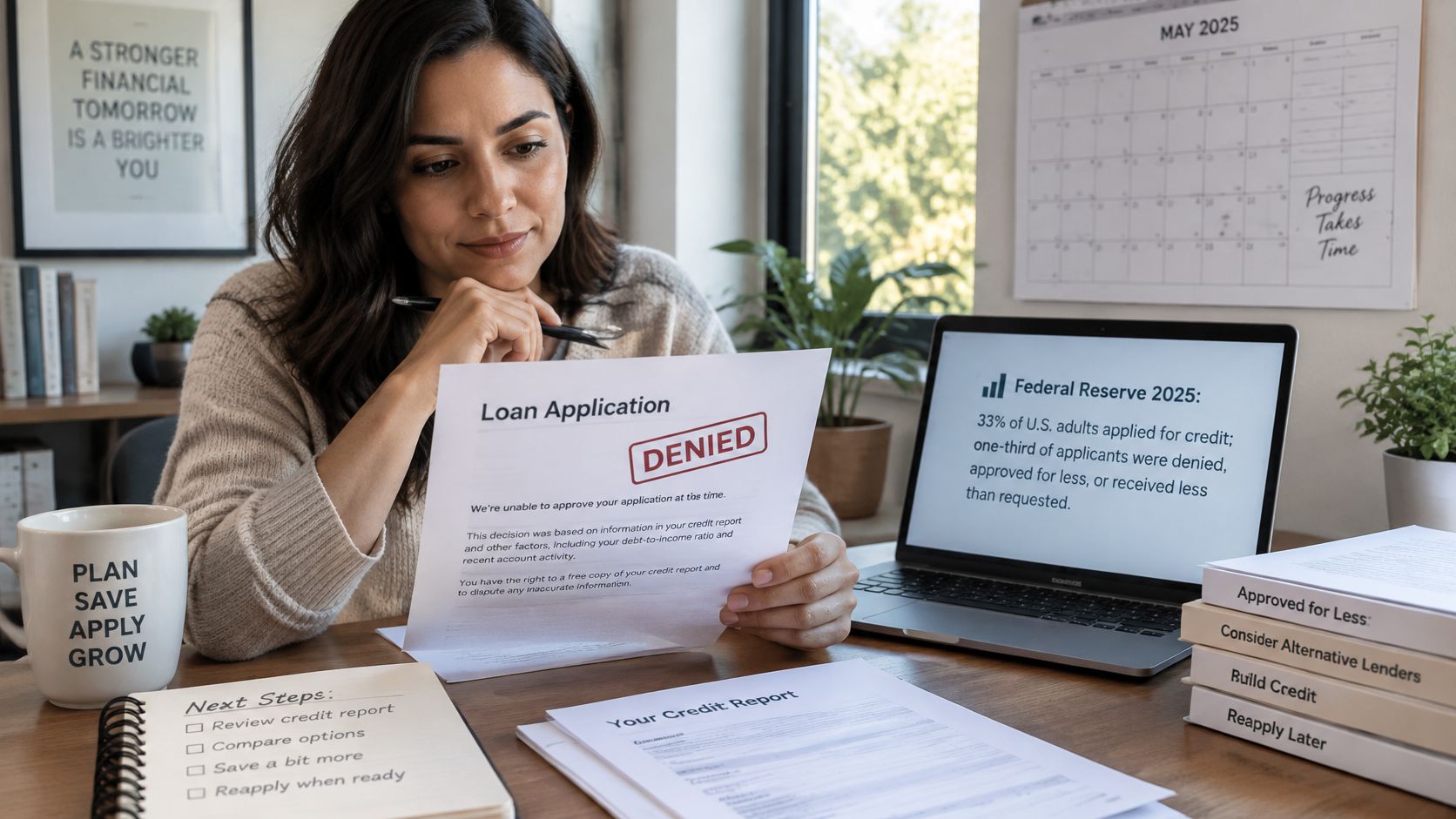
In 2025, 33% of U.S. adults applied for credit, and one-third of applicants were denied or received less than requested, five percentage points higher than in 2021, according to the Federal Reserve's household credit findings. An unsuccessful request isn't a reason to accept the next expensive offer without examination.
Identify what actually happened
These terms describe different things:
- Denial. The lender hasn't approved the credit requested.
- Adverse-action notice. This communicates the unfavorable decision and provides reasons or information about obtaining them. It isn't another kind of loan offer.
- Smaller approval. The lender offers less credit than you requested. Check whether it still solves the expense without requiring additional borrowing.
Read the stated reasons before changing your application. Obtain your credit reports, look for accounts or payment records that aren't yours, and dispute inaccuracies before applying again.
A thin file isn't the same as a history of missed payments. Our guide to no credit versus bad credit explains why those situations may call for different preparation.
Strengthen the evidence, not just the application
Some lenders consider income stability, bank-account cash flow, rent, and utility payment patterns. Cash-flow information may help expand access to small-dollar borrowing, but alternative information can also introduce accuracy, privacy, and fairness concerns.
Before granting account access, ask what information will be collected, who can see it, how long access lasts, and whether you can refuse or revoke access. Don't assume more data necessarily produces a better or cheaper offer.
Practical preparation includes:
- Right-size the request. Match the amount to verified income and a payment you can sustain.
- Reduce existing payment pressure. Paying down revolving debt may lower required payments. Debt-to-income measures monthly debt payments relative to income, not the balance itself.
- Stabilize account activity. Avoid overdrafts where possible and keep records that explain unusual deposits.
- Document accepted payment history. Gather on-time rent or utility records if the lender considers them.
No credit check doesn't mean no affordability assessment, and it doesn't mean low-cost borrowing. None of these preparation steps guarantees approval.
If a smaller offer leaves the bill partly unpaid, negotiate the remainder before accepting. Adding a co-signer transfers responsibility to another person; pledging collateral puts an asset at risk. Wait to reapply until the relevant correction or stronger income evidence is available.
Decide Whether to Accept and Fund
Accept only if the payment, total repayment, fees, and collateral risk work during an ordinary month. If the offer requires everything to go perfectly, it leaves too little room for normal financial setbacks.
There's no obligation to take an offer. Declining terms you can't sustain is a useful financial decision, not a failed application.
Sign only when you're ready to repay
Acceptance happens when you electronically sign the lender's offer and return it, usually through an e-signature page the lender hosts. Save the completed agreement rather than relying on the earlier offer screen.
Funds are deposited directly into your bank account, usually as fast as the next business day. Timing differs by lender, and additional documentation or processing can delay the deposit. Don't commit to spending the proceeds before they're available.
For eligible U.S. readers, NextStopLoans is an optional connector: our secure request form routes information to a network of independent lenders. We don't decide credit or set loan terms, and availability excludes locations where the requested loan would be illegal.
Make repayment administration part of acceptance
- Calendar the dates. Record both the first due date and the authorized debit date.
- Save the records. Keep the signed agreement and disclosures with the lender's name and loan number.
- Raise problems early. Contact the lender before a payment is at risk rather than after missing it.
- Check the first statement. Compare the payment and fees with your agreement, and report discrepancies to the lender in writing.
If the written offer passes your cost and budget tests, sign and organize repayment. If it doesn't, decline and address the specific affordability or application problem before trying again.
Visit NextStopLoans if you want to submit a secure loan request for consideration by our network of independent lenders. Bring your income and banking details, then compare any lender's written offer against your payment limit and total-repayment worksheet before deciding whether to accept.