
No Credit vs Bad Credit: What Lenders Actually See
You can have a decent job, pay your bills on time, and still hear a lender say no. Or you can know you've made mistakes in the past, check your score, and realize the problem isn't the same as having no credit history at all. Those two situations get lumped together all the time, but lenders don't see them the same way, and the fix is different in each case.
A 22-year-old recent graduate with no score and a 38-year-old parent with a damaged file are not starting from the same place. One person is dealing with missing data, the other with negative data. That difference changes how underwriting works, what products make sense, and how long it usually takes to move forward.
Table of Contents
- Two Borrowers, Two Very Different Problems
- What No Credit and Bad Credit Actually Mean
- Why Underwriting Treats Each Group Differently
- How Lenders Price and Approve Each Scenario
- Building Credit From a Blank or Thin File
- Why a Quick Loan Is Not Always the Fastest Fix
- Borrowing Options When You Have Bad Credit
- Choosing the Right Next Step for Your Situation
Two Borrowers, Two Very Different Problems
The recent graduate is polite, organized, and ready to apply for an apartment or a starter car loan. The problem is simple and frustrating, there may be nothing in the file for a scoring model to read. A lender can't use repayment history that doesn't exist, so the applicant often gets treated like a blank page rather than a bad risk.
The parent in the second chair is different. They have accounts in the file, but late payments, collections, or a bankruptcy have left marks that lenders don't like. The score exists, but it's telling a story of past repayment trouble, so the lender can measure risk instead of guessing.
That's why the phrase no credit vs bad credit matters. It sounds like one problem, but it's really two.
The distinction that changes the whole conversation
Practical rule: if there's nothing to score, the lender needs data. If there's negative history, the lender needs compensation for risk.
That sounds technical, but it's reassuring. A person with no credit is not being punished for visible mistakes. A person with bad credit is not being judged for invisibility. Each borrower needs a different path because the file itself is different.
The rest of the discussion gets easier once that clicks. A blank file needs a way to become visible. A damaged file needs a way to become more trustworthy. Those are related goals, but they're not the same job.
What No Credit and Bad Credit Actually Mean
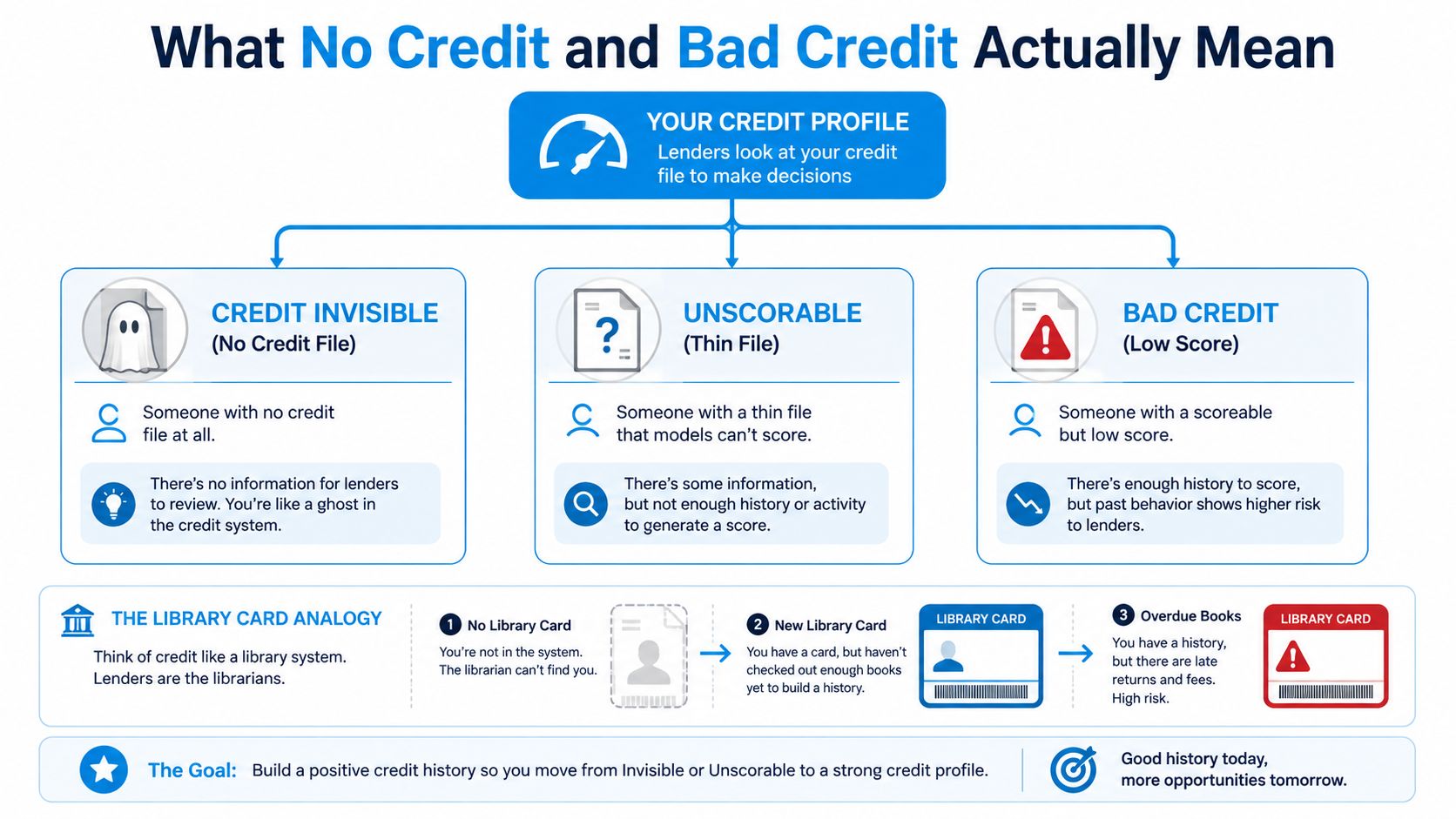
Think of the credit bureaus like a library system. Credit invisible is the person who's never checked out a book, so the library has no borrowing record at all. Unscorable is the person who has a card on file, but there still isn't enough recent or detailed activity to build a score. Bad credit is the borrower whose record is full of late returns, damaged books, and overdue notices.
The CFPB's 2015 benchmark gives that picture real scale. It reported 26 million adults were credit invisible and another 19 million had unscorable files, which together meant roughly 45 million Americans lacked a usable mainstream credit score at the time. That's not a niche issue, it's a large part of the credit market's edge cases, and it explains why lenders often separate people with no score from people with a low score. The source is the CFPB's data point on credit invisibility, which lays out the original estimate and its breakdown. CFPB credit invisibility data point
Why the wording matters
The CFPB draws a clear line between credit invisibles, who have no file at the nationwide bureaus, and unscorable consumers, who have a file but too little or too stale data to generate a score. That difference matters because underwriting reacts to different problems. A no-credit applicant may have no tradeline history at all, while a bad-credit applicant usually has a score, just one burdened by delinquency, high utilization, or collections behavior. CFPB credit invisibles explanation
Here's the simplest way to remember it. No credit means the lender opens the file and finds almost nothing. Bad credit means the lender opens the file and finds a history it doesn't like.
Why Underwriting Treats Each Group Differently
A scoring model can only work with what it can read. If the file has no tradelines, no recent activity, and no score, the model can't produce the kind of answer lenders want, so the application often shifts into alternate review. If the file has repayment history but it's negative, the model can still run, and it usually produces a low number instead of stopping altogether.
That difference shapes the lender's workflow. The no-credit case is a data absence problem. The bad-credit case is a negative data problem. One needs information to become readable, the other needs stronger risk controls because the information already says the borrower has struggled.
The CFPB's later correction matters here because it shifts the underwriting lens. The agency said the original credit-invisible estimate should be roughly cut in half, with more people moving into the unscorable bucket instead. In plain English, that means the bigger issue is often not total invisibility, but files that are too thin to score cleanly. The same CFPB work also notes that credit invisibility and unscored files are concentrated among lower-income and minority consumers, with low-income neighborhoods showing about 30% credit invisibility and another 15% unscored in the cited study. That makes access to credit uneven in a very practical way, because some communities start with less readable files than others. CFPB technical correction and update
Thin files and stale files aren't the same thing
Within the unscorable group, the CFPB separates thin files from stale files. Thin files don't have enough history. Stale files have stopped showing recent activity. Those may sound similar to a borrower, but they tell a lender different things about whether the file is inactive or just underdeveloped.
A lender isn't just asking, “Do you have credit?” It's asking, “Do I have enough reliable information to price this safely?”
That is why lenders don't respond to every no-score case with the same tool. A missing file can point to alternative underwriting or reporting-friendly products. A negative file often points to stricter affordability checks, collateral, smaller loan sizes, or pricing adjustments. The response follows the data problem, not the borrower's mood or intent.
How Lenders Price and Approve Each Scenario
For a borrower with no credit, the lender's first question is often whether there's another way to verify behavior. That can mean a manual review, a look at rent or utility history if the lender accepts it, or a structure that reduces uncertainty, such as a co-signer or collateral. The idea is to replace missing bureau history with other evidence that the borrower pays as agreed.
For a borrower with bad credit, the file usually already produces a decision path. The lender can run score thresholds, adverse-action logic, and pricing rules because there's enough data to classify the risk. The response is usually less about finding information and more about adjusting the loan to match the risk.
| How Lenders View No Credit vs Bad Credit | No Credit Applicant | Bad Credit Applicant |
|---|---|---|
| File status | No usable score or too little history | Score exists, but history shows risk |
| Main underwriting issue | Missing data | Negative data |
| Common response | Manual review, alternate data, co-signer, collateral | Automated decisioning, pricing changes, stricter terms |
| Product fit | Reporting-friendly products that help build a file | Specialized products built for higher risk |
This is why no credit can sometimes be easier to solve than bad credit. A lender may be willing to approve a well-documented no-score applicant if the file shows clean, reportable behavior from another source. A damaged score, by contrast, usually triggers a bigger conversation about affordability and repayment safety.
The useful mindset is simple. If the problem is invisibility, your job is to become visible. If the problem is negative history, your job is to prove the next loan won't repeat the old pattern.
Building Credit From a Blank or Thin File
The safest starting point is usually a product that reports your payments, not just one that promises to “build credit.” A secured credit card can do that if the issuer reports to the bureaus. A credit-builder installment loan can do that too, especially through banks or credit unions that send the payment history to the bureaus. Becoming an authorized user on a well-managed account can also help if the primary user pays on time and keeps the account healthy.
A lot of people miss the most important step, which is checking whether the product reports. Some products look like credit builders but don't populate a bureau file in a way that helps you. If the goal is visibility, the reporting detail matters as much as the monthly payment.
A simple 90-day checklist
- Start with one reporting product. Choose a secured card or credit-builder loan that reports to the major bureaus.
- Confirm the reporting policy before you sign. Ask whether payments are reported to all three bureaus, or only some of them.
- Keep the first account easy to manage. Small charges and automatic payments lower the chance of missed due dates.
- Avoid stacking multiple new obligations at once. One clean reporting trail is better than several stressed accounts.
If you need a small installment product, make sure the payments fit your actual cash flow. A product that only works if everything goes perfectly is not a good credit-building tool.
The goal is not to borrow more for its own sake. The goal is to create a visible, steady record that future lenders can read without hesitation.
Why a Quick Loan Is Not Always the Fastest Fix
A borrower with no credit file and a borrower with bad credit can both feel stuck, but the wrong shortcut causes different kinds of harm. A quick loan sounds like a fast bridge to the system, yet the essential question is whether it creates a readable payment history or just adds another bill to juggle. The CFPB's research on becoming credit visible shows that everyday credit activity is usually how people enter the system, which makes the reporting question more important than the speed of approval. CFPB becoming credit visible
A small loan is like putting a temporary sign in front of an empty file. If the lender does not report, credit bureaus still see an empty shelf. If the payments are too tight, the file can pick up missed payments instead of useful history. If the loan drains cash you need for rent, food, or utilities, the “credit builder” becomes another stress point.
That is why a fast loan is not automatically the fastest route to being credit visible. The path only helps when the product reports, the payment fits your budget, and the loan does not force you to miss something else. For a borrower who is already under strain, that last part matters as much as the underwriting decision.
When a small loan helps, and when it hurts
A small installment loan can make sense if it is affordable, reports to the bureaus, and matches a repayment plan you can keep. It helps when the goal is a clean record, not just cash in hand.
It hurts when the term is too short, the cost is high, or the loan is being used to cover an emergency that needs a safer fix first. In those cases, the loan may solve today's problem by creating next month's problem.
That is the part many guides skip. A quick loan is not always the shortest route to credit visibility. A secured credit card, a credit-builder installment loan, or waiting until the budget can support a reporting product without strain can be the better move.
Use credit-building products to create a record, not to rescue a crisis.
That rule keeps the focus where it belongs. A product that makes today easier but tomorrow harder is a detour, not a fix.
Borrowing Options When You Have Bad Credit
When the file already shows negative history, the lending menu looks different. Personal installment loans can give you a fixed repayment schedule, which helps when you need predictability. Payday loans and other cash advances are built for between-paycheck gaps, but they're short-term tools and need to be judged carefully. Title loans use vehicle equity as collateral, while signature loans and emergency loans may rely more on broader underwriting than a prime score alone.
The key is to compare the full structure, not just the approval speed. A loan that is easy to get can still be a poor fit if the term is too short, the collateral risk is too high, or the total cost is more than your budget can handle. When the file is damaged, the right question is not “Can I get money today?” It's “Can I repay this without making the file worse?”
There are also marketplace platforms that route one request to multiple lenders. NextStopLoans is one such marketplace, it submits consumer loan requests to a network of independent third-party lenders, and the lenders make the actual credit decisions and set the terms. The marketplace itself doesn't set loan terms, and participating lenders may review credit and other underwriting factors. It's available to eligible U.S. residents and isn't offered in places such as Arkansas, New York, Vermont, and West Virginia.
What to compare before you accept an offer
- APR and total cost. Don't stop at the monthly payment, look at what the loan really costs over time.
- Term length. Shorter terms can raise the payment, while longer terms can increase the amount you pay overall.
- Collateral risk. If a loan uses a vehicle or another asset, ask what happens if you miss a payment.
- Reporting behavior. If the loan won't help your file, it should at least solve the emergency cleanly.
- Purpose fit. Match the product to the problem, urgent cash, fixed purchase, debt consolidation, or something else.
Bad credit doesn't remove your options, but it does narrow them. The better move is to choose the product that solves the immediate need without creating a second repayment problem.
Choosing the Right Next Step for Your Situation
Start with three questions. Do you have a score? Is your income stable enough to handle a new payment? Is this a real emergency, or is it a planned purchase that can wait?
If you have no score, the next move is usually a reporting product that helps you become visible. If you have bad credit and you're facing a one-time emergency, a marketplace route or small installment option may make sense if the terms are manageable. If you have bad credit and the purchase can wait, the smarter play is often to build first instead of borrowing under pressure.
The main lesson is simple. No credit is a visibility problem, and bad credit is a risk-history problem. When you treat them as the same thing, you often pick the wrong product and slow yourself down.
If you're comparing loan options and want a single place to submit a request for review by participating lenders, NextStopLoans provides an online marketplace that routes consumer requests to independent U.S. lenders. It's a practical starting point for borrowers who need to match a real credit situation with the right loan type, especially when speed, credit history, and repayment structure all matter.