
Do Payday Loans Go on Your Credit? What to Know

A payday loan usually does not show up as an account on Equifax, Experian, or TransUnion, and paying it on time does not raise a traditional credit score. Unpaid debt that a collector later reports can appear on those reports and hurt that score.
Most answers stop after the first sentence and treat "not on my credit" as "nobody can see it." That skips two other questions. Does a specialty bureau already hold the loan? And what changes if the balance goes unpaid and a collector or a court gets involved?
Those three questions have different answers. A loan can leave a FICO-style score untouched and still sit in a file a later lender opens. The difference is which cabinet that lender checks, and whether anyone reports a default after the due date passes.
Table of Contents
- Where Payday Loans Appear on Your Credit Report
- When an Unpaid Payday Loan Starts Hurting Your Credit
- Why Specialty Reports Matter When the Big Three Are Silent
- How Lender and State Rules Change the Answer
- How to Check and Dispute a Wrong Payday Loan Entry
- Confirm Repayment Before You Apply to Any Lender
- Protecting Your Credit During and After Repayment
Where Payday Loans Appear on Your Credit Report
In most cases, an on-time or paid-in-full payday loan does not appear on the Equifax, Experian, and TransUnion reports that feed traditional scores, so paying it back does not raise your score.
In the United States, a payday loan generally does not appear as a normal account on those three nationwide reports. Federal Reserve research on payday borrowing and consumer credit records found that payday borrowing activity was not reported to the national credit bureaus, so the loan and its repayment history typically did not directly affect traditional scores such as FICO. Consumer guidance from the Consumer Financial Protection Bureau makes the same point from the other direction: even on-time payday-loan payments generally do not build credit, because they are not reported to the nationwide credit-reporting companies.
That is the opposite of how a credit card, a mortgage, or many installment loans work. Those lenders routinely furnish payment history, and each on-time month can help a score. A payday loan behaves more like a cash purchase at a store: money changed hands, the transaction was real, and the credit file never heard about it. Repaying one successfully usually provides little or no positive credit-building benefit. Practices still differ by lender, state, and reporting arrangement, so the loan agreement is the document that tells you what this specific lender does.
| Credit record | Usually reported? | Effect on score |
|---|---|---|
| Equifax, Experian, TransUnion (on-time or paid-in-full loan) | No, generally not | No direct boost or penalty |
| Specialty bureaus such as Clarity Services, DataX, Teletrack | Can be, used by lenders reviewing later applications | Not a standard score input; can influence lender decisions |
| Collection account after default | Yes, if the collector reports it | Negative if reported |
| Lawsuit or court judgment | Possibly, where applicable | Negative where it appears |
| Lender reporting after full payment | Possible; the lender decides | Usually none unless the lender chooses to report |
Read the rows as separate channels, not one yes-or-no answer.
Nationwide bureaus. An on-time loan, or one paid in full, generally never becomes a tradeline, so there is no monthly boost and no monthly penalty on a standard score.
Specialty bureaus. The same loan can still sit in files that payday and short-term lenders pull when a later application arrives. That record does not feed a typical FICO score, but it can shape whether the next lender approves you.
Collections and court records. These appear only after trouble, and only if someone furnishes them. They are negative where they appear.
Reporting after you pay. After a lender receives full payment, it can report that payment to the credit reporting agencies. Many do not. Ask before you sign.
The practical step costs nothing: before you sign, ask the lender in writing which bureaus it reports to, then match that answer against the loan agreement. The loan is usually invisible to the main score. It is not invisible to every lender, and the answer changes if the loan goes unpaid.
When an Unpaid Payday Loan Starts Hurting Your Credit
Credit damage usually starts with non-payment, not with taking the loan. Late payment or non-payment can have a negative impact on credit history. A loan you repay in full on its due date usually leaves no entry on the nationwide reports. The path from a missed date to a lasting mark runs in a set order.
- Fees hit first. A missed due date brings late or non-payment fees written into the loan agreement. Those charges raise what you owe before anyone reports a thing.
- A renewal can stack more cost. Some lenders may automatically renew a short-term loan that becomes past due, and renewal adds charges set by the lender. That term is identified in the loan agreement. Each renewal grows the balance while the original due date is already behind you.
- A collector may get the account. Continued non-payment can lead to referral to a collection agency. The Consumer Financial Protection Bureau explains that payday lenders generally do not report ordinary loan activity to the three major national credit-reporting companies, but a debt collector may report the account after default. U.S. credit-reporting rules generally allow negative payment information, including many collection records, to remain for up to seven years, although the precise treatment depends on the type of record and applicable law.
- The lender may also furnish the failure. Lenders may report a failure to repay a loan to one or all of the major credit reporting agencies, including Experian and Equifax.
- A lawsuit can add a court record. If the lender sues and wins a judgment, that court information may affect the report where applicable.
Say your loan is due Friday and the paycheck is already spoken for by rent. Waiting until Monday does not only add a late fee. If the agreement allows an automatic renewal, Monday's balance can include a new set of lender-set charges, and a later collector can place an account that outlasts the original two-week loan by years.
Practical rule: Any due date you cannot meet should prompt a call to the lender before it passes, because asking early keeps more options open than waiting until a collector calls.
Why Specialty Reports Matter When the Big Three Are Silent
A loan missing from Equifax, Experian, and TransUnion can still be visible to the next lender. Treating those three files as the whole credit system is the gap that surprises people at the counter.
The nationwide reports work like one filing cabinet, and specialty files are a second cabinet beside it. A lender may open that second cabinet when you apply later, even though nothing in the first cabinet moved your score.
The CFPB's 2025 consumer-reporting-company list names agencies that do this work. Consumer-reporting companies can provide reports to payday, personal, title, auto, and other lenders, so a "credit check" is broader than the three nationwide bureaus.
| Agency | Data it collects | Who uses it |
|---|---|---|
| Clarity Services | Payday and installment-loan data | Lenders checking recent short-term borrowing |
| DataX | Payment histories on payday and subprime installment loans | Subprime lenders reviewing payment patterns |
| Teletrack | Information supplied to payday and other high-risk lenders | Payday and other high-risk lenders |
A lender that pulls one of these files before deciding can see a payday loan you already repaid in full, even though Equifax, Experian, and TransUnion never logged it. A clean nationwide score can sit next to a specialty file that still shapes the next yes or no.
NextStopLoans does not pull your credit or look at your creditworthiness; the lenders that receive a request may. Lenders in its network may verify identification and pull credit history from major credit bureaus and alternative bureaus such as Teletrack or DP Bureau, and many third-party lenders run a credit check that can verify submitted information against national databases. If you are weighing a payday loan with no credit check, separate "the marketplace did not score you" from "no lender will look."
Keep three questions separate rather than collapsing them into one:
- Hard inquiry: Did this lender make a hard inquiry on a nationwide file?
- Nationwide furnishing: Does it send payment history to Equifax, Experian, or TransUnion?
- Specialty furnishing: Does it report to a specialty bureau, and which one?
Then request your file from the specialty agencies that lender used, so you see what a future lender will see before you apply again.
How Lender and State Rules Change the Answer
Who made the loan, and where you live, can change the record you leave behind. Two payday loans of the same size can produce two different files.
What the lender furnishes. One lender may send ordinary payment history to a nationwide bureau. Another may report only a failure to repay. A third may send data only to a specialty agency. Picture a lender that reports only defaults. You pay on time, and the nationwide file stays clean. The neighbor who misses the same style of loan can still end up with a collection account, even though both started with a short-term advance.
What the state allows. Each state sets its own limits on payday loan fees and rollovers, and some states ban these loans. Some states cap the APR and the amounts of charges for an online personal loan. The same request can cost more or less because of the borrower's state, and the governing state's law is usually named in the loan agreement. Read that clause before you treat an online offer as if it follows the rules of the state where you sit.
A short checklist keeps the variables from blurring together. Each question has a reason:
- Which bureaus do you report to, and when? This tells you whether a paid loan, a late loan, or only a default leaves a record.
- Does a past-due loan renew automatically? An automatic renewal adds lender-set charges you did not plan to owe.
- What late and non-payment fees apply? Those amounts are how a small advance grows before anyone reports it.
- Which state's law governs this loan? Fee caps, rollover limits, and whether the product is allowed all hang on that choice.
- Are all of these terms in writing? A spoken assurance is hard to match against a report later.
Verify the answers in the loan agreement, then with your state financial regulator if a fee or rollover looks off. Our notes on payday loan requirements are a place to start that comparison before you accept terms.
How to Check and Dispute a Wrong Payday Loan Entry
Ordinary repayment often never reaches the major bureaus, and an unpaid account may only surface after a collector takes it. The harder problem is a line that should not exist at all: a duplicate entry, a re-aged date, or a loan you never took. The Consumer Financial Protection Bureau directs consumers who spot a reporting error to dispute it with the reporting company first. That step comes before any complaint, because the reporting company is the one that can correct or delete the line. A payday loan can leave traces in three places at once, the nationwide bureaus, the specialty bureaus that track short-term lending, and a collector's own file, so a wrong entry has to be hunted in each one.
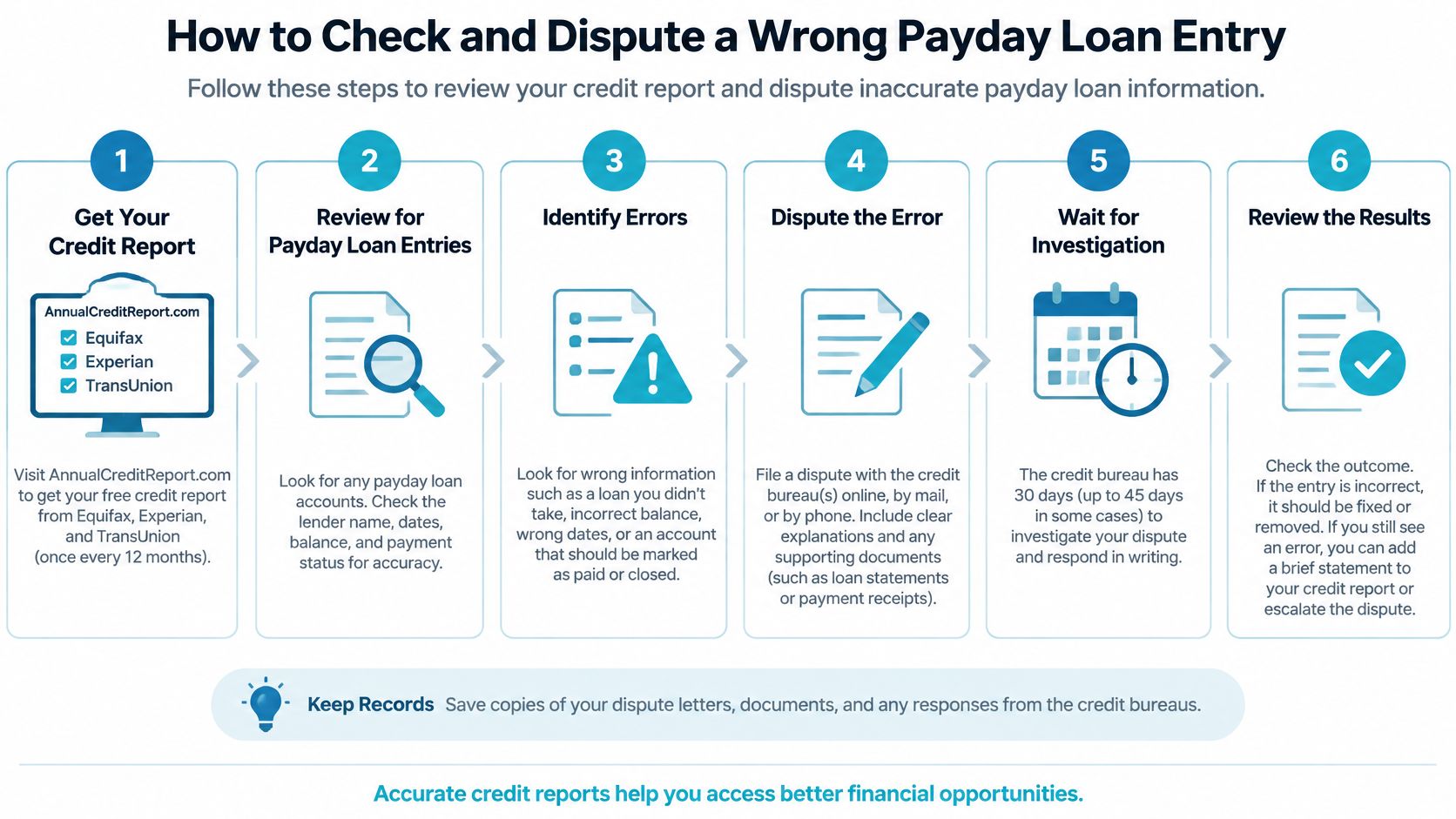
- Pull every file that might hold the loan. Get your reports from Equifax, Experian, and TransUnion, and request your file from specialty agencies such as Clarity Services, DataX, and Teletrack. A payday loan can sit in one cabinet and be absent from the others.
- Mark the bad lines. Flag a duplicate, a wrong balance, a loan you did not take, or a date that looks re-aged. One named error is easier for an investigator to fix than a vague "this looks off."
- Gather proof before you write. Payment records, bank statements, and the loan agreement show what you owed and paid. Without them, the furnisher's version is the only paper in the file.
- Dispute with the reporting company first. That is the route the CFPB directs. Name the account, the error, and the correction you want. Send the same dispute facts to the furnisher if the report shows who supplied the line.
- Read the result, then recheck the report. An investigation letter is not the same as a corrected file. Open the updated report and confirm the line changed or was removed.
- Escalate only what is still wrong. If the error remains, file a complaint with the CFPB and contact the lender with the same documents. Keep copies of every letter and the dates you sent them.
A clean repayment still deserves a look at all three layers. A paid loan that never hit the major bureaus may still linger at a specialty agency, and a default can appear twice, once from the lender and once from a collector. Checking each layer separately is how a loan you handled correctly stops being the line a later lender sees.
Confirm Repayment Before You Apply to Any Lender
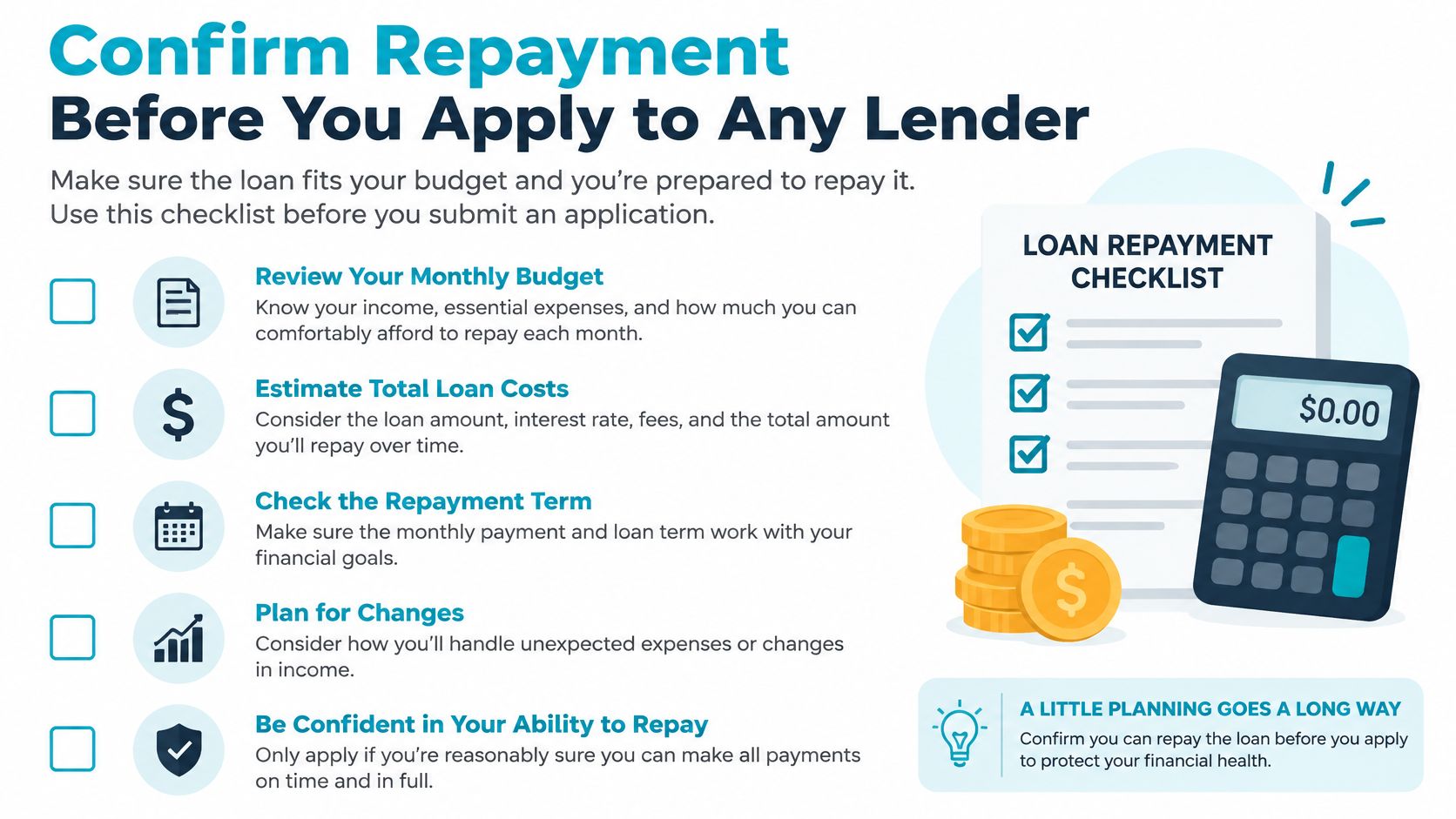
Start with one yes-or-no test. Can you repay the full amount, including fees, from your next paycheck without missing rent, utilities, or other bills?
If the answer is yes, the credit risk is usually limited to the cost of the loan and to whatever reporting that lender does. If the answer is no, compare other paths before you sign. A payment plan with the creditor you already owe, a small loan from a credit union, or an employer advance when one is offered can cost less than a renewal cycle. Our overview of payday loan alternatives lays those options next to a short-term advance.
Before any signature, put the reporting terms in writing using the questions about bureaus, automatic renewal, fees, and governing state law. Compare the total you will repay in dollars, not only a fee per hundred. Set the repayment date from the paycheck that will cover it.
We run an online marketplace that routes your request to independent third-party lenders. We are not a lender, we do not make credit decisions, and we do not set loan terms. Submitting information online does not guarantee approval. We do not pull your credit or look at your creditworthiness. Responsible lenders do. Checking a rate through our site does not affect your credit score. Verify that point on the offer in front of you before you rely on it, because a lender's own credit check is a separate step. Multiple inquiries to Experian, Equifax, and TransUnion may lower a credit score, so register for one loan at a time rather than spraying applications.
Group the decision by when you act:
- Before you apply: Confirm you can repay the full amount from the next paycheck, because a loan you cannot cover is the one that reaches a collector.
- While you read the offer: Confirm reporting terms in writing, because two lenders can leave two different records.
- Before you accept: Compare total cost in dollars and decline any offer that does not fit. You are not obligated to take a term a lender presents.
Confirm repayment, confirm reporting, compare the total, then decide.
Protecting Your Credit During and After Repayment
Work through the loan in the order the dates arrive. Each step is there to stop a small miss from becoming a furnished account.
Before the due date. If you cannot pay, contact the lender before the date passes and ask whether a payment plan is available. Late fees and a referral to collections follow a missed payment, and an automatic renewal, where the agreement allows one, adds charges you did not budget.
While you are applying. Keep applications to the lenders you need. Each application can create a record that a later lender may review, including an inquiry on a nationwide file or a lookup in an alternative bureau.
After payoff. Get written confirmation of a zero balance, and keep the receipt with the loan agreement. Then check your reports about 30 to 60 days later for any entry that should have closed or that never should have been opened. Checking your own reports does not lower your score.
If a line appears that should not be there, use the dispute path: name the error, attach payment proof, start with the reporting company, and escalate only if the correction does not show up. Do payday loans go on your credit in a way you can ignore after you pay? Only if you have looked at both the nationwide reports and the specialty files and confirmed the balance is closed.
If you are comparing short-term options and want to see lender terms before you commit, NextStopLoans routes a single request to independent lenders who set their own credit checks, fees, and reporting. You can review each offer, including how repayment and non-payment are handled, and decline anything that does not fit your next paycheck. Visit NextStopLoans when you are ready to submit a request and compare what those lenders present.