
Debt Consolidation Loan Meaning: How It Works and Costs

A debt consolidation loan is a new installment loan that pays off several existing debts and leaves you with one fixed monthly payment and a set end date. If that one payment is lower than your current bills combined, does that mean you've saved money?
That's where many borrowers get tripped up. A smaller payment can feel like progress while costing more over the full repayment period, especially if fees are added or the term stretches. Understanding debt consolidation loan meaning starts with separating two ideas, simpler cash flow and lower total cost. They're not the same thing, and only one of them puts you ahead.
Table of Contents
- What a Debt Consolidation Loan Means in Plain English
- How One New Loan Replaces Several Debts
- Why a Lower Monthly Payment Can Cost More
- Pros, Cons and Risks to Weigh Before Borrowing
- How Consolidation Compares With Other Debt Relief Options
- Who Should Consolidate and How to Check the Numbers
What a Debt Consolidation Loan Means in Plain English
In plain terms, a debt consolidation loan is usually a personal installment loan used to pay off debts such as credit-card balances, medical bills and other unsecured obligations. After approval, the lender may pay your creditors directly or deposit funds for you to pay them. You then owe one lender instead of several companies.
Think of scattered receipts gathered into one folder. The paperwork is simpler, but what you spent hasn't changed. Consolidation reorganizes repayment, it doesn't erase what you borrowed.

This is a large market. The Federal Reserve overview of personal loans in the U.S. reported U.S. personal loans reached approximately $356 billion at the end of 2022, about 10% of all nonrevolving consumer credit, and that figure also includes medical expenses, vacations and large purchases, so it's broader than consolidation alone.
Three Words You'll See on Every Offer
- Principal: The amount you borrow to pay off the selected debts.
- APR: The yearly cost of borrowing, expressed as a percentage and including certain fees.
- Term: The repayment period, after which the loan should be fully repaid if you pay as scheduled.
Before going further, run two quick checks. Are the debts you want to move mostly unsecured, meaning they aren't tied to a house or car? And could you plausibly qualify for a new APR below the rates you're paying now? If the answer to the second question is no, simplicity alone may not justify a new loan.
How One New Loan Replaces Several Debts
Say a borrower owes $5,000 across two credit cards plus a $1,000 medical bill, for $6,000 in total. Card A charges 24.9% APR and Card B charges 21.5% APR. Minimum payments add up to about $200 a month, spread across different due dates.
A consolidation loan would replace those three obligations with one $6,000 personal loan. At an illustrative 12% APR over 36 months, the payment is about $199 a month. The amount looks familiar, but the structure changes, one due date, one rate and a fixed finish line.
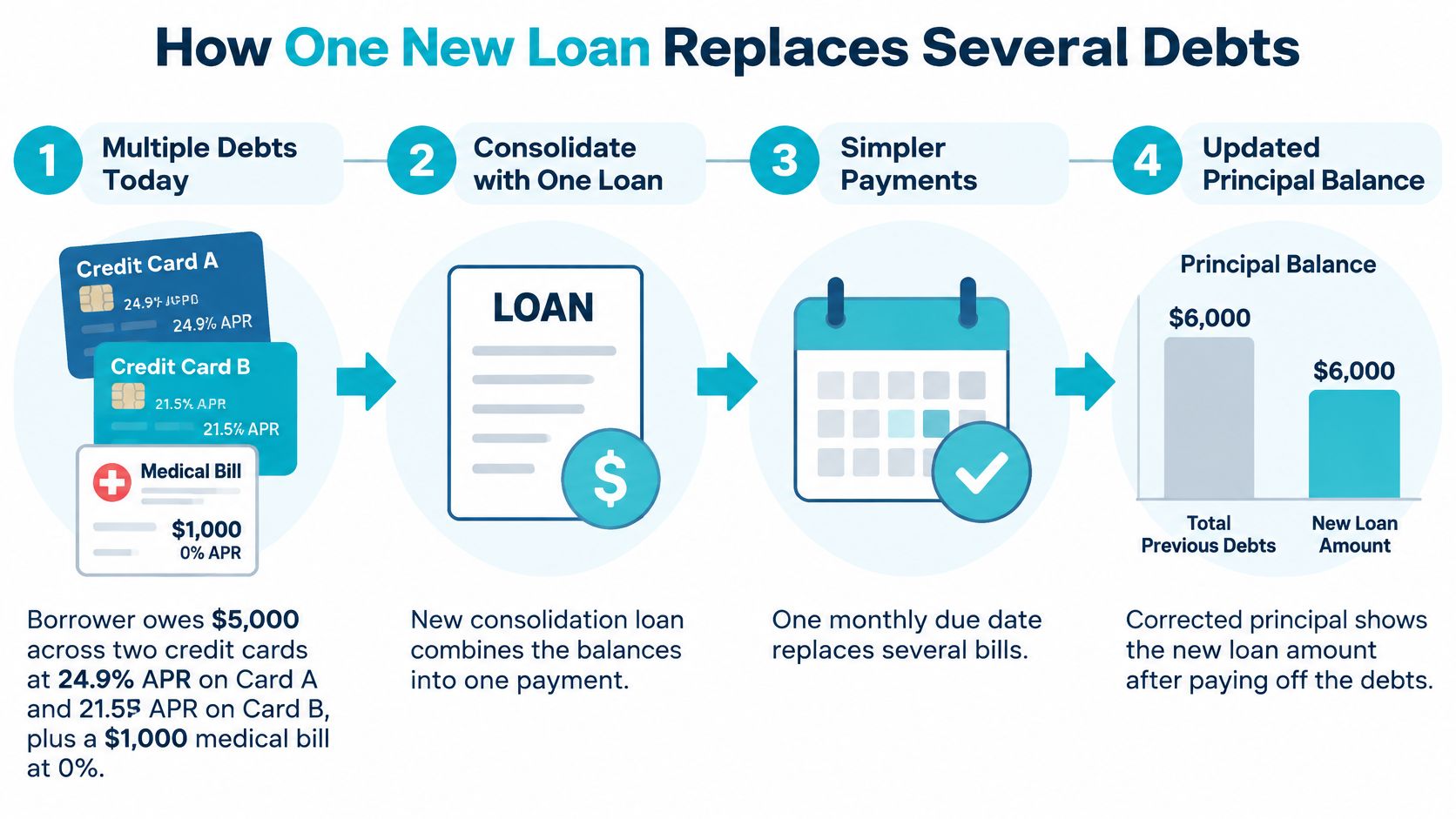
Illustrative debts before and after one consolidation loan
| Debt | APR | Monthly payment |
|---|---|---|
| Credit card A | 24.9% | $96 |
| Credit card B | 21.5% | $54 |
| Medical bill ($1,000) | 0% | $50 |
| Consolidation loan, 36 months ($6,000) | 12% (example) | $199 |
The Four Stages in Order
- Apply for the full amount. You request $6,000, enough to pay each selected balance in full, including any interest due by the payoff date.
- Direct the money to creditors. The lender pays each creditor directly, or funds your account so you can make those payoffs yourself.
- Confirm zero balances. Each old account should show paid off. Credit cards normally stay open unless you close them, so available credit rises and utilization falls, but the temptation to spend returns too.
- Make one scheduled payment. You pay the new lender on the same date each month until the term ends.
Consolidation changes who you pay and when. It doesn't, by itself, change how much you owe.
This example shows structure only. It doesn't prove the new loan costs less, because fees, the actual APR you qualify for and how long you take to repay can change the result. If you're weighing whether to use a personal loan to pay off debt, rebuild this table from your own statements first. List each balance, APR and minimum payment, add them up, then compare that total with a real offer, line by line.
Why a Lower Monthly Payment Can Cost More
A lower payment doesn't automatically mean a cheaper loan. Often it just means you've been given more time, and more time at interest usually means more interest paid overall.
Take the same $6,000 at 12% APR and change only the term. The monthly payment falls as the term lengthens, but the total repaid climbs each time.
Same $6,000 loan at 12% APR across three repayment terms
| Loan term | Monthly payment | Total repaid |
|---|---|---|
| 24 months | $282 | $6,774 |
| 36 months | $199 | $7,174 |
| 60 months | $133 | $8,006 |
These totals cover principal and interest only, before any origination fee. The Federal Trade Commission guidance on getting out of debt makes the test clear, consolidation helps only when the new loan's total cost, including principal, interest, origination charges, points and other fees, is lower than the remaining cost of the debts being replaced.
Costs That Hide Behind the Payment
- Origination fees: Some lenders deduct a fee from the loan proceeds, so you receive less than you borrowed but repay the full amount.
- Teaser rates: A low introductory rate can reset higher after a promotional period, raising later costs.
- Variable rates: If the APR can move, your payment and total interest aren't locked in at signing.
- A longer term: Stretching repayment lowers each installment while interest keeps accruing for more months.
Don't assume you'll get the headline rate either. The Consumer Financial Protection Bureau guide to consolidating credit card debt warns that borrowers with damaged credit may not qualify for the lowest advertised rates.
Use a break-even test before you sign. Divide one-time costs, such as an origination fee, by your monthly savings in interest and fees. If a $300 fee saves you $25 a month, you need 12 months just to recover the fee. If you might sell, refinance or fall behind before then, the deal fails.
Practical rule: Compare total of payments over the same payoff period, not monthly payments over different periods.
Build that comparison in writing, using the same payoff amount and a realistic horizon for both options. Treat the table above as illustrative until you have actual offers with APRs, fees and financed amounts you can verify.
Pros, Cons and Risks to Weigh Before Borrowing
Consolidation has genuine advantages when the numbers work. The catch is that its biggest risk isn't in the loan paperwork, it's in what happens to the emptied credit cards afterward.
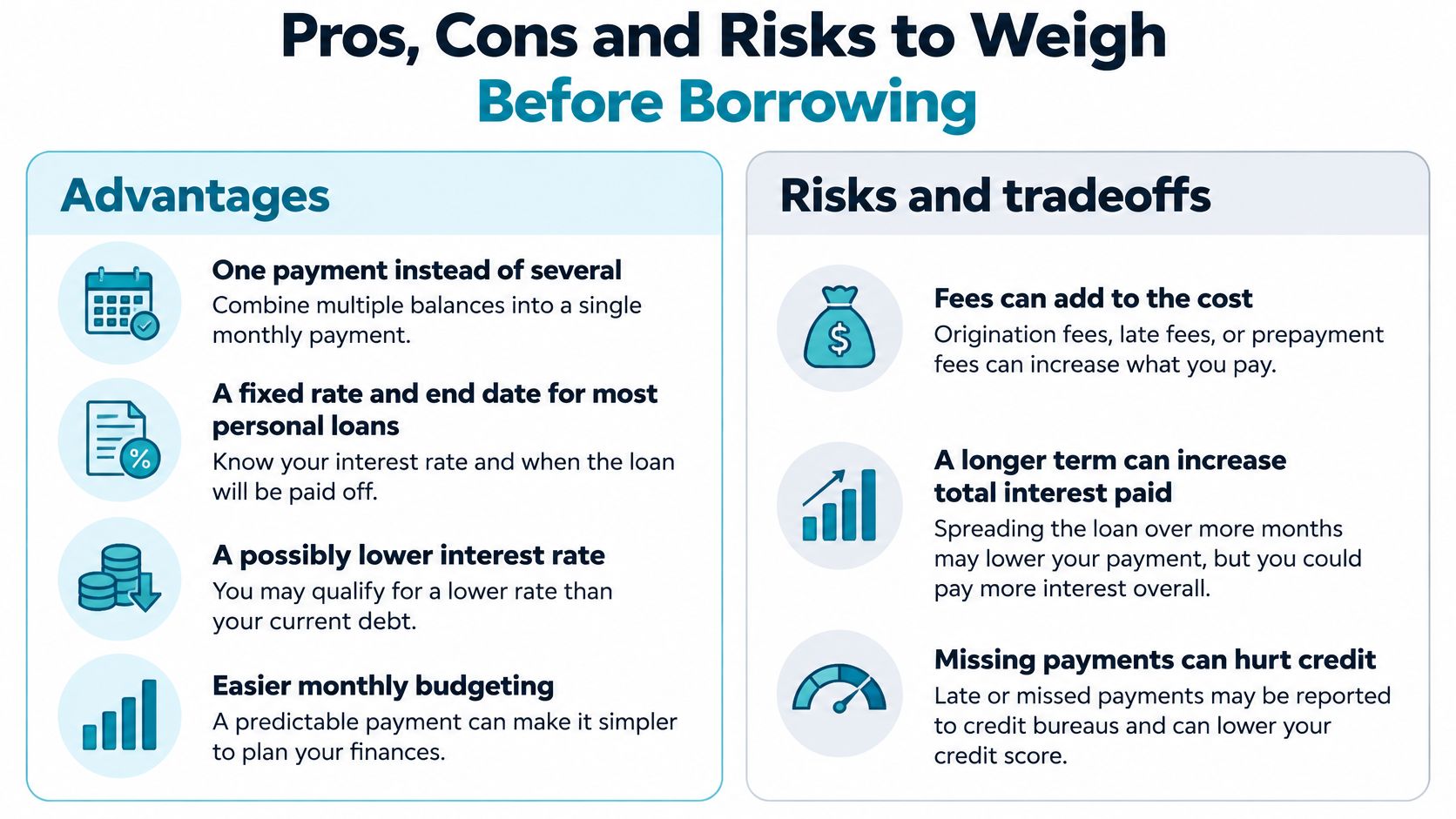
What Can Improve
- One payment instead of several: One due date is easier to track and automate.
- A fixed rate and end date: Most personal loans give you a predictable schedule and finish line.
- A possibly lower interest rate: Replacing high card APRs with a lower loan APR can cut interest costs.
- Easier monthly budgeting: A steady payment is simpler to plan around than shifting minimums.
What Can Get Worse
- Origination fees: Upfront charges eat into any interest savings.
- More total interest: A longer term can outweigh a lower rate.
- Lost promotional terms: Moving a balance can end an introductory rate you were still using.
- A temporary credit dip: Applying triggers a hard inquiry, a point covered in more detail in this explainer on whether debt consolidation hurts your credit.
The re-borrowing risk deserves the most attention. A loan can clear your cards while leaving them open and usable. If spending resumes, you'll owe the consolidation loan plus fresh card balances, which is worse than where you started. That concern isn't theoretical. A Federal Reserve note on recent consumer delinquency dynamics found credit-card delinquency rates reached their highest level since 2010 in late 2023 before staying high, with increases concentrated among nonprime borrowers.
Secured versions raise the stakes further. Using home equity can put your home at risk if payments are missed, and closing costs may add hundreds or thousands of dollars. Turning unsecured card debt into debt backed by your house trades flexibility for a lower rate.
Protect yourself with safeguards set up in advance. Freeze spending on paid-off cards by removing them from your wallet and saved checkout profiles. Build a small emergency fund so the next car repair doesn't go straight back on plastic. Decide deliberately whether to close old accounts, since closing can affect available credit and history length. If income barely covers essentials, nonprofit credit counseling may be safer than borrowing again.
How Consolidation Compares With Other Debt Relief Options
A consolidation loan is one route among several, and each option changes a different part of your situation. Some replace the debt, some renegotiate it, and some stop repayment altogether, with very different consequences.
Debt consolidation compared with other debt relief options
| Option | How it works | Typical cost | Effect on credit | Best fit |
|---|---|---|---|---|
| Debt consolidation loan | One new installment loan pays selected debts | Interest plus any origination fee | Hard inquiry, then on-time payments help | Several high-rate balances and steady income |
| Balance transfer card | Moves card balances to a 0% introductory APR card | Transfer fee, often 3% to 5% of the balance | Hard inquiry; utilization can drop | Balance fully repayable within the promo period |
| Debt management plan | Nonprofit counselor negotiates lower rates and one monthly payment | Monthly program fee set by the agency | Enrolled cards usually closed; steady program payments support recovery | Card debt needing structure without new credit |
| Debt settlement | Negotiates to accept less than the full balance | Fees, often a percentage of settled debt, plus interest and late fees during negotiation | Serious damage from missed payments | Debt too large to repay after other options fail |
| Home-equity loan | Borrows against home equity | Closing costs plus interest, including appraisal and recording charges | Hard inquiry; home is collateral | Homeowners with equity and a firm repayment plan |
| Bankruptcy | Court process that discharges or restructures debt | Court and attorney fees | Long-lasting negative record | Severe hardship with no workable plan |
Where the Table Needs a Closer Look
A balance transfer can beat a loan on cost, but only if you clear the balance before the promotional period ends. Miss that deadline and the remaining balance can jump to a high regular APR, wiping out the benefit.
A debt management plan doesn't involve new borrowing at all. A nonprofit counselor negotiates reduced rates with your card issuers, you make one monthly payment to the agency, and enrolled accounts are usually closed. That closure is restrictive, but for some borrowers it's exactly the guardrail they need.
Debt settlement and bankruptcy sit at the serious end of the scale. Settlement typically requires stopping payments while a company negotiates, which damages credit and doesn't guarantee creditors will agree. Bankruptcy is a court process and a last resort, with lasting public-record effects. A consolidation loan, by contrast, keeps you repaying in full, which is why it suits borrowers whose income can realistically support the payment.
Who Should Consolidate and How to Check the Numbers
The strongest candidate looks like this, several high-interest unsecured balances, steady income that covers a fixed payment with room to spare, and a credit profile that qualifies for an APR clearly below current card rates. Just as important, there's a firm plan to stop adding new balances once the cards are cleared.
Pricing varies a lot by credit profile. A Federal Reserve research paper on U.S. personal loans reported roughly 40% of personal-loan accounts were held by nonprime borrowers with Equifax Risk Scores below 720, which helps explain why two applicants can receive very different APRs for the same loan amount.
Situations Where Consolidation Fits Poorly
- Spending still exceeds income: A new loan rearranges the deficit without fixing its cause, so balances rebuild.
- Your qualifying APR is near your card APRs: Fees can erase a thin rate gap, leaving simplicity as the only gain.
- You hold federal student loans: Refinancing them into a private loan can mean giving up federal repayment protections, so treat them separately.
- You'd pledge a home or car without a solid plan: Secured borrowing puts an essential asset behind what was unsecured debt.
A Six Step Routine to Check Any Offer
- List every debt. Write down each balance, APR and minimum payment from your latest statements, then total them.
- Choose what to include. Start with the highest-rate balances. A 0% medical bill may not belong in a loan that charges interest.
- Collect complete offers. Record the APR, origination and other fees, term, amount you'll receive and total of payments. A tool like a loan calculator helps you test how term changes alter the total.
- Run the break-even test. A $300 fee that saves $25 a month needs 12 months to pay for itself. Confirm you'll stay debt-free longer than that.
- Accept only a lower total. The offer must reduce your total repaid compared with paying the original debts over the same period, not just shrink the monthly payment.
- Set the card plan before signing. Decide now whether paid-off cards get cut up, frozen in your account settings or kept for one small recurring charge paid in full.
Consolidate only when the total repaid falls and the spending that created the balances is addressed. If either condition fails, pause.
One disclosure about where offers come from. NextStopLoans is an online marketplace that sends one request to independent U.S. lenders, who make decisions, set terms and fund loans. It doesn't pull credit itself, though lenders may check credit, and there's no obligation to accept any offer. Availability varies by state, so review the Rates & Fees and Lending Policy pages before submitting a request.
Work through the six steps with your real statements and real quotes, not advertised examples. If the written comparison shows a lower total and your budget holds without new card spending, consolidation is doing its job. If it only shows a lower payment, you haven't found a cheaper loan, you've found a longer one.
If your numbers show a lower total repaid and you're ready to compare real offers, you can submit one request through NextStopLoans to reach independent U.S. lenders who consider personal loans for debt consolidation. There's no obligation to accept an offer, so you can check each APR, fee and total of payments against your worksheet before deciding.