
Can I Get a Loan at 18? Eligibility and Options

At 18, you can generally sign a loan contract in most U.S. states, but approval depends on income verification and credit history, not age alone. Alabama generally requires 19 for the age of majority, while Mississippi generally sets it at 21, so state law can change the answer.
You may be asking this after an unexpected repair, a tuition bill, or a bank balance that won't stretch to payday. Turning 18 gives you legal capacity in many places, but it doesn't give you an established credit profile or convince a lender that repayment is affordable. The useful question isn't only, “Can I get a loan at 18?” It's can you get one without accepting a rate or payment that creates a bigger problem?
Table of Contents
- Legal Age and Contract Requirements
- Overcoming Thin Credit and Income Hurdles
- Loan Types Available to Young Adults
- Using Co-Signers and Alternative Pathways
- Applying Through an Online Lender Marketplace
- Reviewing Terms and Borrowing Responsibly
Legal Age and Contract Requirements
At 18, you may be able to sign a loan agreement on your own, but legal capacity is only the first checkpoint. Personal loan eligibility guidance from InCharge explains that lenders also set requirements around identity, income, residence, and repayment ability. Meeting the age rule gives you permission to apply, not a guarantee of approval or a fair interest rate.
State law can change the result. Alabama generally sets the age of majority at 19, while Mississippi generally sets it at 21. Nebraska is also identified in private student-loan eligibility guidance as a state where the age of majority is 19. If you live in one of these states, signing independently at 18 may not follow the same rules, and a lender could require a co-signer or apply a different contract standard.
Legal eligibility versus lender approval
Separate the decision into two gates:
- Contract capacity: Do your state's rules allow you to enter the agreement?
- Underwriting approval: Can you verify your identity, income, and ability to make each payment?
A lender may also require state residency, a checking account, a U.S. Social Security number, a physical address, or an active email account. Some lenders set their own income and credit standards above the legal minimum. Review those requirements before submitting an application, because repeated applications can make it harder to compare offers calmly.
Practical rule: Treat “18 and eligible to apply” as permission to request terms, not proof that the loan is affordable.
Check the lender's minimum age, state availability, residency limits, income standard, credit requirements, and co-signer policy. If the only offer carries a payment you cannot cover from reliable income, reject it. A legal contract can still be an expensive mistake, especially with a thin credit file.
Overcoming Thin Credit and Income Hurdles
An 18-year-old often has a thin credit file, meaning the credit report contains little history for a lender to evaluate. The problem isn't automatically bad credit. It's uncertainty. A lender may not know whether you pay bills consistently, manage revolving credit, or can handle a new monthly obligation.
That uncertainty can lead to denial or less favorable pricing. Finder's explanation of loans for young people notes that approval generally depends on income, identity verification, and state rules in addition to age. Federal guidance on age-based credit decisions also explains that applicants under 21 may need to demonstrate an independent ability to pay or apply with an adult co-signer, as described in this FDIC credit-card lending document.
What lenders need to see
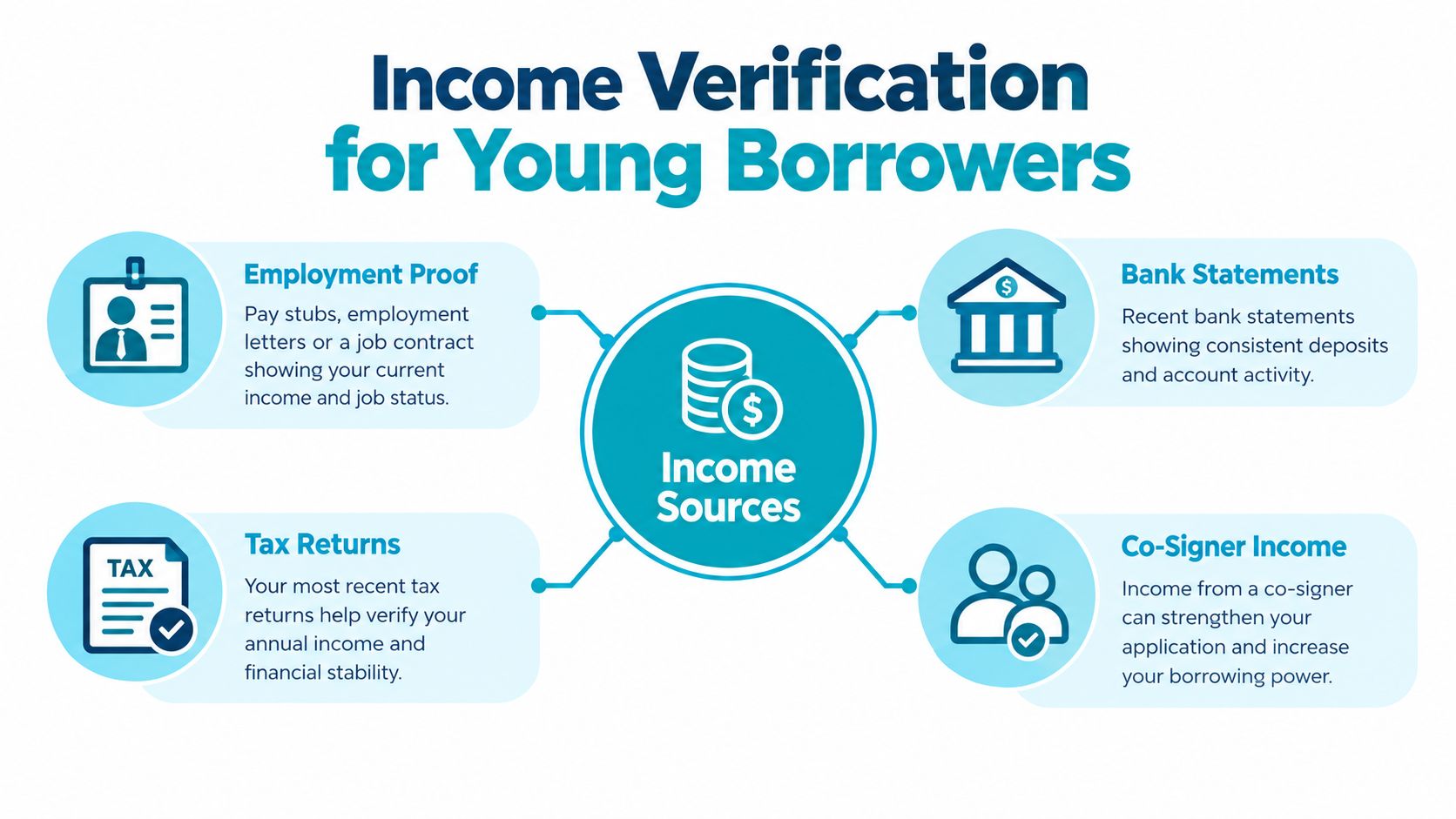
A part-time job, freelance work, or gig income may help if you can document it consistently. Gather the records before submitting an application, rather than applying first and searching for proof later.
- Employment proof: Recent pay information or employer details can show that money regularly reaches you.
- Bank statements: These can help demonstrate recurring deposits and ordinary cash flow.
- Tax returns: If you've earned self-employment or gig income, filed tax documents may support the application.
- Co-signer income: A qualified co-signer can provide the repayment evidence you don't yet have independently.
Lenders also assess whether your existing obligations leave room for another payment. They may review rent, credit-card balances, student debt, and other recurring commitments when judging repayment capacity. Don't inflate income, omit obligations, or rely on an optimistic future paycheck. A lender's approval doesn't make an unaffordable payment safe.
The affordability issue deserves more attention than the legal one. SoFi's borrower insights reports that nearly half of surveyed personal-loan shoppers were first-time borrowers, while 51% identified interest rates as their top concern. For a thin-file borrower, compare the total repayment cost, not just the advertised monthly payment. If the rate looks extreme, pause and consider a smaller amount, a co-signer, a credit union, school-based assistance, or delaying the expense.
For practical eligibility preparation, review this personal loan eligibility guide and assemble your identification, income records, address information, and banking details before you apply.
Loan Types Available to Young Adults
Different loan products solve different problems, and the cheapest option depends on the purpose, urgency, collateral, and repayment period. A personal loan may fit a planned expense, while a payday product can create serious pressure if your next paycheck can't cover both the loan and your ordinary bills.
| Loan Type | Best For | Key Requirement |
|---|---|---|
| Personal loan | Larger planned expenses, medical bills, or debt consolidation | Verifiable income, identity, and lender-specific credit criteria |
| Payday or cash loan | A short-term gap between paychecks | Proof of income and a repayment source, with careful review of cost |
| Installment loan | A fixed schedule that spreads repayment over time | Regular income and acceptance of the lender's payment and term |
| Title loan | Borrowing against vehicle equity | A qualifying vehicle and sufficient equity, with the vehicle at risk if you fail to repay |
Match the product to the problem
A personal loan can be reasonable when the expense is necessary, the amount is controlled, and the payment fits your budget. Debt consolidation deserves special caution. Combining balances doesn't fix spending or make expensive debt affordable if the new loan carries a high cost.
An installment loan offers predictability because the schedule is set by the lender. Predictability helps with budgeting, but it doesn't tell you whether the price is fair. Read the annual percentage rate, origination charges, late fees, and total repayment amount before accepting.
Payday and cash loans should be a last resort, not the default answer to a low balance. They're designed around short-term repayment, so a missed due date can trigger additional costs or force you to borrow again. If you can't identify the exact money that will repay the loan, don't take it.
A title loan adds collateral risk. You may qualify because your vehicle secures the debt, but failure to repay can put that vehicle at risk. Don't pledge transportation you need for work or school unless you've exhausted safer alternatives and can confidently meet the schedule.
The right loan is the one whose repayment plan remains manageable after the emergency has passed.
At 18, start with the least costly and least destructive option. Ask the school financial-aid office about available assistance for education expenses, negotiate a medical or repair bill where possible, and compare a credit union with online lenders. Speed matters, but it shouldn't replace a cost comparison.
Using Co-Signers and Alternative Pathways
A co-signer can turn a weak application into a credible one because the lender evaluates another person's income and credit history alongside yours. That may improve approval odds or produce more manageable terms, but it also transfers legal responsibility. If you miss payments, the co-signer can be pursued for the debt and may suffer credit damage.
Choose a co-signer only when both people understand the agreement. Discuss the amount, payment date, interest cost, missed-payment procedure, and what happens if your income disappears. Put the plan in writing, even when the co-signer is a parent or close relative.
Use the safety net carefully
A co-signer isn't free money. Their involvement can protect you from accepting an overpriced thin-file loan, but it can also damage a relationship if you treat the obligation casually. Set up automatic payments only after confirming that the account will contain enough money, and tell the co-signer immediately if a payment problem appears.
Some lenders use alternative underwriting data rather than relying entirely on a traditional credit score. Depending on the lender, that may include documented rent payments, bank-account activity, employment records, or educational information. Approval isn't guaranteed, and alternative-data lenders still need evidence that repayment is realistic.
Bad-credit pathways can be useful when the loan purpose is necessary and the terms are transparent. They aren't a reason to skip affordability checks. Compare offers, verify the lender's identity, and reject any provider that demands an upfront fee for guaranteed approval or pressures you to sign before showing the full terms.
If you don't have regular employment, review loan options for applicants without income, then be honest about your current cash flow. A lender may consider a co-signer or another repayment source, but you shouldn't borrow based solely on the hope that work will appear later.
Before submitting several applications, ask whether each inquiry could affect your credit file. Also check whether the lender offers a soft eligibility check, what information it shares, and whether a declined application creates any cost. Your objective is not merely to find a lender willing to say yes. It's to find a payment you can make without sacrificing rent, food, utilities, or transportation.
Applying Through an Online Lender Marketplace
An online lender marketplace can simplify the search by collecting one request and routing it to participating independent lenders. NextStopLoans operates as a connector, not as the lender. The participating lenders make the credit decision, set the terms, and handle funding.
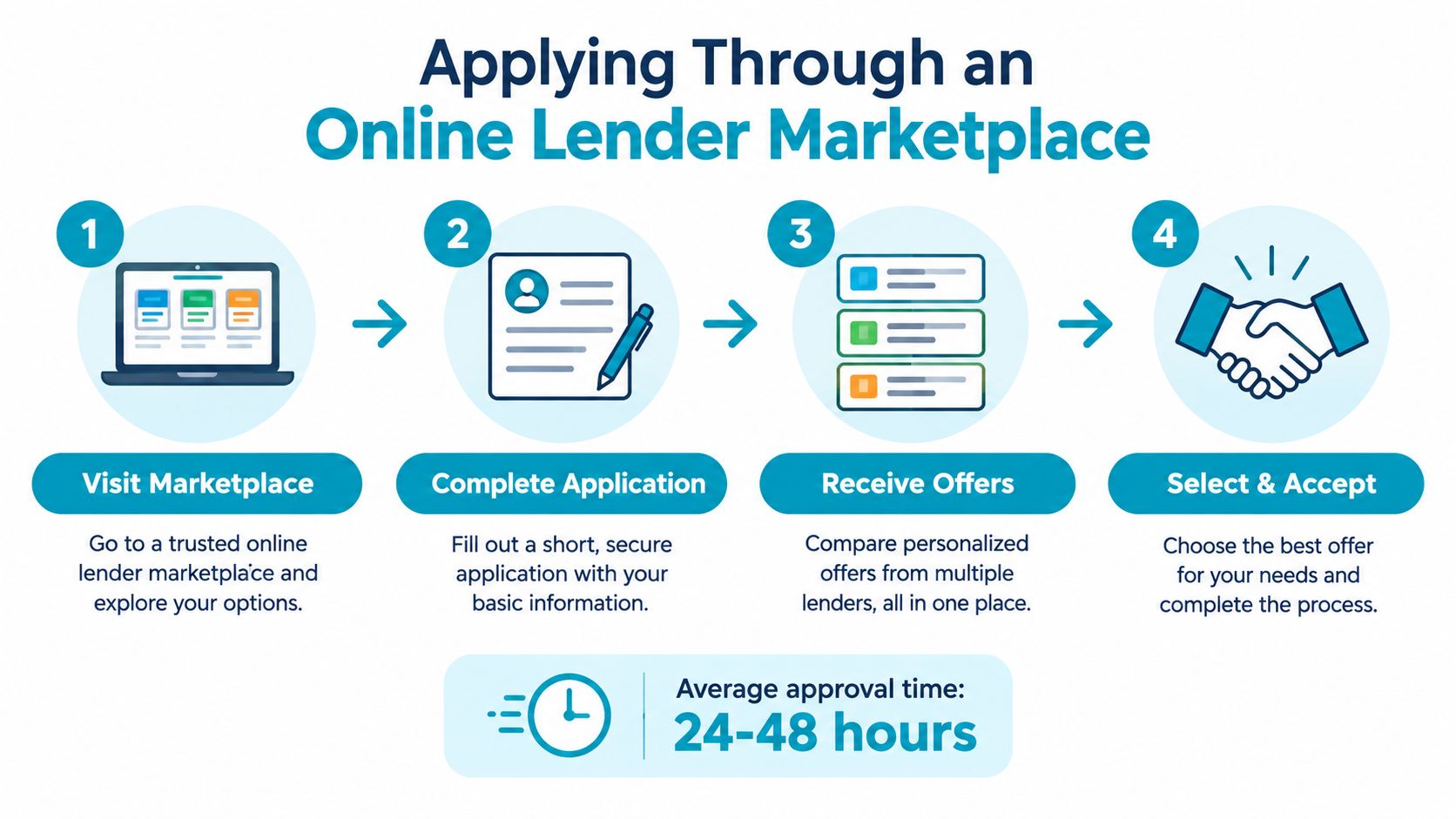
Follow the process in order
- Visit the marketplace: Use a secure phone or computer connection and confirm that the service accepts applicants in your state.
- Complete the application: Enter accurate information about your identity, residence, income, employment, bank account, and requested amount.
- Review potential offers: Read the lender name, rate, fees, repayment schedule, total cost, and any electronic-consent disclosures.
- Select or decline: Accept only after confirming that the payment fits your budget. You aren't required to accept an offer just because one appears.
The marketplace's single intake can reduce the need to complete separate forms for multiple lenders. The marketplace itself doesn't pull credit, although participating lenders may check credit through major or alternative bureaus. That distinction matters, so read the consent language carefully before submitting.
Protect your information
A legitimate application should explain how your information is collected, shared, stored, and used. NextStopLoans describes a mobile-friendly request process using 256-bit SSL encryption and secure servers, while lender decisions and funding remain the responsibility of independent third parties.
Don't pay an upfront fee to access a guaranteed loan. Don't provide passwords for unrelated accounts. Confirm that the website uses secure connections, review its privacy and advertiser disclosures, and save copies of any offer before electronically signing.
Response and funding speed depend on the lender, your bank, verification, and the time of approval. Some lenders may offer direct-deposit funding as soon as the next business day, but you should treat that as conditional, not guaranteed. Read how to apply for a personal loan online before submitting a request so you know which information to prepare.
Reviewing Terms and Borrowing Responsibly
Approval is not the finish line. It's the moment when you decide whether the loan deserves a place in your budget. Compare the annual percentage rate, finance charges, origination fees, late fees, payment frequency, total repayment amount, and consequences of early or late payment.
Look past the monthly figure. A smaller payment can result from a longer repayment period, which may increase the total cost. Ask yourself whether you could still pay after losing work hours, facing a routine bill, or dealing with another modest emergency.
Use this acceptance checklist
- Confirm the lender: Know which company is making the offer and where to find its disclosures and customer-support details.
- Check the full cost: Record the rate, fees, payment amount, number of payments, and total amount repaid.
- Test the budget: Subtract the new payment from dependable monthly income after essential expenses.
- Understand default: Read what happens after a missed payment, including collections, collateral consequences, and added charges.
- Protect the co-signer: If someone shares responsibility, agree on payment monitoring and immediate communication.
- Keep records: Save the agreement, payment schedule, disclosures, and confirmation of electronic consent.
Borrowing standard: If you need optimistic income, skipped essentials, or repeated refinancing to make the payment work, the loan is too expensive.
A small, manageable loan paid on time may help establish a positive credit record, but borrowing solely to build credit is rarely wise if the terms are excessive. Use a secured card, a credit-builder product, or ordinary bill management only after checking the fees and reporting practices. Your first loan should support a clear need, not create a long repayment burden.
The answer to “can I get a loan at 18?” is usually yes in the legal sense, subject to state rules. The financially responsible answer depends on proof of repayment capacity and the total cost. Compare alternatives, involve a trusted co-signer when appropriate, and walk away from terms that consume the money you need for basic living.
NextStopLoans provides a secure online request form that can route your information to independent third-party lenders, including lenders that may consider applicants with limited credit histories. If you're ready to compare potential options, visit NextStopLoans, review the disclosures, and accept an offer only when the full repayment cost fits your budget.