
How to Title Loans Work and What to Watch For

An unexpected repair bill, a late rent payment, or a medical expense can make the money in your bank account disappear quickly. If you own a car, a title loan may look like a simple answer: use the vehicle title, receive cash, and keep driving. Under pressure, the advertised loan amount can seem more important than the repayment terms.
That's where many borrowers get caught off guard. A title loan isn't just a fast-cash product. It's a debt secured by your vehicle, and the cost, renewal rules, default process, and state law can matter more than the amount you borrow. This guide explains how title loans work in plain language, from collateral and valuation to fees, repeat borrowing, repossession, state differences, and safer ways to compare offers.
Table of Contents
- Introduction to How Title Loans Work for First Time Borrowers
- What a Title Loan Is and How Collateral Secures It
- How the Title Loan Process Works From Application to Funding
- Understanding Valuation Loan Amounts Fees and Repayment Terms
- Repossession Risk State Rules and What Changes by Location
- Smarter Alternatives to Title Loans and How to Compare Offers
- Making a Confident Decision Before You Pledge Your Title
Introduction to How Title Loans Work for First Time Borrowers
Your car needs a repair before you can get to work, your bank balance is low, and a traditional loan seems out of reach because of your credit history. A lender offers cash in exchange for your vehicle title. The application looks simple, and keeping the car makes the offer feel less risky.
You generally continue driving the vehicle and remain responsible for insurance, maintenance, and everyday use. The lender, however, receives a legal interest in the car. The right questions are, “How much will I owe, when is the balance due, and what can happen if I miss that deadline?”
A title loan is usually a short-term, high-cost loan secured by a vehicle's title. Research from the Consumer Financial Protection Bureau on single-payment vehicle title lending found that a typical auto title loan was about $700, with an annual percentage rate near 300%. Those terms can turn a temporary shortage into debt that continues beyond the original emergency.
Why the first offer can feel manageable
The amount deposited into your account is only the principal. The contract may also include interest, finance charges, title-related fees, late charges, extension costs, and other expenses. A payment that seems affordable by itself can become difficult when the full balance is due.
The structure of repayment often matters more than the amount borrowed. If your next paycheck covers rent, food, and utilities but not the entire title-loan balance, renewal, refinancing, or another loan may appear to solve the immediate problem. Each option can keep the car available for now while raising the total cost and extending the debt.
State rules can change the result. Licensing requirements, interest limits, advertising standards, renewal practices, and repossession procedures differ by location, so an offer in one state may not operate the same way in another.
What this guide helps you check
Before pledging your title, examine:
- The collateral: What lien the lender places on your vehicle and what that claim means for your rights.
- The pricing: How APR, fees, and the due date determine the final amount owed.
- The default risk: When missed payments can put the vehicle at risk of repossession.
- The state rules: Which protections and lender practices apply where you live.
- The alternatives: Whether another option can protect your transportation with a more manageable payment structure.
A careful comparison cannot remove financial pressure. It can keep the advertised loan amount from hiding the repayment obligation.
What a Title Loan Is and How Collateral Secures It
A title loan uses your vehicle title as collateral, which means the lender has a legal claim to the vehicle if you fail to meet the agreement. You generally keep possession of the car and continue driving it, but the lender records a lien or otherwise secures an interest in the title.
A useful analogy is a pawn shop. With a traditional pawn transaction, you hand over an item in exchange for money and reclaim it after repayment. A title loan is similar, except you typically hand over the legal claim represented by the title while keeping the vehicle in your possession.
The basic arrangement
The process usually works like this:
- You identify a vehicle you own and provide its title.
- The lender checks whether the title is clear or whether another lien already exists.
- The lender estimates the vehicle's value and decides how much it's willing to advance.
- You review and sign a contract stating the balance, charges, due date, and default terms.
- The lender records its security interest, and you receive the funds if you accept.
A clear title generally means no unpaid auto loan or competing lien blocks the lender's claim. Requirements differ by lender and jurisdiction, but lenders commonly care more about the vehicle's value and your ownership position than about a strong credit score. That doesn't mean approval is guaranteed. The lender may still verify identity, income, residence, insurance, vehicle condition, and repayment ability.
Why the vehicle matters so much
An unsecured lender primarily relies on your promise and financial profile. A title lender also has an asset it may pursue after default. That security can make the product available to some borrowers who might not qualify for conventional credit, but it shifts the risk to your transportation.
The car's value doesn't become cash at its full market price. Lenders usually advance only a portion of their valuation because they need room for resale costs, depreciation, and repayment risk. Your available amount may therefore be much smaller than the vehicle's value.
Core trade-off: A title loan can provide access to cash while you keep driving, but the vehicle securing the debt remains at risk if the balance isn't handled under the contract.
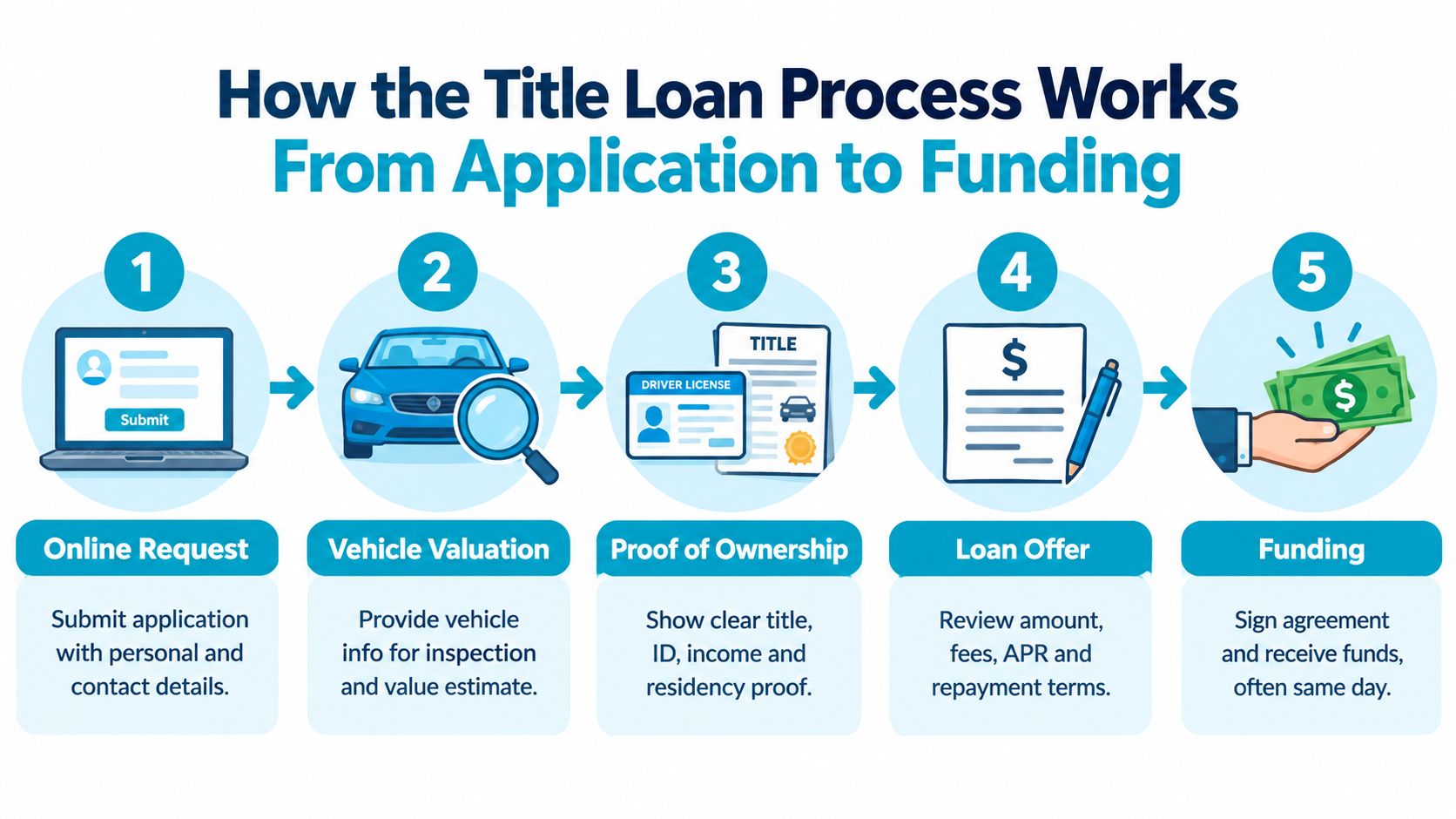
How the Title Loan Process Works From Application to Funding
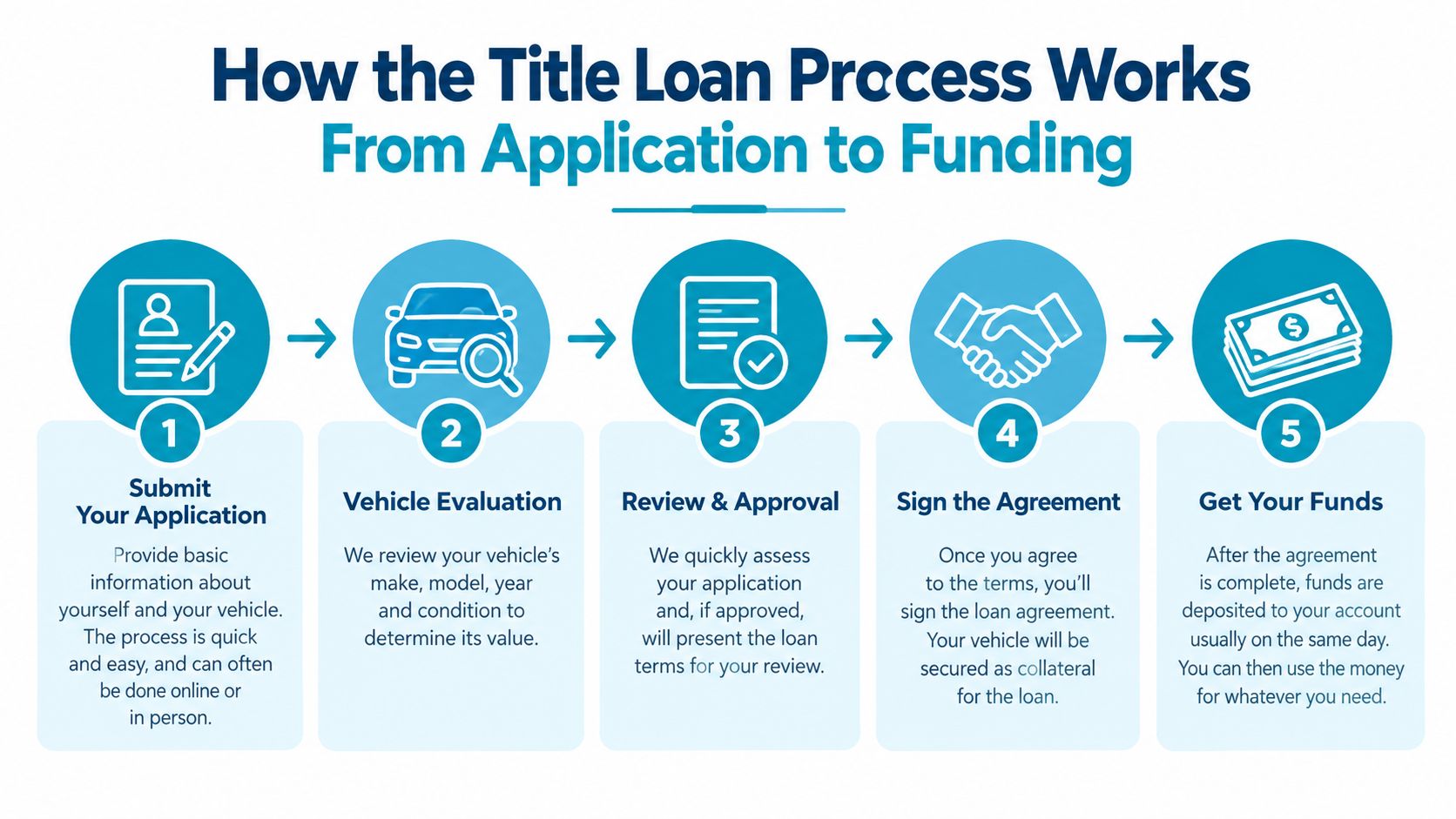
Most title-loan applications follow a predictable sequence, even though the documents and timing vary by lender and state. Knowing the workflow helps you identify missing information before you agree to anything.
Step one, submit the request
You'll provide personal details, contact information, employment or income information, and the amount you're seeking. An online request may be convenient, but submitting information doesn't mean you must accept an offer. Read the privacy terms and consent language before sending the form.
Step two, provide vehicle details
The lender may ask for the make, model, year, mileage, identification number, title information, and photographs. Some lenders require an in-person inspection, while others use documents and remote valuation methods. The condition of the car can affect the lender's estimate and the amount it offers.
Step three, verify ownership and identity
Expect requests for a government-issued ID and the vehicle title. The lender may also request proof of residence, income, insurance, or registration. If another lender already has a lien, you may not qualify for a standard title-backed loan unless that lien is addressed.
Step four, review the offer
The offer should identify the principal, APR, finance charges, other fees, payment schedule, maturity date, renewal terms, late consequences, and repossession language. Don't rely on a verbal explanation if the written agreement says something different.
Step five, sign and receive funds
After you accept, the lender may use electronic signatures or in-person documents. Funding can occur by direct deposit or another approved method. Timing depends on lender review, bank processing, required documents, and state requirements. For a broader explanation of application timing, see how long loans take to process.
Where an online marketplace fits
NextStopLoans operates as a connector, not a lender. It can submit one secure request to independent third-party lenders, which may return offers quickly, but those lenders decide whether to approve, set the terms, and fund the loan. You're not required to accept an offer, and you should compare the full written disclosures before signing.
The lender's disclosure is the controlling document. Check whether the quoted amount is the amount deposited or the amount before fees, and confirm whether the first payment covers interest only, fees, principal, or a combination.
Understanding Valuation Loan Amounts Fees and Repayment Terms
The vehicle's value determines the lender's starting point, but it doesn't determine whether the loan is affordable. A lender can approve a relatively small advance while attaching a very high cost and a demanding due date.
Loan-to-value in ordinary language
The loan-to-value ratio, or LTV, compares the loan principal with the vehicle's estimated value. Independent analysis in the Center for Responsible Lending's car-title lending report reported a median LTV of about 26% and a median APR of 300%. Using the report's illustration, a borrower could pledge a car worth roughly $3,150 for a much smaller advance.
That gap protects the lender, not necessarily the borrower. Even if the lender advances only a fraction of the car's value, the borrower may still face a triple-digit cost of credit and a payment schedule that doesn't match their income.
APR and fees tell the real story
APR helps express borrowing cost over an annualized period, but you should also inspect the actual dollar charges and the time until payment is due. A short loan with a high APR can create a large cost over a brief period, especially when the contract adds origination, title, documentation, or renewal fees.
For a plain-language discussion of pricing, see car title loan interest rates.
| Loan feature | Typical value or outcome |
|---|---|
| Typical auto title loan | About $700, according to CFPB research |
| Annual percentage rate | Near 300% in the CFPB data |
| Median loan-to-value ratio | About 26% in the cited independent analysis |
| Common repayment structure | Many loans are short-term obligations, including 30-day, single-payment arrangements |
| Main cost concern | Interest, fees, extensions, and repeated borrowing can keep the balance high |
Why repayment structure creates the trap
Consider a borrower who receives a modest advance but must repay the principal, interest, and fees in one payment. The borrower may have enough income for ordinary monthly expenses but not enough to cover the entire title-loan balance by the due date. If the lender permits an extension, the borrower may pay additional charges without reducing the principal very much.
That's the central distinction between a one-time bridge loan and a repeat-debt product. The initial amount can be small, yet the obligation remains difficult because the contract demands a large payment quickly. The CFPB's complaint data identifies unexpected fees or interest as a common consumer problem, and borrowers report confusion about still owing substantial balances after making payments. The CFPB consumer response report describes this repayment confusion and the importance of understanding the full structure.
Repossession Risk State Rules and What Changes by Location
A borrower who misses the due date may be putting the vehicle at risk, not just adding a late fee. Because a title loan is secured by the vehicle, the lender may have rights to repossess it after default. The answer to “When can the lender repossess?” depends on the contract and the law where the loan was made. An online summary cannot replace a state-specific review.
The CFPB reported that one in five borrowers with a single-payment auto title loan had their car or truck seized after failing to repay, according to its report on vehicle seizure and title-loan debt. The report also found that more than two-thirds of title-loan business came from borrowers who took seven or more consecutive loans. These figures show why the repayment design matters more than the initial loan amount. A small advance can still create serious risk if the contract requires a large payment before the borrower has rebuilt available cash.
Why repeat borrowing matters
A renewal can move the deadline without removing the debt. The borrower may pay another charge to keep the account open, while the principal changes little. The lender's claim against the vehicle remains in place, so each extension can preserve the same repossession risk.
CFPB research found that over 80% of vehicle title loans were reborrowed on the same day a previous loan was repaid, and nearly 90% were reborrowed within 60 days. Only about 12% of borrowers repaid a title loan in a single payment without quickly borrowing again. The earlier analysis supports a practical question: can you pay the full balance on the due date without taking another loan?
State law can change the outcome
State rules may cover lender licensing, interest caps, advertising, default notices, repossession timing, redemption rights, and surplus money after a vehicle sale. Florida, for example, has a 2025 statutory chapter on title lenders that requires lender licensing, sets tiered interest limits, and establishes conditions related to default and repossession. It also restricts advertising phrases such as “interest free loans” and “no finance charges.”
Florida's requirements do not automatically apply in another state. Before signing, check whether title loans are available where you live, whether the lender is licensed there, and what notice and sale procedures govern a default. Resources such as information about title loans in New York can help identify local availability, but read the contract alongside the applicable state rules.
Smarter Alternatives to Title Loans and How to Compare Offers
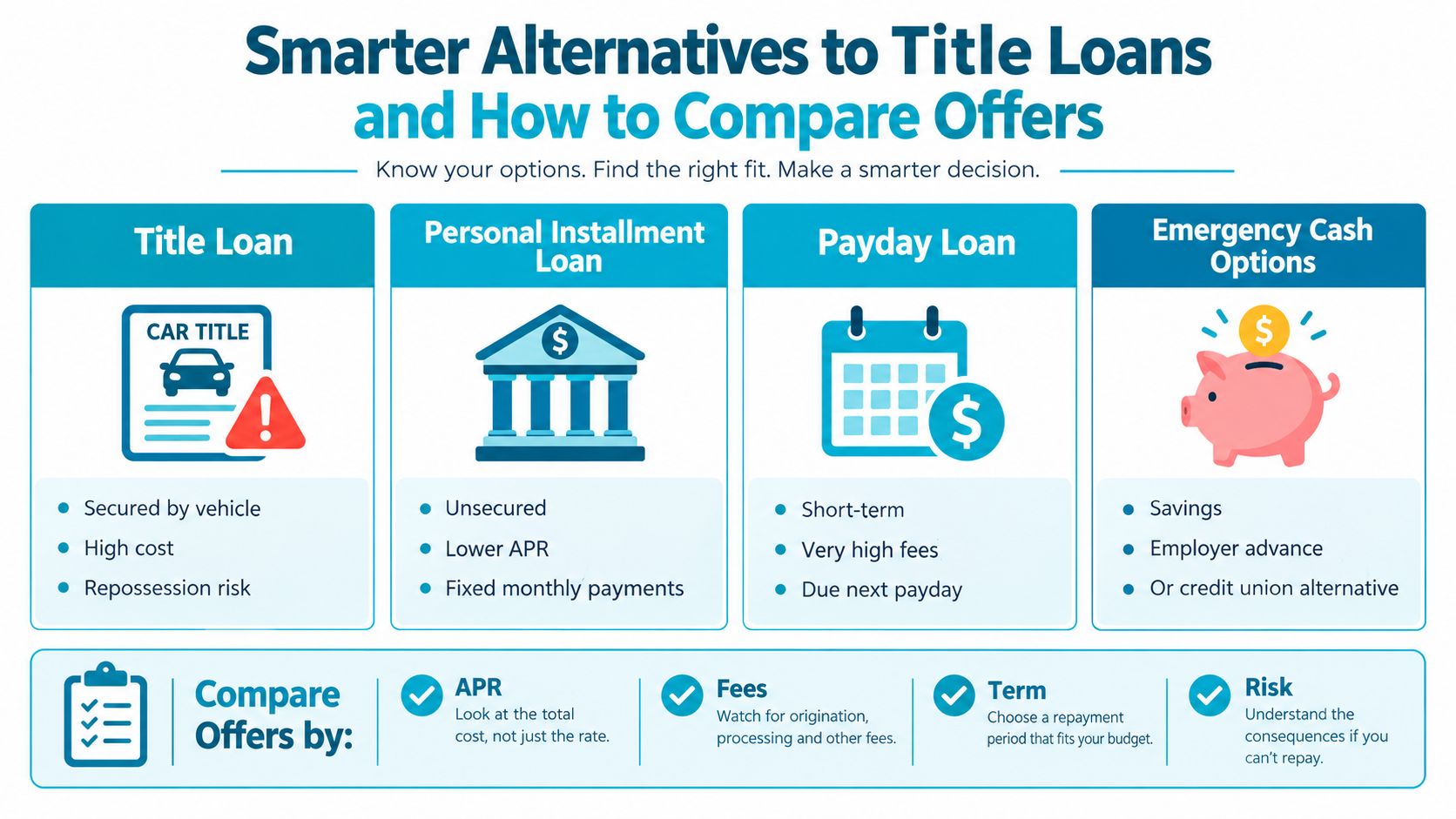
Putting your vehicle at risk may not be necessary if another option can meet the same expense with a more manageable repayment schedule. The right comparison starts with the asset you're protecting, the date your money arrives, and the payment you can make without borrowing again.
| Option | Collateral | Repayment focus | Main risk to consider |
|---|---|---|---|
| Title loan | Vehicle title | Often short-term, with high fees or a large maturity payment | Vehicle repossession after default |
| Personal installment loan | Often unsecured | Fixed payments over a defined schedule | High cost may still apply for weaker credit |
| Payday loan | Usually unsecured | Short-term payment tied to payday | Very high fees and repeat borrowing |
| Emergency cash option | Varies | May include assistance, an employer advance, or a credit-union product | Availability and eligibility differ |
Compare the structure, not just the approval
A personal installment loan may avoid a lien on your car and spread repayment across scheduled payments, though you still need to check APR, fees, and total repayment. A credit union may offer a lower-cost product or a secured alternative, but eligibility and timing vary.
A payday loan doesn't put the vehicle directly behind the debt, but it can still create a severe short-term payment problem. Community assistance, an employer advance, payment arrangements with a biller, or help from a trusted family member may reduce the amount you need to borrow.
Use a practical screening checklist
Before accepting any offer, compare:
- APR and total repayment: Identify the complete cost, not just the fee shown in an advertisement.
- Payment dates: Match each due date to your actual income schedule.
- Renewal terms: Find out whether an extension adds fees or leaves the principal unchanged.
- Collateral consequences: Confirm whether your car, account, or another asset is exposed.
- State protections: Check licensing, cancellation rights, repossession rules, and surplus-sale treatment.

An online marketplace can reduce the need to submit separate requests to multiple lenders. If you use one, remember that participating lenders make the decisions and set the terms. Review every offer independently, and decline anything that depends on a payment you're unlikely to make.
Making a Confident Decision Before You Pledge Your Title
A borrower with a late paycheck may focus on receiving cash today and overlook the vehicle tied to repayment. Before signing, write down the answers to three questions:
- What will I repay altogether? Add the principal, APR-based interest, finance charges, title fees, late fees, and extension costs.
- Can my budget cover each payment? Start with take-home income, then subtract rent, food, utilities, transportation, and existing debt.
- What follows a missed due date? Read the default, notice, repossession, redemption, and vehicle-sale provisions.
The loan amount is only one part of the risk. The structure determines whether a short-term balance becomes repeated extensions, added fees, or a vehicle you may need to recover or lose. If losing the car could affect work, childcare, medical access, or housing, include that practical cost in your decision.
Rules differ by state, so check the lender's license and local requirements. Compare an unsecured installment offer, credit-union option, employer advance, assistance program, or negotiated bill payment before pledging the title.
NextStopLoans is a marketplace connector, not a lender. It does not set rates or approve applications. Review its Rates and Fees, Lending Policy, and FAQ disclosures, then examine each lender's repayment terms before proceeding.