
Debt Consolidation Loans Good or Bad: The Honest Breakdown

Debt consolidation loans are good only when they lower your total repayment and you stop building new balances, bad when they just stretch the debt out or tempt you back onto the cards. The math matters, and so does your behavior.
Debt consolidation is a tool, not a solution by itself. That's the part the marketing usually buries. A consolidation loan can replace revolving credit with one fixed payment, but it doesn't erase the debt, and it doesn't fix spending habits on its own. The Federal Reserve reported that U.S. credit-card balances reached about $1.2 trillion in the third quarter of 2025, and 45% of credit-card owners carried a balance at least once in the prior 12 months, which explains why this option gets so much attention (Federal Reserve credit-card report).
Table of Contents
- The Honest Truth About Consolidation
- How Debt Consolidation Actually Works
- The Danger of Lower Monthly Payments
- Secured Loans Versus Unsecured Options
- Calculating Your True Cost
- The Behavioral Risk of Consolidation
- Alternatives and Final Decision Framework
The Honest Truth About Consolidation
Debt consolidation loans good or bad is the wrong first question if you're still looking at the monthly payment in isolation. The right question is whether the new loan gives you a lower all-in cost and a structure you can keep. If it does, consolidation can be a disciplined reset. If it doesn't, it's just a more polished version of the same problem.
The structure changes, the debt doesn't disappear
Consolidation works by swapping several revolving balances for one installment loan with a defined payoff path. That can improve predictability, because the payment is fixed and the end date is visible. The catch is that the principal still exists until you pay it down, so the loan is only as helpful as the discipline behind it.
The Federal Reserve's numbers show why the pitch is so persuasive, but they don't promise savings for every borrower. A lower annual percentage rate can help, especially when it replaces high-cost card debt, but the new loan has to beat the old balances after fees and over the full term. A loan that feels easier can still cost more.
Practical rule: If the loan doesn't lower your total repayment, it hasn't really improved your position.
Why the pitch works so well
People often turn to consolidation because juggling several due dates is exhausting. One fixed payment can make budgeting cleaner, and a defined payoff date can be motivating. Those are real advantages.
But there's a built-in trap. A smaller payment can make a borrower feel better before the math is better. That feeling is not the same as progress. The true test is whether the new structure reduces interest, shortens the payoff path, and keeps you from refilling the cards you just emptied.
How Debt Consolidation Actually Works
A consolidation loan replaces several credit-card balances with one new installment loan, often a personal loan. The old revolving debt becomes amortizing debt with a fixed schedule, so every payment is split between principal and interest. That matters because minimum payments on cards can keep balances hanging around for years, while an installment loan has a set finish line.
What changes next is the payment structure. Once the new loan pays off the old accounts, the borrower has one balance to track instead of several. That only helps if the cards stay closed to new spending. If the old balances come back, the borrower ends up with the consolidation loan and the same spending problem that created the debt in the first place.
The shift is mechanical, not magical. Revolving debt is flexible, and that flexibility makes it easy to carry a balance forward. Installment debt is less flexible, but it gives a predictable path to payoff. Predictability is the main benefit.
The mechanics that decide whether it works
Three details determine whether consolidation improves the numbers:
- Rate: the new APR has to be lower than the rates being replaced.
- Term: a longer term can lower the monthly payment while increasing total interest.
- Fees: origination charges and similar costs can erase savings quickly.
The structure can look attractive even when the outcome is weaker. A borrower may get a lower payment and still pay more over the full life of the loan if the term stretches too far or fees are high.
For readers comparing approval paths, loan terms, and basic eligibility, NextStopLoans' debt consolidation loan qualification guide lays out the lender side of the process in plain terms.
The best-looking loan on paper can still lose if the borrower keeps using the paid-off cards.
The Danger of Lower Monthly Payments
Lower monthly payments are the feature most likely to mislead people. A smaller bill can feel like relief, but relief isn't the same as savings. If the term stretches out, the total interest can climb even while the monthly burden falls.
The New York Fed reported that total U.S. household debt reached $18.8 trillion at the end of the fourth quarter of 2025, while 4.8% of outstanding household debt was in some stage of delinquency (New York Fed household credit data). That backdrop matters because it shows how fragile affordability can be. A loan that feels manageable today can become costly if it merely delays the pain.
Shorter pain, longer bill
Stretching repayment from three years to five years is a classic payment illusion. The monthly amount falls, but the borrower keeps paying interest for longer. That's not a minor trade-off, it's the whole decision.
The danger is most obvious when the borrower focuses on monthly cash flow and ignores the full schedule. A lower payment can help someone avoid delinquency in the short term. It can also create a more expensive path if the loan stretches the payoff date too far.
The real comparison is total dollars
A serious comparison should ask one question. What will I repay in total under the new loan, and what would I repay if I stayed with the current debts? That includes interest, fees, and timing. If the consolidation loan wins only because it spreads the pain out, it may not be the better choice.
Bottom line: A lower payment is useful only when it comes with a lower lifetime cost or a clearly safer repayment path.
That's why borrowers should treat a monthly reduction as a signal to keep checking, not as proof the deal is good.
Secured Loans Versus Unsecured Options
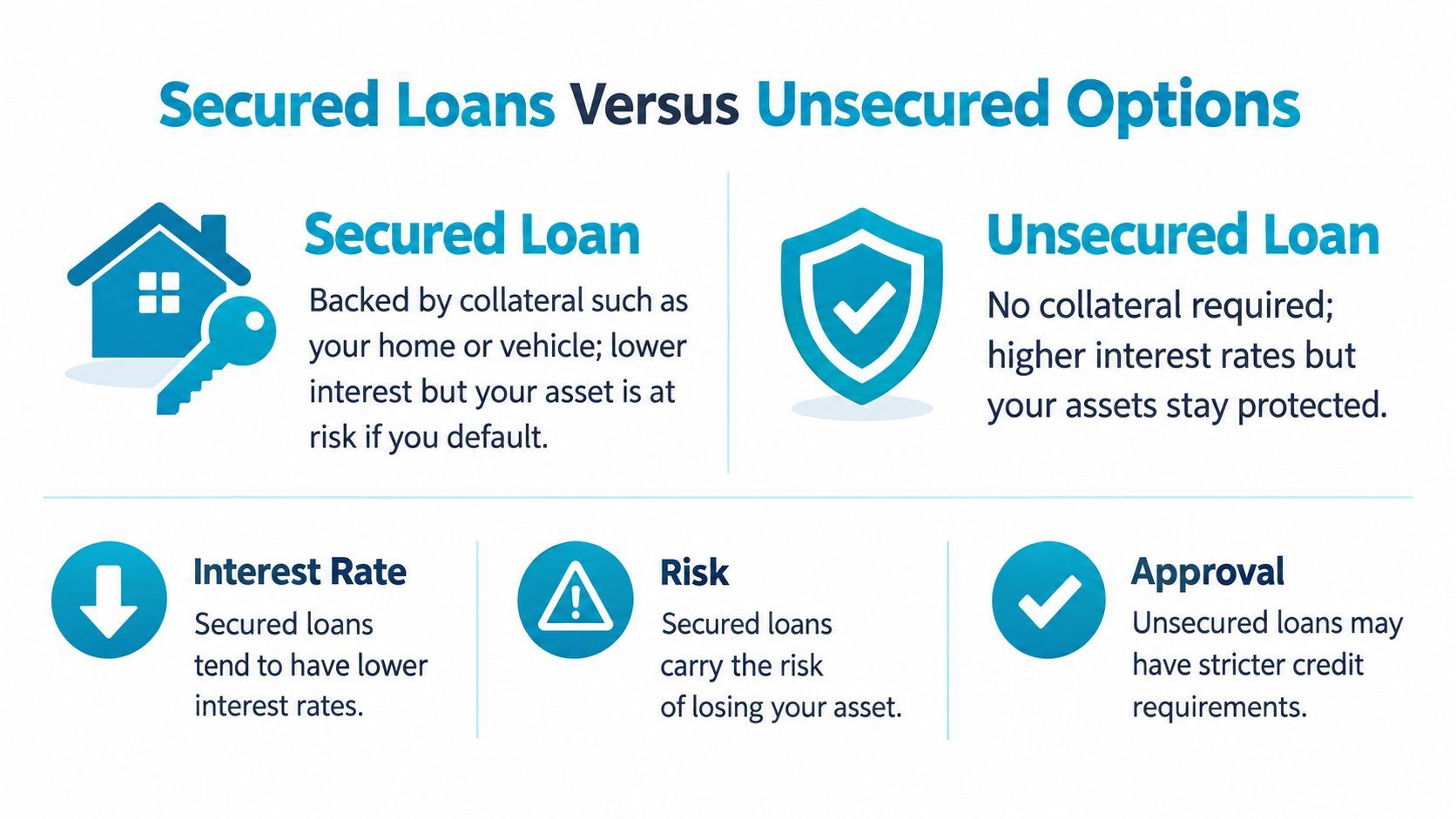
Secured consolidation can look cheaper because collateral lowers the lender's risk. The trade-off is obvious and serious, if you tie the loan to a home or vehicle, you've turned unsecured card debt into debt backed by something you can lose. Unsecured loans leave assets untouched, but they may price in the borrower's weaker credit profile.
The Consumer Financial Protection Bureau warns that home-equity consolidation can place the home at foreclosure risk after missed payments, and that fees and temporary rate features can make a deal more expensive than it looks (CFPB debt consolidation guidance). That warning is the right lens to use. Cheap funding isn't cheap if the collateral is essential to your household.
Collateral changes the stakes
A secured loan can be reasonable when the borrower is stable, the rate advantage is real, and the monthly payment is comfortably affordable. But the asset risk is not theoretical. If the payment fails, the lender has a claim on something tangible.
Unsecured consolidation avoids that specific danger. It can still be expensive, especially when credit has already weakened. So the decision isn't just secured versus unsecured, it's whether you're willing to trade asset safety for pricing.
If you're comparing collateral-backed options, the secured-loan overview at NextStopLoans' secured loan guide gives a useful view of how that structure differs from an unsecured personal loan.
A simple way to judge the trade-off
Ask yourself three things:
- Is the collateral essential? If losing it would create a second crisis, the risk is high.
- Is the rate gap meaningful? A tiny difference may not justify asset risk.
- Can the payment survive a bad month? If not, the structure is too tight.
A secured loan isn't automatically bad, and an unsecured loan isn't automatically safe. The choice depends on what's being put on the line and whether the payment fits the budget.
Calculating Your True Cost
The only honest way to judge consolidation is to compare total repayment, not the headline payment. That means adding up the loan principal, interest, origination fees, and any other charges, then comparing that total with the cost of keeping the current balances open. Anything less is guesswork dressed up as math.
In U.S. data cited by the Federal Reserve Bank of St. Louis, average credit-card interest rates rose from about 15% in November 2021 to about 21% in November 2023, while personal-loan rates rose from roughly 9% to 12% over the same period (St. Louis Fed rate comparison). That spread creates a real opportunity for some borrowers. It also means the savings depend on the terms, not the sales pitch.
The break-even check
Use this sequence before you sign anything:
- Add up your current balances.
- Estimate the interest you'd pay if you kept making payments as planned.
- Add the new loan's APR, fees, and repayment term.
- Compare the total dollars repaid in each scenario.
- Reject the loan if the new total is higher or only looks better because the term is longer.
That's the entire test. If the new loan doesn't beat the old path in total dollars, it's not a consolidation win. It's just a different bill.
Fees can wipe out the spread
Origination fees matter because they change the true cost of borrowing. If the fee is deducted from the proceeds, you receive less cash than the loan amount but can still pay interest on the full principal. That creates a hidden drag on the deal.
Ask for the net proceeds, not just the stated loan amount.
For rate shopping and payment modeling, a calculator can help you compare scenarios before you commit. A practical place to run those numbers is NextStopLoans' loan calculator.
The Behavioral Risk of Consolidation
The most overlooked risk is simple. You can pay off the cards, then run the balances back up. That turns consolidation into a temporary reshuffle instead of a real reduction in debt. The loan still exists, and now the credit-card balances do too.
The scale of that risk is not abstract. U.S. credit-card debt reached $1.18 trillion in Q1 2025, while total household debt reached $18.20 trillion, and 4.3% of outstanding household debt was in some stage of delinquency (New York Fed research note). Those figures show how easy it is for debt to stay embedded in household finances when spending habits don't change.
A paid-off card is not a solved problem
A consolidation loan can improve cash flow, which is useful. But cash-flow relief can also lower the pressure that was forcing discipline. Once the cards are available again, the temptation returns.
That's why the behavioral fix matters as much as the rate. If you're prone to rebuilding balances, consolidation can make the total problem larger. The loan becomes one more obligation, not a reset.
What disciplined borrowers do differently
Borrowers who make consolidation work tend to do the unglamorous things:
- Stop using the freed-up cards. If the account stays open, the spending has to stop.
- Build a strict budget. Every payment needs a place in the month.
- Use friction. Remove cards from wallets and saved online accounts.
- Treat the loan as final. No new debt while the old one is being retired.
Consolidation is most useful when it's paired with spending control. Without that, a lower rate can finance the same habits more efficiently.
Alternatives and Final Decision Framework
Consolidation is one option, not a default answer. For borrowers whose credit is already deteriorating, a new loan may be costly, hard to obtain, or just the wrong tool. If the problem goes beyond monthly cash flow, adding another obligation can make the household less flexible, not more.
Recent complaint data point to that strain. The CFPB received about 13,500 personal-loan complaints and 7,200 debt- or credit-management complaints in 2025 (CFPB consumer complaint note). Those figures do not tell anyone which choice to make, but they do show how often consumers get stuck between imperfect options. In that setting, triage before borrowing is often the cleaner move.
A practical decision tree
Start with the source of the problem:
- Temporary cash-flow stress: A lower-cost consolidation loan or a creditor hardship program may help.
- Unaffordable minimum payments: Nonprofit debt management may fit better than a new loan.
- Insolvency-level debt: Bankruptcy advice may be the more honest path.
- Collateral risk on the table: Secured options deserve caution unless the payment is very stable.
The question is which intervention minimizes expected harm, not which one sounds easiest. A loan works only if it lowers total cost and fits a budget that can survive normal life.
Where consolidation fits, and where it doesn't
Consolidation works best when the borrower has steady payment discipline, a lower-cost offer, and a real plan to stop adding debt. It loses value quickly when approval comes with a high rate, fees erase the savings, or missed payments are already part of the pattern. In those cases, counseling or legal advice may be the more responsible route.
If you want a marketplace that routes requests for personal loans and debt consolidation to independent third-party lenders, NextStopLoans is one place to review loan-request options and lender responses before deciding whether to proceed. Treat it as a comparison step, not a shortcut around the math.