
Credit Score of 500: What It Means and How to Move Forward

You check your credit app before applying for a loan and see 500. Your stomach drops. You may already be thinking that no lender will consider you, or that the number says something permanent about your reliability. It doesn't. A credit score of 500 is serious, but it's a risk signal, not a diagnosis of who you are or a guarantee that every application will be denied.
The useful question isn't only, “Is 500 bad credit?” It's what caused the score, what information a lender will use, and whether the repayment structure fits your budget. Once you answer those questions, you can replace panic with a practical plan.
Table of Contents
- Where a 500 Credit Score Actually Sits
- What Is Actually Dragging the Score Down
- The Medical Debt Question Most Articles Skip
- Loan Options for a 500 Credit Score
- Why the Fastest Offer Is Often the Riskiest
- A 90-Day Plan to Start Moving the Number
- What to Carry Away From a 500 Score
Where a 500 Credit Score Actually Sits
A general-purpose FICO score runs from 300 to 850, and a score below 580 falls in FICO's “poor” category, according to myFICO's consumer education guide. A score of 500 is therefore near the bottom of the standard range. Lenders generally interpret it as indicating substantially higher repayment risk than a score near the middle or upper end.
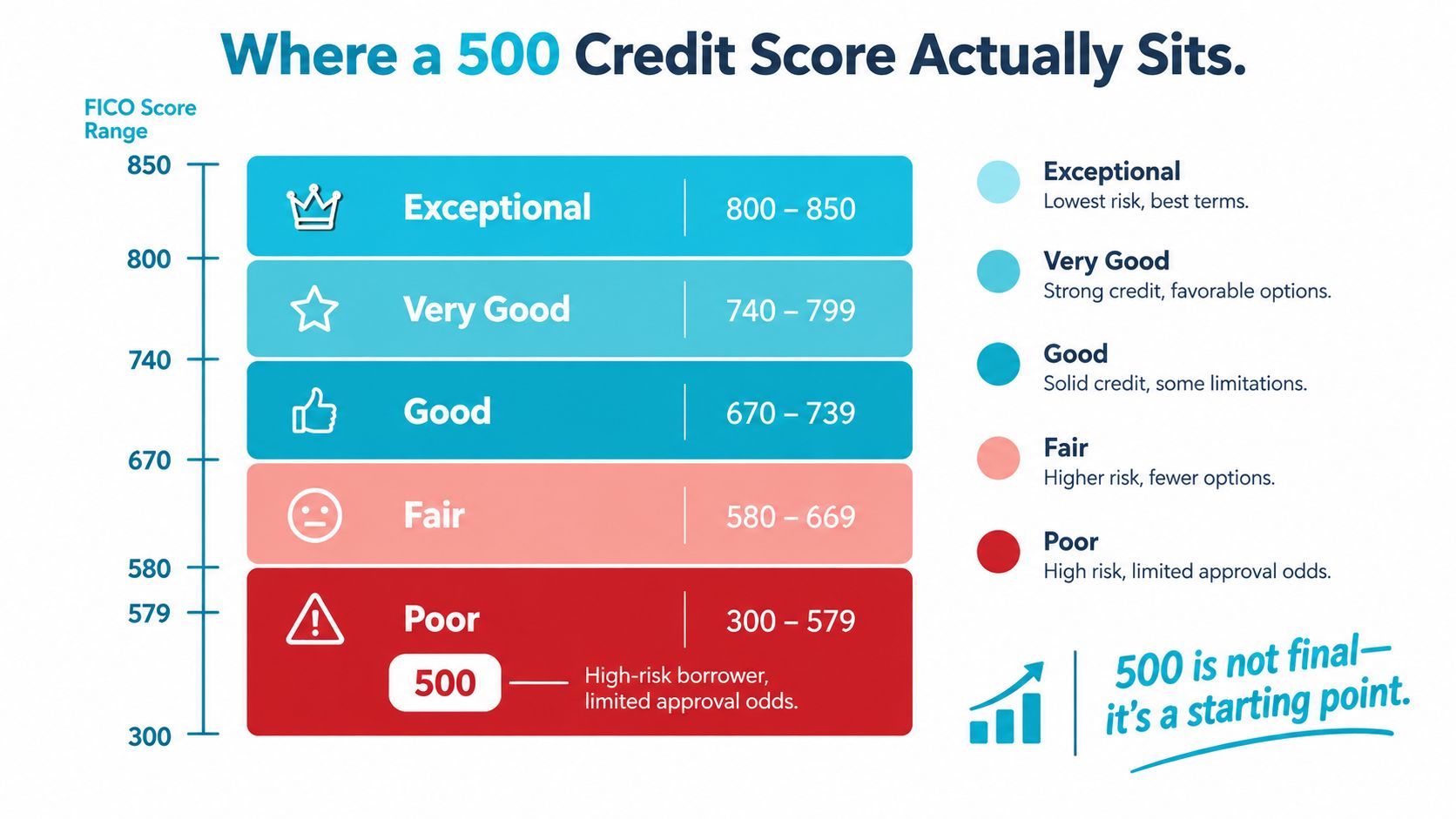
That classification matters because lenders use scores to rank risk. It doesn't operate as a universal approval line. An underwriter may also review your income, employment, existing debt, payment history, collateral, debt-to-income ratio, and the lender's internal rules. Two lenders can reach different decisions because they use different scoring versions, credit-report data, and underwriting methods.
Why the number carries weight
FICO introduced its modern general-purpose scoring model in the United States in 1989, creating a standardized way for lenders to compare credit risk across consumers, according to FICO's account of the score's history. The score became available through Experian, Equifax, and TransUnion in 1991, then gained an important role in conforming mortgage lending when Fannie Mae and Freddie Mac adopted FICO scoring in 1995.
That history explains why the number appears on so many financial decisions today. It does not mean your commonly viewed FICO score is necessarily the exact score a lender will use.
Keep this distinction in mind: 500 describes how a particular scoring model ranks information in a credit file. It doesn't predict your future with certainty.
Start with the facts, not the label. Confirm which bureau supplied the score, which model produced it, and whether the lender uses a different version. That small piece of context can prevent you from treating one number as the final word.
What Is Actually Dragging the Score Down
A 500 score is a result, not a diagnosis. To understand what pulled it down, examine the information behind the number. The Consumer Financial Protection Bureau's explanation of credit scores describes factors scoring models commonly consider, including payment history, unpaid debt, account mix, account age, credit utilization, new applications, collections, foreclosure, and bankruptcy.
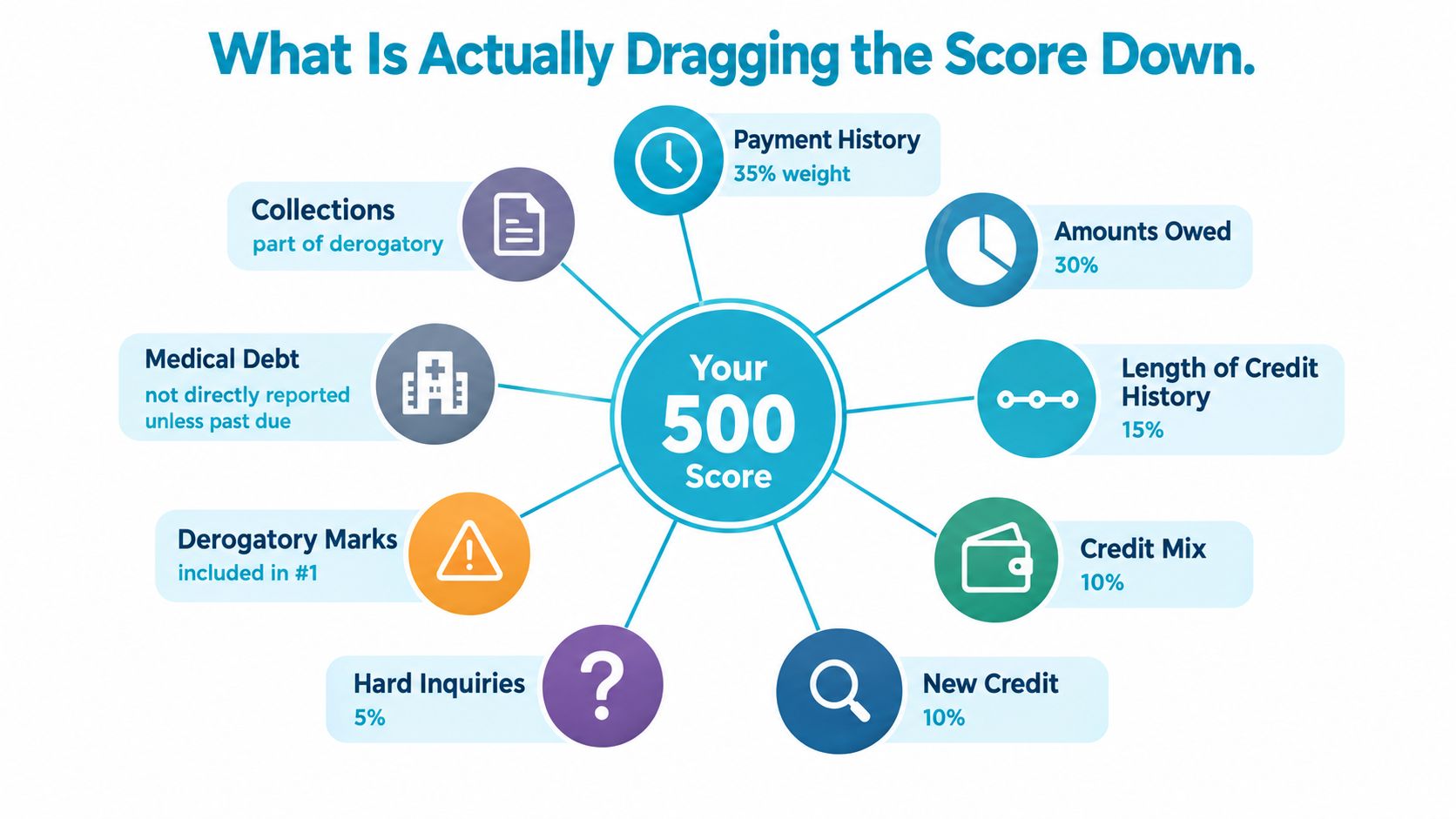
The right repair depends on the cause. A thin file needs a different response from a credit card reporting a balance near its limit. Repeated late payments call for a different plan again. Treat the score like a warning light on a car dashboard. It tells you that something needs attention, but the credit report helps identify the part.
Begin with payment history
Payment history deserves an early review because missed payments can add recent negative information. Bring delinquent accounts current if possible, then protect each due date with reminders or automatic payments for at least the minimum. This stops new derogatory events while you investigate older ones.
Check reported balances and utilization
Credit utilization measures how much of your available revolving credit appears in reported balances. A card with a low limit and a high balance can weigh heavily on a file. Paying it down before the statement date may lower the balance sent to the bureaus.
Your online balance and credit-report balance may differ because the card issuer reports on a particular schedule. Check when each account reports before deciding whether a payment has changed the information lenders see.
Review the remaining entries separately:
- Collections and unpaid debt: Confirm that each account belongs to you, the balance is accurate, and the reporting dates make sense.
- New applications: Avoid applications without a clear purpose. Extra inquiries can make an already fragile file harder to assess.
- Account age and mix: Older accounts and different account types may matter, but opening accounts only to create variety can backfire.
- Foreclosure or bankruptcy: These serious derogatory items require careful planning rather than a burst of applications.
A denial can function as a personalized repair checklist. Creditors generally must provide an adverse-action notice stating the principal reasons for the decision. If a credit score was used, the notice generally includes the score and key factors that lowered it.
Place that notice beside your credit reports. A high-balance reason points toward utilization. A late-payment reason points toward current status and payment protection. If the notice does not match your reports, investigate a possible reporting error before applying with another lender.
The Medical Debt Question Most Articles Skip
A borrower can have a 500 score after an unpaid hospital bill, even when regular payments were never the problem. Medical debt is a useful example because research summarized by the Commonwealth Fund in a public testimony document finds that it has limited predictive value for underwriting. Consumers whose scores fell because of medical debt were often as likely to repay as consumers with higher scores.
The three major credit bureaus removed paid medical collections, recent medical collections, and medical debts under $500 in stages. The under-$500 exclusion took effect in April 2023, as noted in the same testimony. Voluntary bureau exclusions remain even though a federal rule issued in 2025 was overturned in July 2025.
Check what each report actually says
Pull reports from Experian, Equifax, and TransUnion. Search for medical providers, collection agencies, account status, balances, and dates. A bill that was paid, a small medical collection, or an account you do not recognize may need closer review rather than automatic acceptance.
If an item is inaccurate, duplicated, paid, or obsolete under applicable reporting rules, dispute it with the bureau and the company that furnished the information. Keep copies of bills, payment confirmations, insurance explanations, and dispute correspondence.
Ask the lender a direct question
Before applying, ask whether the lender considers medical collections and what other information it reviews. Some lenders may weigh income, bank-account cash flow, collateral, and current obligations alongside traditional credit data.
If medical expenses are the reason you need funds, read this guide to loans for medical bills beside the offer's full repayment terms. A 500 score is a warning sign to investigate, not a complete diagnosis. The report and the lender's criteria can show whether the cause is a current repayment problem, an old reporting issue, or information that says little about your ability to repay.
Loan Options for a 500 Credit Score
A credit score of 500 can narrow access to mainstream unsecured credit, but it doesn't create one single borrowing path. The right comparison starts with structure, not the promise of approval.
A fixed-payment installment loan gives you scheduled payments over an agreed term. That predictability can make budgeting easier, though the lender may charge a high rate or fees for the additional risk. A personal loan may be used for a major purchase or debt consolidation, but approval and terms depend on the lender's underwriting. Learn more about personal loans for a 500 credit score before treating an advertised offer as guaranteed.
Match the product to the risk you can carry
| Loan structure | What to examine first | Main risk |
|---|---|---|
| Installment loan | Fixed payment, term, total repayment, and late fees | A payment can still be unaffordable even when it is predictable |
| Payday-style loan | Rapid due date, renewal or refinancing terms, and electronic debit authorization | A short repayment window can trigger repeated borrowing |
| Title-backed loan | Vehicle value, total repayment, and collateral rules | Failure to repay can place the vehicle at risk |
| Personal loan | Annual percentage rate, origination fee, monthly payment, and total cost | A longer term may reduce the payment while increasing total cost |
| Marketplace request | Which independent lenders may respond and how offers are presented | A match isn't an approval, and the marketplace doesn't set lender terms |
A secured structure may improve access because collateral gives the lender another source of repayment. That benefit comes with a consequence you shouldn't minimize. If the loan is title-backed and you can't pay, your vehicle may be at risk.
Compare the complete offer
Look beyond the payment shown in a large font. Ask for the annual percentage rate, dollar finance charge, origination fee, late fee, total repayment, due dates, prepayment terms, electronic-debit authorization, collateral consequences, and credit-bureau reporting policy.
A marketplace such as NextStopLoans submits a single request to independent third-party lenders. It isn't the lender, doesn't make credit decisions or set terms, and you aren't obligated to accept an offer. Participating lenders may use credit reports or alternative information, so read each lender's disclosures before signing.
The safest available option is the one whose full schedule you can complete without skipping essentials or taking another loan to make the payment.
Why the Fastest Offer Is Often the Riskiest
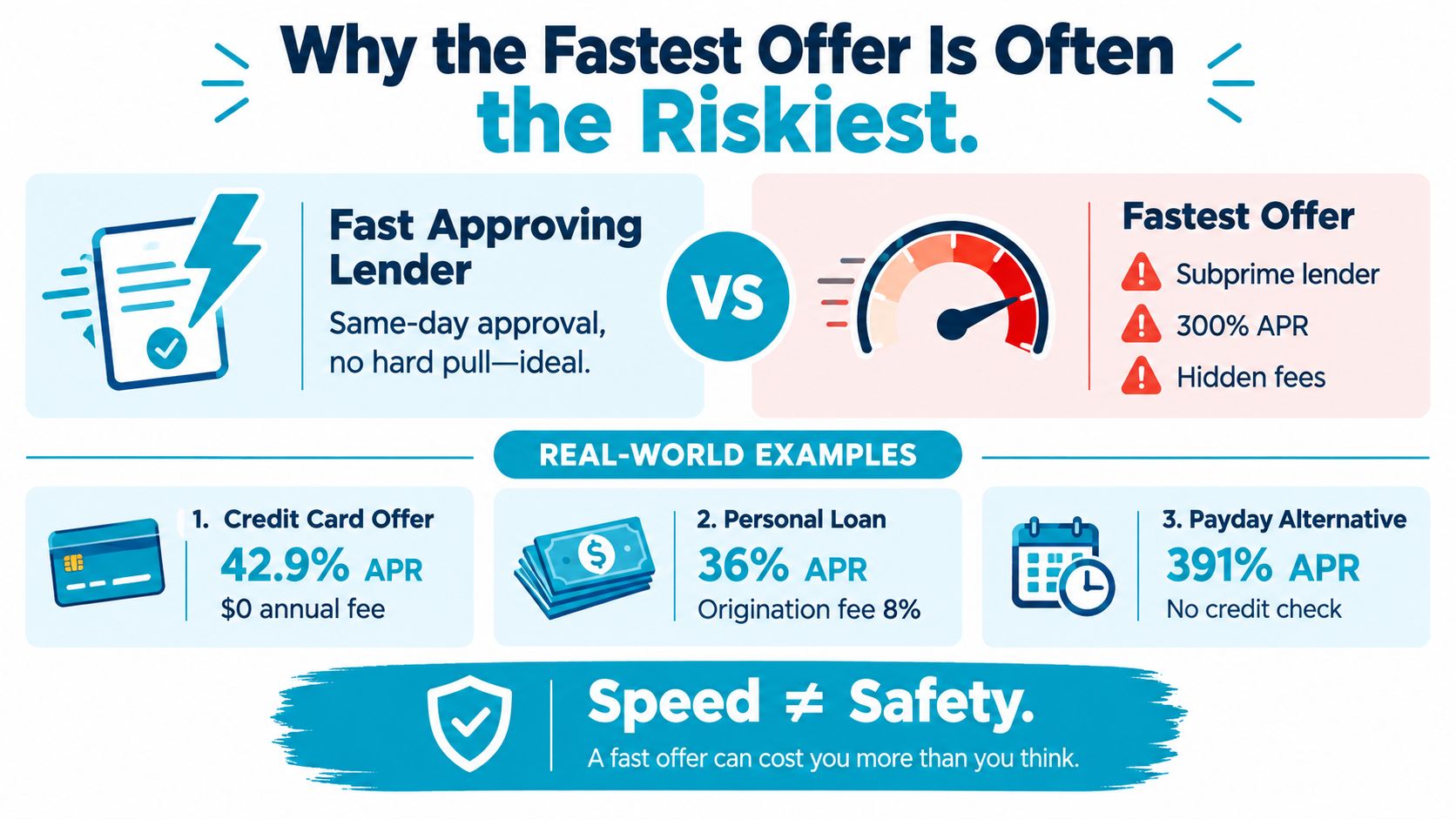
Approval is only the midpoint of a borrowing decision. A lender can say yes quickly and still offer a repayment schedule that leaves you worse off.
Federal Reserve household-survey data reported that, among applicants, roughly one-third were denied credit or received less than requested, a result five percentage points higher than in 2021, according to the Federal Reserve's 2025 household credit findings. Limited access can make a fast offer feel like your only opportunity. It isn't a reason to stop comparing.
Put the repayment schedule under a microscope
A fixed-payment installment loan spreads repayment across scheduled due dates. A payday-style product may demand rapid repayment or encourage refinancing when the original due date arrives. A title-backed product may offer access based on vehicle equity but creates a direct risk to the vehicle.
Don't compare these products by speed alone. Compare what leaves your bank account, when it leaves, and what happens if your paycheck arrives late.
Use this checklist before accepting any offer:
- Total repayment: How much will you repay from beginning to end?
- Finance charge: What dollar amount represents the cost of borrowing?
- Payment timing: Does the due date match your income schedule?
- Late consequences: What fee or other consequence follows a missed payment?
- Electronic debits: Can the lender automatically withdraw funds, and can you control the authorization?
- Collateral: Can the lender take property if you fall behind?
- Credit reporting: Will on-time payments or missed payments be reported?
The practical test is simple: can you finish the schedule without borrowing again to make the final payment?
If a marketplace presents an offer, remember that matching isn't approval. The independent lender decides whether to approve the request and sets the terms. You can decline if the total cost or payment timing doesn't fit.
A 90-Day Plan to Start Moving the Number
A score of 500 is a warning light, not a diagnosis. The repair plan should follow whatever is causing the problem. Before opening another account, find the information lowering the number and prevent a new late payment from adding to it.
In the first part of the plan, establish the record
Pull all three credit reports and compare your name, addresses, account numbers, balances, payment status, and dates. Mark late payments that are inaccurate, duplicate accounts, collections you do not recognize, and balances that are wrong.
Send disputes with documents that support your position. Contact the company that reported the information as well as the credit bureau when appropriate. Keep a dated file of every letter, form, and attachment. If the adverse-action notice names a specific balance or late payment, review that item first. The notice can function as a personalized repair list because it shows what influenced the lender's decision.
Next, reduce what gets reported
Direct available cash toward revolving accounts that are near their limits. Paying before the statement closing date can lower the balance sent to the bureaus. Paying by the due date prevents the account from becoming newly delinquent. Those dates serve different purposes, so mark both on your calendar.
Avoid unnecessary applications while you correct errors and establish steady payments. Do not request a credit-limit increase without checking whether the lender may make a hard inquiry and whether a larger limit could encourage additional spending.
Make on-time payment automatic
List every due date and set reminders or automatic minimum payments when your account can support them. An automatic minimum payment is a safety net, not a debt-reduction plan. It can help keep one missed date from creating another negative entry while you address larger balances.
Ask current and prospective lenders whether they report payments to credit bureaus. Timely payments cannot strengthen your credit history when the lender does not report them.
A few supporting habits also deserve attention:
- Protect older accounts: Do not close an older account automatically if it has no harmful fee and you can manage it responsibly.
- Separate roles: An authorized user is not the same as a primary borrower. Confirm whose payment behavior and balance the account reflects.
- Avoid paid shortcuts: Be cautious of credit-repair companies charging for disputes or advice you can often pursue yourself.
- Review consolidation carefully: A consolidation loan may simplify several bills, but its monthly payment and total repayment must fit your budget. Use this bad-credit debt-consolidation guide as a comparison aid, not as a substitute for reading the offer.
Finish by checking whether the plan protects rent, food, utilities, and other necessary expenses. A payment that looks manageable on paper can still create another late payment if it leaves too little money for the rest of the month.
What to Carry Away From a 500 Score
A credit score of 500 tells a lender that the current file ranks as high risk under the scoring model used. It doesn't tell the whole story. One borrower may have recent missed payments, another may have high card balances, and another may be dealing with inaccurate or weakly predictive medical information.
Use a three-part framework whenever you face a credit decision:
- Identify the cause. Read the adverse-action notice, then inspect all three reports for the exact accounts and balances behind the result.
- Choose the structure. Compare total repayment, payment timing, fees, reporting, and collateral risk instead of selecting the fastest approval.
- Rebuild in sequence. Reduce harmful revolving balances, prevent new late payments, correct errors, and avoid unnecessary applications.
Save this short checklist:
- Confirm the bureau and scoring model.
- Read the denial notice.
- Review every report for errors.
- Check statement dates and reported balances.
- Protect every payment due date.
- Calculate total repayment before signing.
- Ask what happens after a missed payment.
- Decline any offer that requires another loan to repay it.
The goal isn't to perform perfectly for a number. The goal is to build repayment capacity, document it clearly, and choose credit that doesn't undermine your essential expenses. A score can change as the information behind it changes, but the next decision should be based on what you can afford today.
If you need to compare possible bad-credit borrowing pathways, NextStopLoans lets you submit one secure request that participating independent lenders may evaluate. Review each lender's APR, fees, payment schedule, and total repayment carefully, and accept an offer only if the payments fit your budget.