
APR for Bad Credit: Ranges, Costs and How to Lower It

A payday loan that charges $15 to $20 for every $100 you borrow looks manageable across a two-week horizon. Annualized, the U.S. Government Accountability Office's review of payday lending found those same fees equal roughly 300% to 600% APR. The dollar figure on the storefront poster and the annualized figure in the disclosure describe the same loan, and only one of them tells you what the money really costs.
That gap is where most borrowers with damaged credit get hurt. The APR for bad credit isn't a single number you look up once. It's a range stretching from bank small-dollar programs in the low double digits to payday products in the hundreds, and the term, fees and renewal rules can change your total repayment even when the quoted rate stays put. Three things decide where you land on that range: how the lender prices risk, how the loan is structured, and how repayment is enforced. Each one is more negotiable than most borrowers ever test.
Table of Contents
- Typical APR Ranges for Bad Credit Loans
- How Lenders Price Bad Credit Risk
- Fees, Term and Structure That Change the Real Cost
- Ways to Lower Your APR or Choose a Cheaper Path
- Fees, Penalties and Rollovers That Raise Total Cost
- Compare Offers and Decide Whether to Accept
Typical APR Ranges for Bad Credit Loans
The table below lines up the products a borrower with weak credit is most likely to be offered, from the cheapest annualized cost to the most expensive. Find your own quote on the scale before reading further.
| Loan type | Typical APR | Context |
|---|---|---|
| Federal credit-union Payday Alternative Loans | Up to 28% | Introduced after 2010 as a lower-cost short-term option |
| Bank small-dollar programs | 12% to 32% | Historically with low or no fees |
| Average bad-credit personal loan (scores below 630) | About 30.98% | Recent marketplace data |
| Some bad-credit personal loans | Above 50% | Reported in some marketplace samples |
| Payday loans | Roughly 300% to 500% | Usually due in a lump sum about two weeks later |
Why the bank tier sits where it does
FDIC small-dollar lending guidance has encouraged banks to offer affordable small-dollar credit at no more than 36% APR, and examples of bank programs historically ranged from 12% to 32% with low or no fees. That 36% marker also shows up in the federal Military Lending Act and in state interest-rate limits in many jurisdictions, which is why comparison guides keep returning to it as an affordability line.
Where the rest of the ladder lands
Federal credit-union Payday Alternative Loans, introduced after 2010, could historically carry rates up to 28%, as the Federal Reserve's analysis of small-dollar loans notes. Membership in the credit union is the price of entry. Personal loans marketed to bad-credit borrowers cluster near 30.98% for scores below 630, while some marketplace samples report rates above 50%.
Payday products top the scale. The FDIC reports they commonly reach approximately 300% to 500% APR and are generally due in a lump sum around two weeks later. Earlier FDIC research put the arithmetic on the table: a fee of $10 per $100 borrowed equated to about 261% APR, while an average online fee of $25 per $100 equated to approximately 652%. Nothing about the dollar amount changed. Only the time frame did.
What the spread tells you
One credit-score range covers hundreds of percentage points because each lender prices its own loss expectations, its own cost of funds and its own collection costs. Two offers at the same score can differ by design rather than by error, and a sample average tells you almost nothing about the specific contract in front of you.
Working rule: locate your quote on the scale first, then ask what would have to change to move you one tier down. Anything well above 36% deserves a comparison before you sign.
How Lenders Price Bad Credit Risk
APR is a risk price. A lender estimates the probability you'll repay, then sets a rate and approval terms that compensate for the chance you won't. None of that calculation is a judgment about your character, and none of it is fixed. The same borrower can be quoted differently by two lenders on the same afternoon.
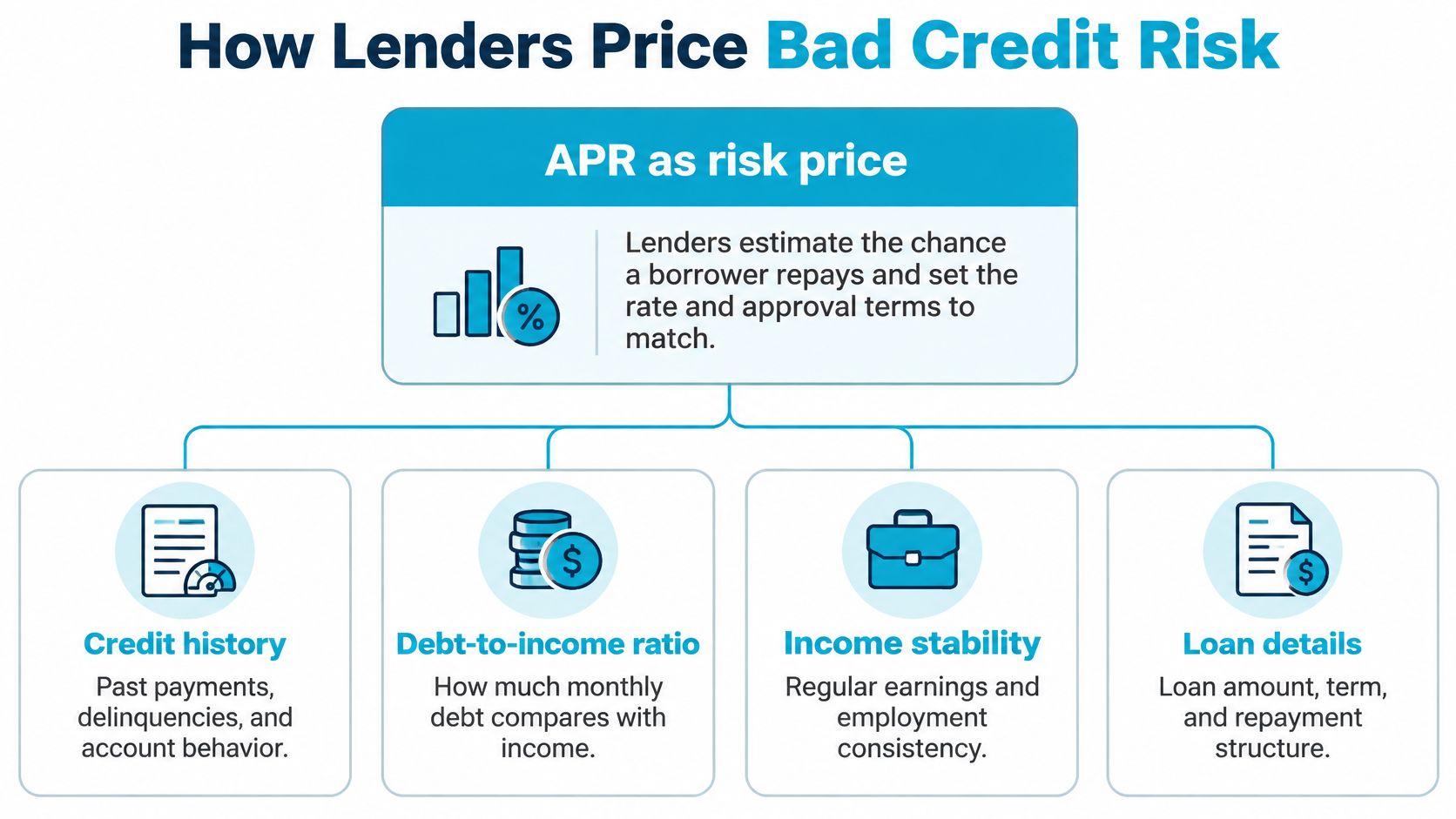
Four inputs move the price more than anything else: credit history, debt-to-income ratio, income stability and the details of the loan itself. Your score is only a summary of the first one.
The score bands, defined
Subprime means an Equifax Risk Score below 620. Nonprime means below 720. Deep subprime means 300 to 500. Those bands matter because pricing tables are built around them, and a 40-point move inside a band can leave your rate unchanged while a move across a boundary reprices the whole loan.
What one score band is worth in dollars
The Federal Reserve's credit reports and scores guide prices the same five-year, $30,000 auto loan for two bands:
| Credit score band | APR | Monthly payment | Total interest |
|---|---|---|---|
| Scores 720 to 850 | 5.636% | $575 | $4,495 |
| Scores 500 to 589 | 17.536% | $754 | $15,255 |
Same vehicle, same term, same principal. The lower band pays a difference of $10,760 in interest over the life of the loan.
Beyond the score
Lenders in our network review creditworthiness by pulling credit history from the major credit bureaus and from alternative bureaus such as Teletrack or DP Bureau, which record short-term lending activity the big three may not display. Income stability, existing debt payments, loan amount, collateral and payment history all enter the decision. Think of car insurance: two drivers with the same rating can pay different premiums because one commutes eight miles and the other drives 30,000 a year.
Access is a separate problem from price. Federal Reserve reporting shows one-third of consumers who applied for credit were denied or received less than they requested in 2025, according to its credit findings from the 2025 household survey. If you're in that group, the goal isn't a marginally better rate, it's an approval at a survivable cost. Reviewing personal loan eligibility requirements before you apply stops you from spending inquiries on lenders whose criteria you don't meet.
An unsecured personal loan is priced on your profile alone. A secured loan adds collateral, which shrinks the lender's loss if you default, so the APR usually falls. The trade-off is concrete: the lender can take the asset.
Fees, Term and Structure That Change the Real Cost
Two offers can carry the same APR and still cost different amounts, because term length does most of the damage. The table holds the principal steady at $5,000 and changes only the rate and the repayment period, using estimates from NerdWallet's bad-credit loan marketplace data.
| APR | Monthly payment | Total repayment |
|---|---|---|
| 30.98% over 36 months | About $212 | About $7,630 |
| 50.83% over 36 months | About $273 | About $9,830 |
| 30.98% over 24 months | About $282 | About $6,770 |
Read the first two rows together: a 20-point jump in APR adds about $61 a month and roughly $2,200 in total repayment. Read the first and third together: cutting the term from 36 months to 24 months saves about $860 overall but raises the monthly payment by about $70. That's the trade you make every time you choose a term, and no headline average captures it.
The AP part of APR does the work
The percentage in the advertisement is usually the nominal interest rate. APR includes mandatory origination or administrative fees, so it reflects what you pay to get the money. Say a $5,000 loan carries a $250 origination fee deducted from the proceeds. You receive $4,750 and repay interest on $5,000, which pushes the cost above the quoted rate. That isn't a trick, it's disclosure, and it's the reason to compare APR instead of advertised rates.
Payment schedule changes the total too
A biweekly schedule splits the monthly payment in half and collects it every two weeks. Twenty-six half-payments a year equal thirteen full monthly payments, so the balance falls faster and less interest accrues. Confirm the exact debit dates and whether the lender charges for that schedule before you agree to it.
Choosing a term without guessing
Longer terms lower the monthly payment and raise total interest. Shorter terms do the reverse, and can make a high APR unaffordable in the month you can least afford a surprise. Running every offer through a loan calculator at the same principal and term settles the comparison faster than any conversation with a salesperson.
Comparison rule: never evaluate two offers at different terms. Convert both to total repayment at the same amount, then choose.
A rate near the commonly cited affordability line doesn't guarantee comfort, either. A payment that fits one household budget can sink another, and the only test that matters is your own monthly surplus after the payment clears.
Ways to Lower Your APR or Choose a Cheaper Path
Before you accept a quote, check whether any of six levers applies to you. Most borrowers stop at the first one they can't move and sign, which is exactly how people end up on the expensive end of the range.
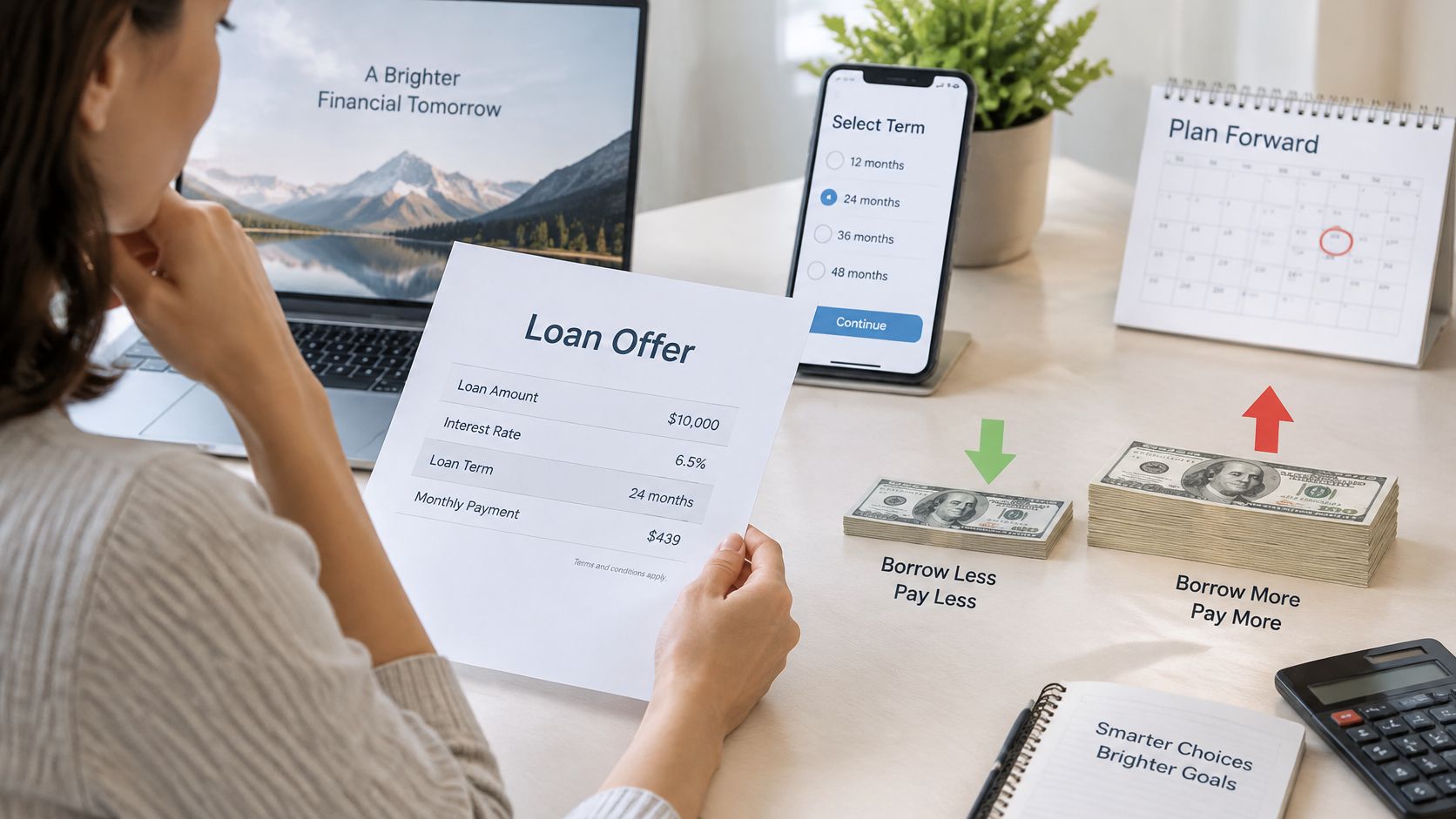
1. Borrow less than you're approved for. A smaller principal prices better because the lender's exposure falls, and your total drops twice over: fewer dollars borrowed, and often a lower rate on them. Requesting $3,000 instead of $5,000 can change the tier, not just the payment.
2. Choose the term on purpose. The earlier comparison produced a $282 payment over 24 months and $212 over 36 at the same rate. Neither is wrong. Pick the one your budget survives without a rollover.
3. Add a co-borrower. A second applicant with stronger credit and steady income shares legal responsibility for the debt, which lowers the lender's risk and can reprice the loan. It also puts your co-borrower's credit on the line if you miss a payment. Have that conversation before the application, not after.
4. Put up collateral. Vehicle-secured lending shows the effect clearly. In the fourth quarter of 2024, deep-subprime borrowers with scores of 300 to 500 paid average auto-loan APRs of 15.75% for new cars and 21.81% for used cars, according to Experian's analysis of auto loan rates for fair and poor credit. That sits well below what unsecured bad-credit offers often charge, and the reason is simple: the lender can repossess the car. Miss the payment and you lose the vehicle, with repossession fees usually attached. Ask what happens after a missed payment before pledging anything.
5. Document steady cash flow. Pay stubs, bank statements and proof of a regular pay schedule answer the question a score can't: whether money arrives predictably. Self-employed borrowers should bring more than one month of statements.
6. Collect several offers before deciding. Pricing dispersion is normal. Two lenders reviewing the same file often land a hundred basis points apart.
When the state sets your ceiling
Location is a pricing input you can't change but should know about. Some states cap the APR and the amounts of charges for an online personal loan, so the same request can come back at a very different cost depending on where you live.
Cheaper paths and what each one asks of you
Credit-union payday alternative loans were built as a short-term substitute for the storefront product and price far below that tier. The catch is membership, a small maximum loan amount and a waiting period if you've borrowed one recently.
Bank small-dollar programs carry low or no fees and repayment schedules tied to direct deposit. The catch is that they aren't offered everywhere and usually require an existing account in good standing.
Secured borrowing trades a lower rate for asset risk. Vehicle equity can provide a larger sum than an unsecured approval would, which is useful for a genuine emergency and dangerous for a want.
Match the tool to the job: an emergency expense calls for a small amount over a short, certain term. Debt consolidation calls for a fixed installment plan you can actually finish, not another balance to renew.
Payday loan alternatives that cost less covers the short-term options in more depth, including which ones report payments to the credit bureaus.
Fees, Penalties and Rollovers That Raise Total Cost
A missed payment doesn't cost you a late fee and nothing more. The fee is the cheapest part of it. Typical penalties for non-repayment run through several stages:
- Late fees. Charged once or repeatedly, depending on the contract, and often deducted from your next payment so the principal barely moves.
- Collection referral. Your account leaves customer service and lands with a collections team, and the negotiation starts from a worse position.
- Credit reporting. Late payment or non-payment can have a negative impact on your credit history, and lenders may report a failure to repay to one or all of the major credit reporting agencies, including Experian and Equifax. That blemish outlasts the loan itself and prices your next one.
- A renewal offer. The lender proposes rolling the balance forward with additional fees and interest. It feels like relief and functions like a new loan.
How a rollover grows the balance
Say you take a $300 advance with a $45 finance charge, due on your next payday. If you can't cover it, a renewal adds another $45, and the principal stays at $300. Four cycles later you've paid $180 in fees and still owe the original $300. That's how a loan advertised at a modest flat fee turns into a balance that grows faster than you can pay it down.
Before signing, ask three questions: what is the exact due date, how is a renewal priced, and what happens to the balance if I pay late? Write down the answers.
Then build the repayment plan around the answer, not around hope. If the due date lands before your paycheck, that's a structural problem no discipline fixes.
Compare Offers and Decide Whether to Accept
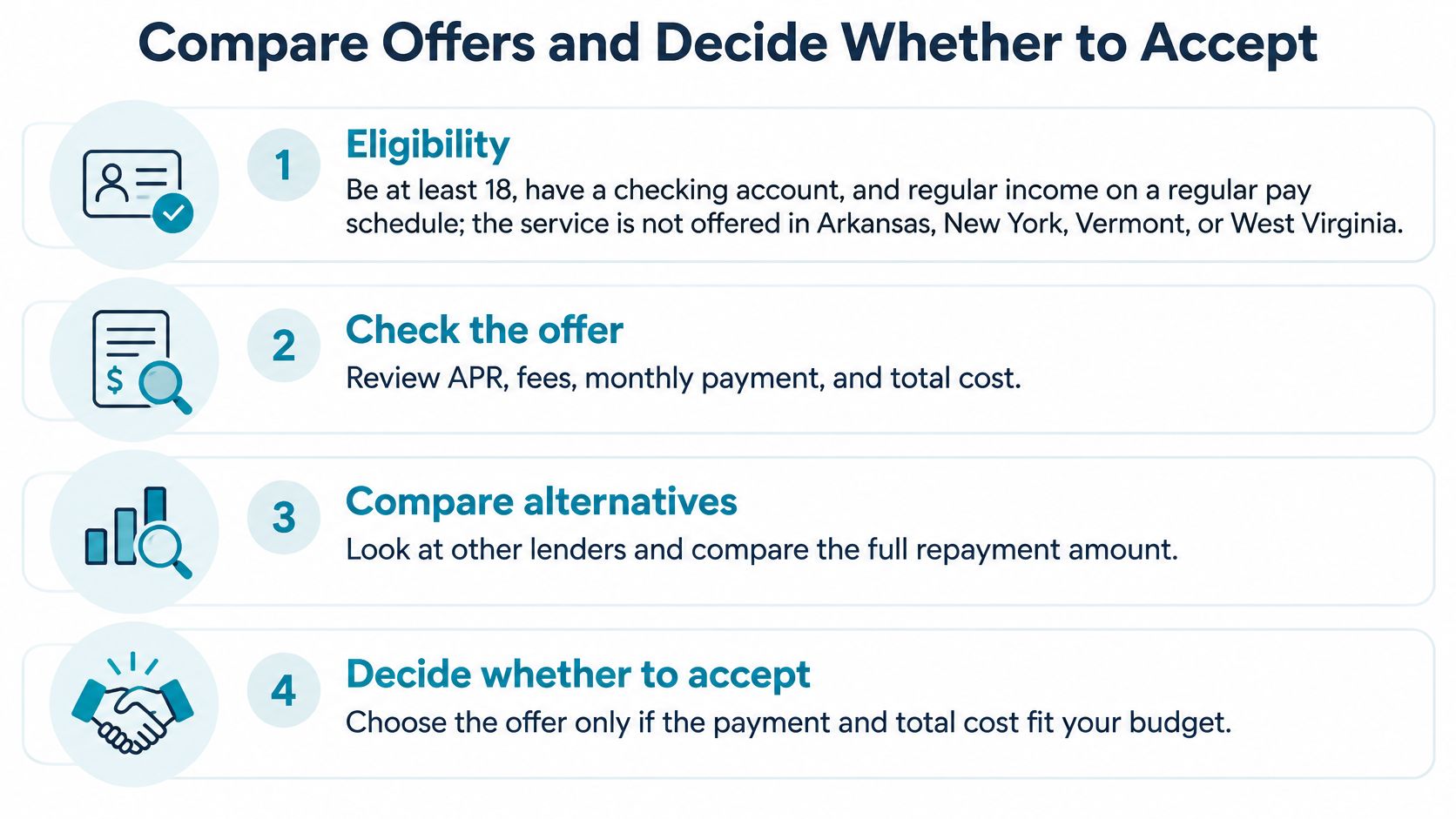
Who qualifies
The basic requirements are being at least 18 years old, holding a checking account, and being employed with regular income and a regular pay frequency. Availability depends on where you live, and the service isn't offered in Arkansas, New York, Vermont or West Virginia.
Protect your score while you shop
Checking a rate through NextStopLoans does not affect your credit score. A full application can trigger a credit check from the lender, though, and multiple inquiries to Experian, Equifax and TransUnion may lower your score, so register for one loan at a time rather than firing off five applications in a week.
The eight-point comparison
Run every returned offer through the same list, in this order:
- APR as the all-in rate. Not the nominal rate, not the monthly payment. The annualized figure that includes mandatory fees.
- Amount received after fees. If $250 comes off the top, your real principal is smaller than the note says.
- Monthly payment and due dates. Check the dates against your pay schedule, not against the calendar month.
- Total of payments. Multiply the payment by the number of payments and compare that number across offers.
- Every fee, including renewal. Origination, late, nonsufficient-funds and rollover charges belong in your notes before you sign anything.
- Credit reporting. Ask whether the lender reports on-time payments to the major bureaus. It changes what the loan does for you afterward.
- Prepayment and payoff rules. Confirm there's no penalty for paying early and get the payoff figure in writing.
- Licensing and legality. Verify the lender is licensed to lend in your state; a contract that isn't legal where you live isn't a bargain.
The decision rule
Accept only when three things are true: the total repayment fits your monthly budget with one month of cushion left over, the APR is the lowest available at that same amount and term, and no penalty or rollover provision can trap you if your income dips.
Compare offers directly only at identical amounts and terms. If one lender quotes 24 months and another quotes 36, convert both to total repayment before you judge either. Your request goes to network lenders, no offer is obligatory, and approval isn't guaranteed.
One action today
Submit a single request, then hold the returned terms against the eight points above. Decline anything you couldn't repay comfortably in a normal month, and remember that the cheapest-looking payment is frequently the most expensive loan.
NextStopLoans passes your request to a network of independent third-party lenders, so you can compare the terms they return side by side at the same amount and term before committing to anything. No offer is obligatory and approval isn't guaranteed, which means the decision stays yours at every step. Visit NextStopLoans to submit one secure request and see how the offers you receive measure up against the checklist above.