
Web Advance Application: A Complete How-To Guide
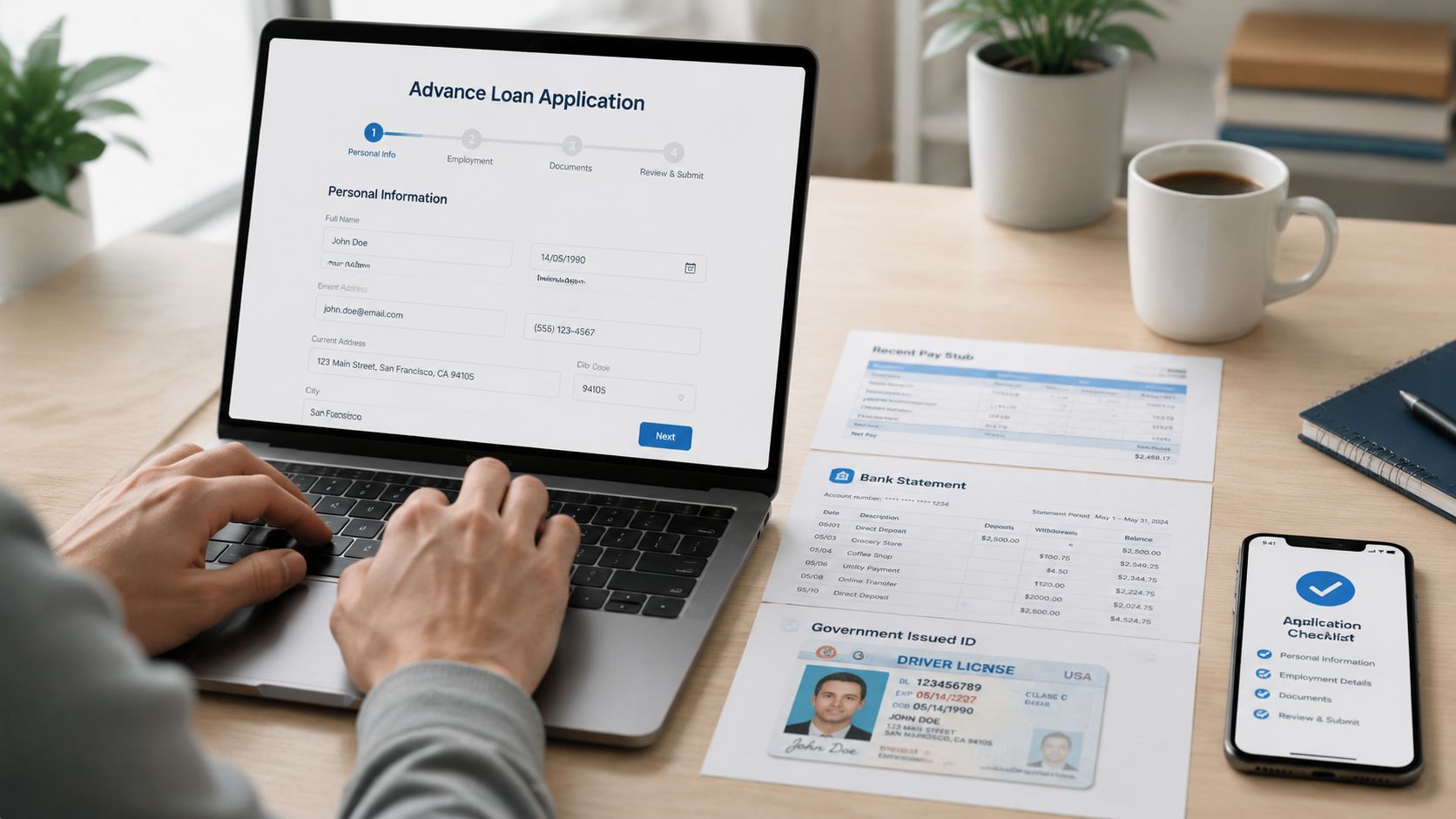
You're staring at an unexpected bill, checking the balance in your account, and searching for a web advance application that might get you through until payday. The promise is usually simple: complete a form online, receive a decision quickly, and possibly get funds by direct deposit. The process is more complicated. Your request may be screened by multiple lenders, verified against banking and income information, repriced after review, or declined because a small detail doesn't match.
A web application can be convenient, but convenience isn't the same as affordability or approval. The borrowers who fare best treat the process like a financial decision, not a race to click “submit.” They check eligibility, control what data they share, compare the complete repayment cost, and understand what happens between the request and funding.
Table of Contents
- What a Web Advance Application Really Is
- Who Qualifies and What You'll Need on Hand
- Submitting Your Application Step by Step
- What Happens After You Hit Submit
- Pitfalls That Derail Approvals and Funding
- Key Takeaways and Common Questions
What a Web Advance Application Really Is
A web advance application is an online request for short-term or personal credit submitted through a lender's site, comparison portal, or lending marketplace. The label describes the channel, not a single product. Depending on the provider, you might be seeking a payday advance, cash advance, installment loan, line of credit, emergency loan, or another unsecured borrowing option.
That distinction matters after you submit. A marketplace may screen your information and route it to participating lenders. Each lender can apply its own eligibility rules, pricing, verification steps, and funding process. A bank personal loan may use an online form but remain inside the bank's underwriting system. A peer-to-peer platform connects borrowers with investors. An employer-earned-wage app generally provides access to wages already earned instead of extending a conventional loan. Read the product description and agreement before treating these options as interchangeable.

Why the channel changes the experience
Online intake removes a branch visit and lets providers collect documents and account information electronically. That can speed up lender matching and review, but it also makes the first screening depend on complete, consistent answers.
A marketplace request can reach independent lenders with different underwriting models. One may examine income, employment details, credit information, and account activity. Another may weigh those signals differently, then present a different loan amount, repayment period, fee structure, or annual percentage rate. Your form is therefore a data-sharing decision as well as a credit request. Check which parties may receive your information and what consent you are giving before continuing.
Practical rule: A fast form starts the process. It does not guarantee approval, a low rate, same-day funding, or a repayment schedule you can afford.
Digital lending is a common intake route. A 2024 digital lending report found that 90% of financial institutions offered online or web loan applications, while 65% offered a mobile application process (2024 digital lending report). The report also found that 57% said consumers could complete the entire application online, so digital access does not always mean the full process ends online. Verification, lender review, disclosures, and funding can still determine what happens after submission.
Who Qualifies and What You'll Need on Hand
Before opening an application, check whether you meet the basic conditions. Lenders set their own rules, and state law can affect availability, pricing, and product design. A marketplace may connect you with participating lenders, but each lender makes its own approval and funding decision.
Most applicants should expect to provide:
- Age and residency: You'll generally need to meet the lender's minimum age requirement and be a legal U.S. resident in a state where the product is available.
- Bank account: An active checking account in your name is commonly required for verification and electronic funding or repayment.
- Income: Lenders typically want recurring, verifiable income. Employment income, benefits, or other accepted sources may qualify, depending on the lender.
- Contact details: Use a working phone number and email address. Lenders may use both for identity checks, disclosures, and follow-up questions.
- Identification: A government-issued photo ID is often requested.
- Tax identity: The form may request your Social Security number or, where accepted, an ITIN.
- Address evidence: A utility statement, lease document, bank statement, or other accepted record may be used to confirm residence.
- Income records: Recent pay stubs or bank statements can help verify the amount and regularity of deposits.
Prepare records that agree with each other
The most common avoidable problem is inconsistency. If the address on your application differs from the address on your identification, or the income you enter doesn't resemble the deposits shown in your account, verification may pause or fail. Don't estimate income to reach a desired loan amount. Enter the amount and source accurately, then let the lender decide what it can support.
Credit requirements vary. Some lenders consider applicants with limited or damaged credit histories, but weaker credit can lead to higher pricing, a smaller offer, stricter conditions, or a denial. A lender that accepts subprime borrowers isn't promising an inexpensive loan.
Soft checks and hard checks aren't the same
A soft credit inquiry may support prequalification without affecting your credit score in the same way as a hard inquiry. A formal application or final approval may involve a hard inquiry, depending on the lender and product. Look for the consent language before authorizing a credit check, and don't assume that every “check your options” button uses a soft pull.
| Requirement | What It Usually Means |
|---|---|
| Age | You meet the lender's minimum age rule for your state |
| U.S. residency | You live in an eligible state and can verify your identity |
| Checking account | The account is active, belongs to you, and can receive electronic transfers |
| Recurring income | You can document income that the lender accepts |
| Identification | Your photo ID is current and readable |
| Social Security number or ITIN | The lender can complete identity and credit-related checks where applicable |
| Phone or email | The lender can contact you during verification |
| Proof of address | Your residence matches accepted records |
Submitting Your Application Step by Step
Start by choosing the channel deliberately. A direct lender's website sends your information to that lender. A broker or comparison portal may distribute one request across a lender network. That can reduce repeated forms, but it also makes the privacy notice, consent language, and marketing permissions especially important.
1. Select the route
Check whether the site is a lender, broker, or marketplace. Review its privacy policy and disclosures before entering sensitive information. You should know who receives the request, whether participating lenders may contact you, and whether credit or bank verification can occur.
2. Create an account only if it helps
Guest submission may be available, while registration can make it easier to return to an incomplete request. An account may also create a profile for future messages and offers. Use an email address you monitor, but don't create multiple accounts to submit the same request.
3. Complete the identity and income fields accurately
Enter your legal name, current address, employment information, income, bank details, and requested amount exactly as your records show them. Small mismatches can trigger manual review. Never use another person's account, invent an employer, or inflate income.
4. Choose an amount and repayment period
The maximum displayed amount is not necessarily the amount you should borrow. Request only what solves the immediate expense, and test whether the scheduled payment fits after rent, utilities, food, transportation, and existing obligations. A longer term may reduce each payment while increasing the time you remain in debt.
5. Read the offer and disclosures
Look beyond a headline fee. Review the APR, finance charge, repayment frequency, total repayment amount, late-payment terms, origination charges, optional services, and authorization language. If the agreement doesn't clearly show what you'll repay and when, stop before signing.
6. Sign and authorize verification
Electronic signatures may finalize consent to lender communications, credit checks, bank verification, and account access. Save the agreement and confirmation page. If the lender requests additional documents, submit them through the secure portal rather than sending sensitive records through an unverified address.

Common stalls include an expired ID, an incomplete address, incorrect bank details, unverifiable income, and names that don't match across documents. Slow down at those fields. A careful application is usually more useful than a hurried one.
What Happens After You Hit Submit
After submission, the request enters several checks before money can move. A marketplace may route your profile to participating lenders, but it does not approve the loan or set its terms. Each lender applies its own eligibility rules and may request more information.
Lender matching comes first
The system can compare your requested amount, state, income source, account type, and other details with lender criteria. A match means a lender is willing to review the request, not that funding is guaranteed. Several responses may appear because lenders use different risk limits, product rules, pricing, and verification standards.
A direct lender portal sends your request through one institution's process. An aggregator or marketplace can expose it to more lenders, with a trade-off: broader data sharing and potentially more lender communications. Read the consent screen carefully. Do not assume one submission stays with one company.
Credit and identity checks follow
Prequalification may use a soft inquiry, while a formal application can involve a hard inquiry. The order depends on the lender. Bank verification may confirm account ownership, recent deposits, balances, and transaction patterns. Income verification may require pay stubs, account data, employer details, or an automated verification service.
Underwriting can also review employment stability, existing obligations, overdraft activity, and whether the proposed payment fits your income. These signals do not produce one universal result. One lender may decline while another offers different terms because their models and thresholds differ.
A fast status update is not the same as completed underwriting. If the lender cannot verify a key detail, the request may pause or move to manual review.
Approval has levels
Prequalified usually means the information provided appears to fit a lender's initial criteria. Conditionally approved means the lender still needs to verify documents, identity, account ownership, or another requirement. Fully approved means the required review is complete, although final documents and acceptance may still be required.
Verification can change the requested amount, repayment term, or APR. A lender may lower the amount, alter the term, add a fee, require a permitted co-applicant, or withdraw the offer when the information cannot be confirmed. Manual underwriting often follows conflicting automated data, unclear documents, or a request outside standard rules.
Digital lending has expanded, but fully online processing remains uneven across products. As noted earlier, product-level completion varies widely. A straightforward cash request may move quickly, while a more complex application can require deeper review, more documentation, and additional lender contact. Treat every preliminary result as a checkpoint, not a promise of funding.
Pitfalls That Derail Approvals and Funding
A polished form doesn't fix weak or contradictory information. Automated underwriting can reject a request before a person reviews the circumstances, especially when the data resembles a known risk pattern.
| Pitfall | Why It Happens | How to Prevent It |
|---|---|---|
| Income doesn't match deposits | Applicants report gross income while the account shows irregular or lower net deposits | Enter the correct income type and keep supporting records ready |
| Recent overdrafts | The lender sees unstable account activity or insufficient repayment capacity | Review account activity before applying and avoid requesting more than necessary |
| Outstanding short-term debt | Existing advances may reduce available cash flow | Disclose current obligations and calculate the next payment alongside existing payments |
| Outdated employment records | Old pay stubs or employer details no longer match | Upload current documents and check employer information before submission |
| Repeated applications | Multiple hard inquiries or conflicting requests can create concern | Compare eligibility first and avoid submitting identical requests everywhere |
| Bank-access confusion | The applicant doesn't understand what account data the service can view | Read the authorization screen and use the narrowest permitted access |
Treat bank access as a major decision
Some verification services use a secure bank connection, while others may rely on credentials entered into a third-party interface. Don't hand over banking credentials to an unfamiliar page. Prefer a clearly identified, read-only connection where available, verify the recipient, and check what data the permission covers.
After the application, review your bank's connected-app settings and revoke access you no longer need. Encryption protects information while it moves, but it doesn't answer every question about reuse, retention, lender sharing, or future marketing. The Consumer Financial Protection Bureau's consumer finance answers provide a neutral starting point for questions about financial products and consumer protections.
Fraud controls matter even when reported rates look small. TransUnion's 2024 omnibus fraud report presented tracked-channel sample rates of 0.15%, 0.16%, and 0.22%, illustrating why lenders use identity and transaction checks even for high-volume digital applications (TransUnion's 2024 fraud report). Those checks can create friction, but skipping them would expose both lenders and borrowers to account takeover and identity fraud.
Keep the first request short and accurate. Provide only essential information initially, then complete lender-specific verification after you understand who is reviewing the request. FICO survey findings cited in the same fraud research found that identity-check complexity can cause applicants to abandon personal-loan applications, reinforcing the practical value of progressive disclosure rather than an unnecessarily long first form.
Key Takeaways and Common Questions
A sensible web advance application begins before you visit the form. Check age, residency, income, account ownership, and state availability. Gather identification, income records, address proof, and bank details first. Choose a direct lender or marketplace based on how much lender reach and data sharing you're comfortable with.
Use this short checklist:
- Assess eligibility: Don't submit blindly and hope the system finds a way around missing requirements.
- Prepare documents: Current records reduce avoidable verification delays.
- Choose the channel: A marketplace can route one request across participating lenders, while a direct portal keeps the process with one lender.
- Read the agreement: Compare APR, fees, payment dates, and total repayment before signing.

Does applying hurt your credit?
It depends on the inquiry. Prequalification may use a soft pull, while a formal application may trigger a hard pull. Read the lender's authorization language before you approve the check.
How quickly can funds arrive?
A decision can come quickly, but funding depends on final verification, lender processing, and the delivery method. Same-day availability isn't guaranteed. A request that needs manual review or additional documents can take longer.
What happens after a denial?
Read the notice and identify the reason if the lender provides one. Correct inaccurate information, address unresolved account issues, and avoid immediately submitting the same incomplete application to multiple lenders. A denial is a signal to review the request, not an instruction to borrow elsewhere at any cost.
Can you change the terms after approval?
Usually, you can't alter a signed agreement unilaterally. Before accepting, ask whether the lender can adjust the amount or term and request the revised disclosures in writing. Don't rely on a verbal promise that isn't reflected in the contract.
Is refinancing sensible?
It can make sense only if the new loan reduces the total cost or creates a payment schedule you can realistically maintain. Replacing one expensive short-term balance with another expensive balance extends the problem. Compare the new APR, fees, payoff amount, and total repayment with the existing agreement.
The deciding comparison is APR and total repayment, not the smallest advertised fee or the fastest headline. If you're ready to compare a web-based request through a single intake, NextStopLoans offers an online marketplace that routes consumer loan requests to independent third-party lenders, with lender decisions and funding handled by those lenders. Visit NextStopLoans to review the application workflow and disclosures before deciding whether to submit.