
Loans to Help Pay Rent: Your Practical Options

Rent is due in a few days. Your checking account isn't ready. You're doing the math in your head, moving bills around, and asking the same question a lot of renters ask under pressure: should I get a loan to cover rent, or will that just make next month worse?
That's the right question.
Most advice about loans to help pay rent treats the problem like a simple cash shortage. It usually isn't. Sometimes you're dealing with a short timing gap. Sometimes your income got hit for one pay cycle. Sometimes rent is no longer fitting your budget at all. Those are three different problems, and they need three different responses.
A loan can absolutely help in the first scenario. It can be a bad move in the third. The hard part is telling the difference before you sign.
Table of Contents
- When Rent Is Due and Cash Is Short
- Why Rent Shortfalls Keep Happening
- Loan Options That Can Cover Rent
- Non-Loan Ways to Cover Rent First
- Should You Borrow to Pay Rent Right Now
- How NextStopLoans Fits Into the Picture
- Your Next Move When Rent Comes Due
When Rent Is Due and Cash Is Short
Maria rents a one-bedroom in a mid-sized city. In the second week of the month, her retail hours get cut. She was already close to the edge, so by the time the next rent due date rolls around, she's short. Not by a huge amount. Just enough to create a real problem.
Her choices show up fast.
She can call the landlord now and try to get a short extension. She can ask family for help, which works only if she has someone able to step in. She can try a credit card, if the landlord takes one and the limit is available. She can look for a fast loan. Or she can wait, miss the due date, and deal with late fees, notices, and the stress that comes with that.
None of those options feels good when the deadline is close.
The three pressure points that matter
Most rent crises come down to three facts:
How much you're short
A small gap can sometimes be solved with a payment plan, a community grant, or a microloan. A larger shortfall is harder because repayment pressure follows you into next month.How soon you can realistically repay
If you can replace the money quickly, a loan may be a bridge. If repayment depends on hope, overtime that hasn't been approved, or a tax refund you haven't received, it's not a bridge. It's a bet.Whether housing risk is immediate
If your landlord files quickly, or you're already behind, speed matters more. If you still have room to negotiate, borrowing may not be your first move.
Practical rule: Borrowing to protect housing can make sense. Borrowing without a clear repayment path usually turns one rent problem into two.
If you're in Maria's spot, don't shop blindly. Start by figuring out which track fits your situation: non-loan help, a personal or installment loan, an emergency cash option, or a hard stop because the loan won't solve the issue. If you need a fast overview of short-term funding mechanics, this guide on getting emergency cash is a useful primer.
Why Rent Shortfalls Keep Happening
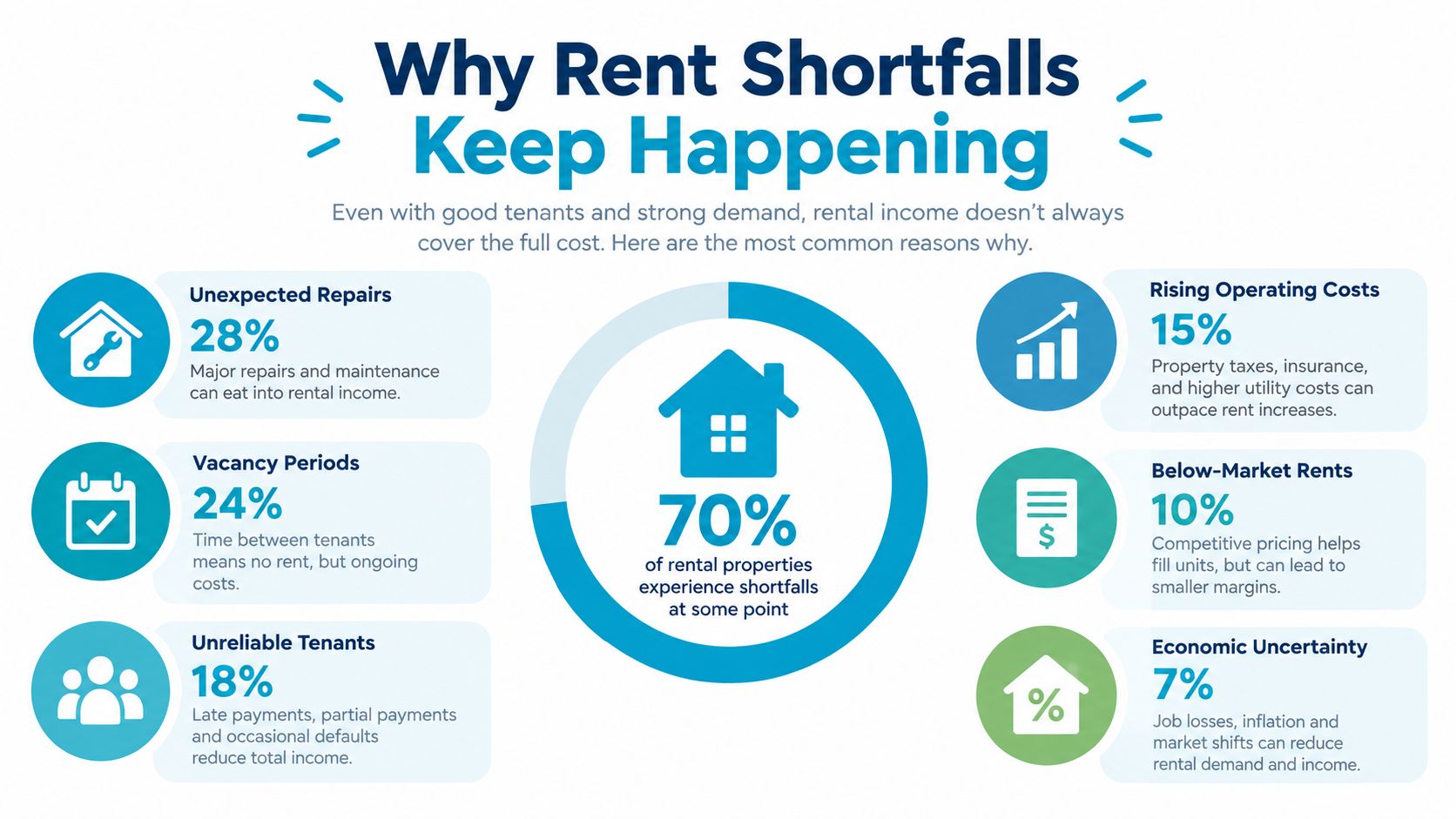
This isn't just about bad budgeting. Rent pressure is widespread and persistent.
In the United States, 22.7 million renter households were housing cost burdened in 2024, meaning they spent more than 30% of income on housing, and that represented 49.4% of all renter households. The same federal analysis found that 12.1 million renter households were severely cost burdened, paying more than half of income toward housing, and that in every state, more than one-third of renters were cost burdened according to the Congressional Research Service housing affordability analysis.
That matters because many rent shortfalls are not random. They come from a budget that already has no slack.
Why one shortfall turns into another
The pattern is familiar. An hourly schedule drops. A car repair lands at the wrong time. A medical bill hits the same week as utilities. Or your paycheck clears after rent is due, not before.
Then the first missed amount creates the second problem. If this month's gap gets filled with expensive debt, next month starts with less cash because the loan payment is now sitting on top of rent, not instead of it.
The arrears picture shows how large this problem has become. The CFPB's FDCPA annual-report materials estimate more than $9 billion in U.S. rental debt and more than 4.5 million households behind on rent payments in the CFPB annual report materials.
This is about stress, not convenience
Borrowers also tend to protect housing payments ahead of other debts. In a 2025 to 2026 consumer survey, borrowers prioritized mortgage or rent payments above auto loans, credit cards, and student loans, according to the Philadelphia Fed survey summary.
That tells you something important. People usually don't seek loans to pay rent because it's convenient. They do it because they're trying to stop the most dangerous bill from going unpaid.
When rent is the bill you're trying hardest to protect, a rent loan request usually signals a cash-flow problem, not careless spending.
Loan Options That Can Cover Rent
Not all rent loans are equally risky. Some are workable for a short-term gap. Some are traps dressed up as convenience.
The right way to compare them is simple: How fast does the money arrive, how painful is repayment, and what happens if your next month is tight too?
What each loan type really means
Personal loans are usually the cleanest option if you qualify. They often come with fixed payments and a defined term. That gives you structure, which matters when you're already under pressure. The downside is that approval can depend on credit, income, and recent banking history.
Installment loans are similar in that they break repayment into scheduled payments. For a renter with weaker credit, this can be more realistic than a traditional bank personal loan. The catch is cost. Some installment loans are manageable. Others are just payday pricing stretched over more time.
Credit card cash advances can move quickly if you already have an open card and available limit. They're rarely cheap. Interest can start immediately, and fees can pile on fast. Still, if the alternative is a title loan, a cash advance may be the less dangerous option for some borrowers.
Payday loans are built for speed, not stability. They're usually short-term, expensive, and brutal if you can't clear them on schedule. If repaying the full balance means you'll be short on next month's rent, don't take one.
Title loans are the option I push back on hardest. You're putting your vehicle at risk to solve a rent gap. If missing rent threatens housing, losing your car can wreck your income too. That's a bad trade.
For a fuller breakdown of the tradeoffs, read this comparison of installment loans vs payday loans.
Loan Options for Covering Rent Compared
| Loan Type | Typical Funding Speed | APR Range | Est. Total Cost on $1,000 | Main Risk |
|---|---|---|---|---|
| Personal loan | Often not instant, but can be relatively fast with online lenders | Varies by lender and borrower profile | Depends on rate, fees, and term | You may not qualify, or payments may still be too high |
| Installment loan | Usually fast if approved | Often higher than many bank personal loans | Depends on rate, fees, and term | Affordable-looking payment can hide high overall cost |
| Credit card cash advance | Immediate if card access is available | Often expensive and interest may start right away | Depends on advance fee and interest | Easy access can lead to revolving debt |
| Payday loan | Very fast | Typically very high cost relative to amount borrowed | Often expensive for a small balance | Balloon-style repayment can trigger reborrowing |
| Title loan | Fast | Often very high cost | Depends on fee structure and term | You can lose your vehicle |
| Emergency cash loan | Fast if approved by a lender | Varies widely | Depends on lender terms | Speed can distract you from total repayment cost |
Which ones are usually reasonable
For a one-time, short timing gap, the least bad borrowing options are usually a lower-cost personal loan, a carefully reviewed installment loan, or a small emergency cash loan with terms you can clear without reborrowing.
Avoid products that demand a full payoff too quickly or tie the debt to essential property.
If the loan fixes this month but guarantees panic next month, it didn't solve anything.
Non-Loan Ways to Cover Rent First
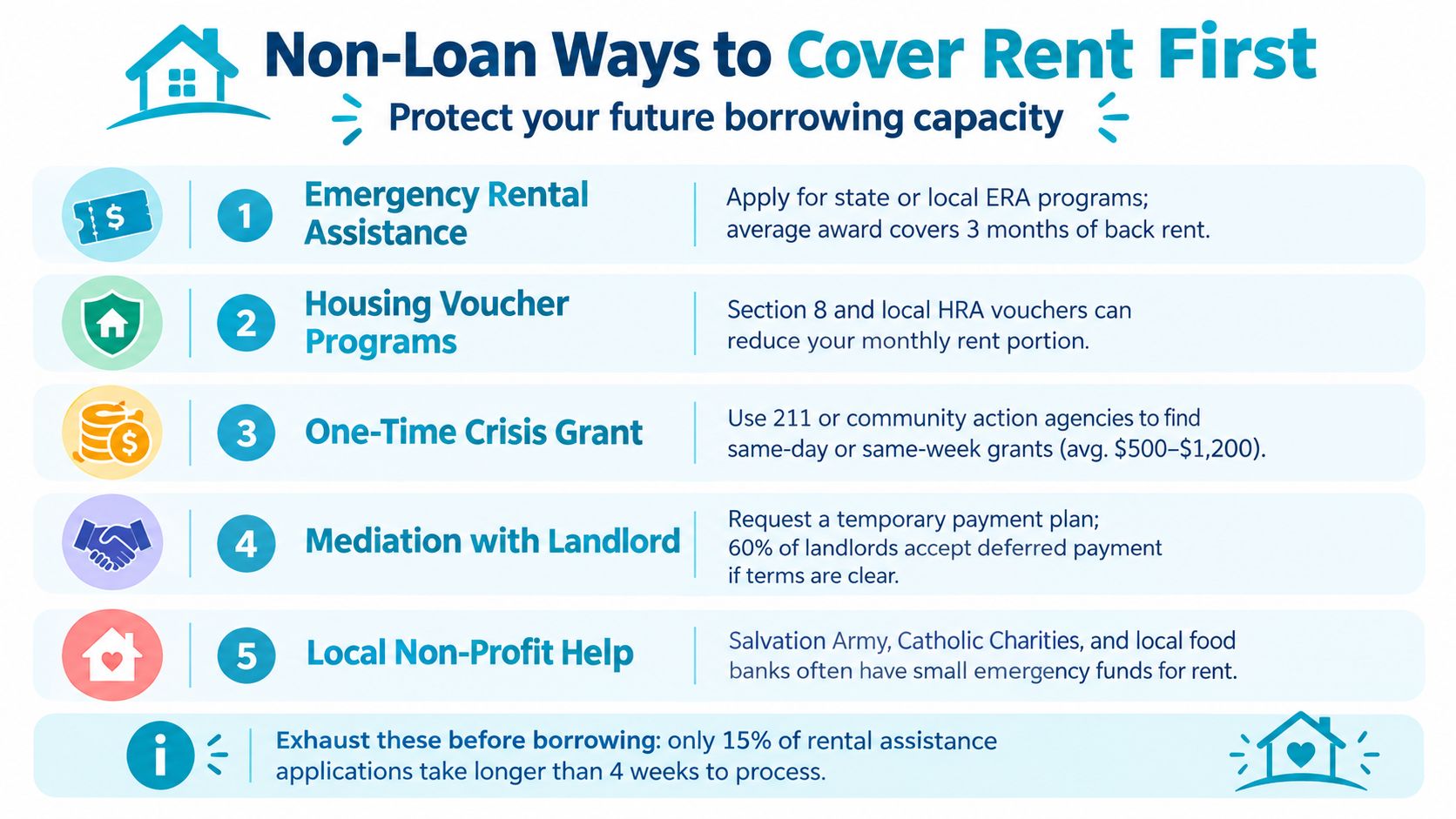
Before you borrow, try the options that don't leave you with new debt. That's not soft advice. It's practical protection.
If you can cover rent through assistance, a landlord payment plan, or a small community program, you preserve your future cash flow. That matters because once a loan payment lands on top of rent, your margin gets thinner.
Start with the landlord, not the lender
A lot of renters wait too long to make this call. Don't.
Contact the landlord or property manager before the due date if possible. Be direct. Tell them the exact amount you can pay now, when the rest will be available, and what plan you're asking them to accept.
Use language like this:
“I'm short this month because my income dropped. I can pay part now and the rest on my next pay date. Can we put that in writing so I can avoid falling further behind?”
Landlords don't always say yes. But clear communication beats silence every time. Silence makes you look unreliable. A concrete proposal makes you look like someone trying to solve the problem.
Apply for outside help in parallel
Don't wait to hear back from one source before trying the next. File multiple requests the same day.
Here's the order I'd use:
Call 211 first
Ask specifically for emergency rental assistance, eviction prevention, and local housing stabilization programs.Check city and county housing portals
Many local programs route help through housing departments, community action agencies, or nonprofit partners.Contact HUD-connected or local housing service agencies
They often know which programs are open right now, not just which ones exist on paper.Ask community and faith-based groups
Catholic Charities, Salvation Army branches, neighborhood nonprofits, and local relief groups sometimes have small emergency rent funds.Look for community microloans
Some local programs are designed specifically for eviction prevention. One example is a 2026 Atlanta pilot offering $500 no-fee, no-interest rent loans with no credit checks, no credit reporting, and repayment at $20 per week for 25 weeks, as reported by Fox 5 Atlanta on the city's eviction-prevention loan program.
Watch for scam behavior
Rent stress attracts scammers fast.
Be cautious if someone asks for upfront fees, gift cards, wire transfers, or promises guaranteed rent relief with no paperwork. Real aid programs may be slow or annoying, but they don't usually operate like a hustle.
Should You Borrow to Pay Rent Right Now
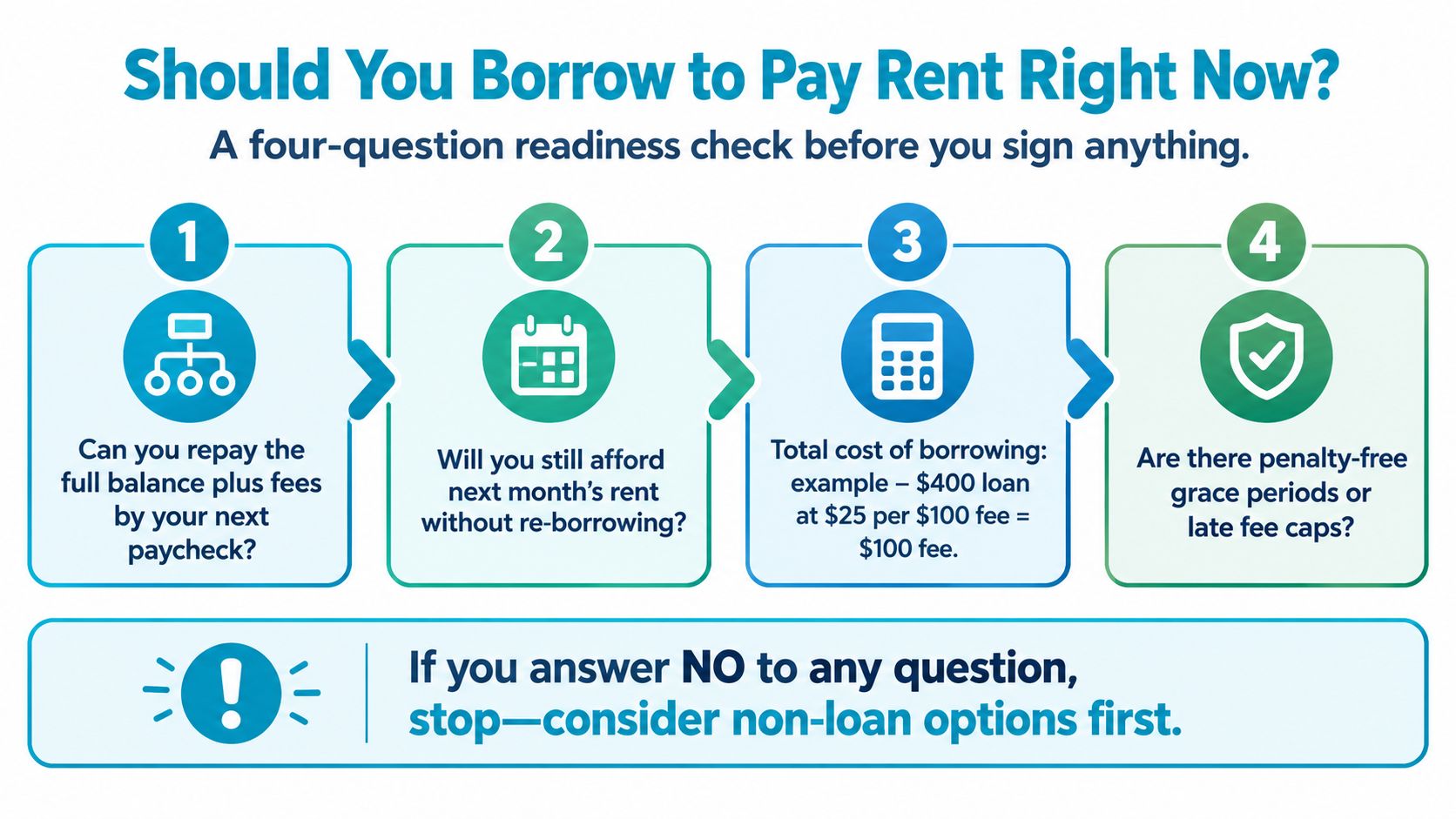
This is the checkpoint. Slow down and answer four questions.
If you can't answer them clearly, you're not ready to borrow.
The four-question filter
Can you repay the full balance plus fees inside the loan term without skipping another essential bill?
Don't use best-case math. Use the income you're sure is coming.Will next month's rent still be unaffordable after this loan?
If yes, borrowing only delays the collision.Have you already tried negotiation and assistance routes?
A loan shouldn't be your first move if you still have no-debt options left.What is the all-in dollar cost compared with the damage you're avoiding?
Ask the lender for the total repayable amount, not just the payment and not just the APR.
A simple decision standard
You don't need fancy formulas here. Ask one practical question: how many dollars do you have to repay to solve this rent problem today, and what will that do to your next paycheck?
If a short-term product charges by the amount borrowed, convert it into real dollars before you agree. If you borrow a few hundred dollars and the fees add a painful amount on top, that may still be worth it to stop a filing or buy time. But only if repayment doesn't force you to borrow again.
Skip the loan if you already know the repayment will collide with food, utilities, transportation, or next month's rent.
My recommendation is blunt:
- Go ahead if the shortfall is temporary, repayment is clear, and the loan cost is survivable.
- Proceed carefully if the loan helps but leaves your next month tight.
- Skip it if you'll need another loan to clean up the first one.
How NextStopLoans Fits Into the Picture
A marketplace is not a lender. That distinction matters.
When you use how NextStopLoans works, you're not borrowing from the marketplace itself. You're submitting one request that can be routed to independent third-party lenders in a network. Those lenders decide whether to approve, what terms to offer, and how funding works.
That setup makes sense when time is short and you don't want to fill out separate forms all over the internet.

What to have ready before you apply
Move faster by getting your documents in one place first:
- Identification such as a government-issued ID
- Income proof like pay stubs or benefit documentation
- Bank information if a lender uses direct deposit and reviews account activity
- Recent bank statements if requested
- Housing proof such as your lease, ledger, or another document showing rent owed
Some lenders care less about your score than about whether your income and account activity support repayment. That can help borrowers with weak or thin credit, but it doesn't remove the need to read terms carefully.
How to judge any offer that comes back
Most stressed borrowers look at one thing first: “Can I get funded quickly?” That's understandable, but it's not enough.
Compare offers using these questions:
- What is the total amount I will repay?
- How long is the term?
- Are there fees beyond interest?
- Can I prepay early without penalty?
- Does the payment fit after rent and essentials are covered?
If a lender presents terms you don't like, decline them. You are not required to accept an offer just because you filled out a request.
A marketplace fits well in the broader rent-stability toolkit. It can help you surface borrowing options when non-loan help won't close the gap in time. It does not replace rental assistance, landlord negotiation, or local hardship programs. It sits beside those options, not above them.
Your Next Move When Rent Comes Due
When you're short on rent, don't improvise. Use the same decision path every time.
First, confirm the exact amount due, the due date, any grace period, and any late fee policy in your lease or tenant portal. Don't rely on memory. Small details matter when the clock is running.
Second, contact the landlord or property manager before the payment is officially late if you still can. Ask for a short extension, partial-pay arrangement, or written payment plan. At the same time, submit applications to local rental assistance channels and community groups. Do those in parallel, not one after another.
The best order of operations
Use this sequence:
Pin down the shortfall
Know the exact gap, not a rough estimate.Open the landlord conversation
A short written agreement can buy time without new debt.Apply for emergency help immediately
City, county, nonprofit, and faith-based programs can all be in play at once.Run the readiness check
Only consider a loan after you know assistance or negotiation won't close the gap fast enough.Compare borrowing offers in one sitting
Look at total repayment, payment schedule, fees, prepayment policy, and funding time.
What to do on rent day
If you do end up using a loan, finish the cycle cleanly:
- Confirm the payment posted
- Save the receipt or screenshot
- Set up your next month plan immediately
- Review your cash flow within the next month
That last step matters more than people think. One rent crunch can be random. Two in a row usually means the budget itself needs a change, outside assistance, or a housing adjustment.
The goal isn't just to survive this due date. It's to avoid needing another emergency fix on the next one.
If you need to compare borrowing options quickly, NextStopLoans lets you submit one online loan request to a network of independent lenders and review any offers that come back. Use it the right way: after you've checked landlord flexibility and rental assistance, and only if the repayment terms fit your post-rent cash flow.