
Car Title Loan for Older Cars: Eligibility and Smarter
You're standing in the driveway looking at an older car that still runs, still gets you to work, and still has a title in your name. Then an urgent bill shows up, and the question gets very simple very fast: can that car provide enough cash to matter, or will you just put the title at risk for a small loan that's expensive from day one?
A car title loan for older cars is not really an approval question. It's a loan-size question and a borrower-fit question. If your car is old, the lender may still say yes, but the core issue is whether the vehicle's equity can cover what you need without trapping you in a payoff you can't realistically handle.
Table of Contents
- The Older Car, the Urgent Bill, and the Decision in the Driveway
- How a Car Title Loan Works
- Which Older Cars Qualify
- What an Older Car Is Worth to a Lender
- The Cost of Borrowing Against an Older Car
- When the Title Loan Is the Wrong Tool for an Older Car
- A Practical Checklist Before You Apply
- A Clear Decision Rule for the Driveway
The Older Car, the Urgent Bill, and the Decision in the Driveway
A lot of borrowers reach this point on a bad afternoon. The repair shop says the transmission is slipping, the landlord wants rent by Friday, or a medical bill landed in the mail, and the only asset sitting outside is a paid-off sedan with 140,000 miles. The car still has value, but not a lot of it, and that's exactly why title lending can look attractive.
Pew found that more than 2 million people, about 1% of American adults, used high-interest auto title loans annually, and that borrowers paid about $3 billion a year in fees on loans averaging $1,000 with typical APRs around 300%. Pew also reported that 6% to 11% of borrowers had a vehicle repossessed each year, which is the part people often push out of mind when they're focused on the immediate cash gap. Those are not abstract market numbers. They represent the true cost of using a car title as a short-term lifeline. Pew's auto title loan report
The three questions that matter
Before anyone signs, they need three answers.
Practical rule: if the loan won't cover the bill, or it covers the bill only by putting the car at risk, it's a bad trade.
First, can the car qualify. Second, how much can it provide. Third, what does repayment really cost if cash is tight next month too. Older-car borrowers get hurt when they answer only the first question and skip the other two.
That's why age alone is the wrong lens. A 15-year-old car can still have enough equity to support a loan, while another 10-year-old car may be too worn out, too high-mileage, or too low-value to justify meaningful proceeds. The decision should start with the amount you need, then work backward to the vehicle's value, not the other way around.
How a Car Title Loan Works
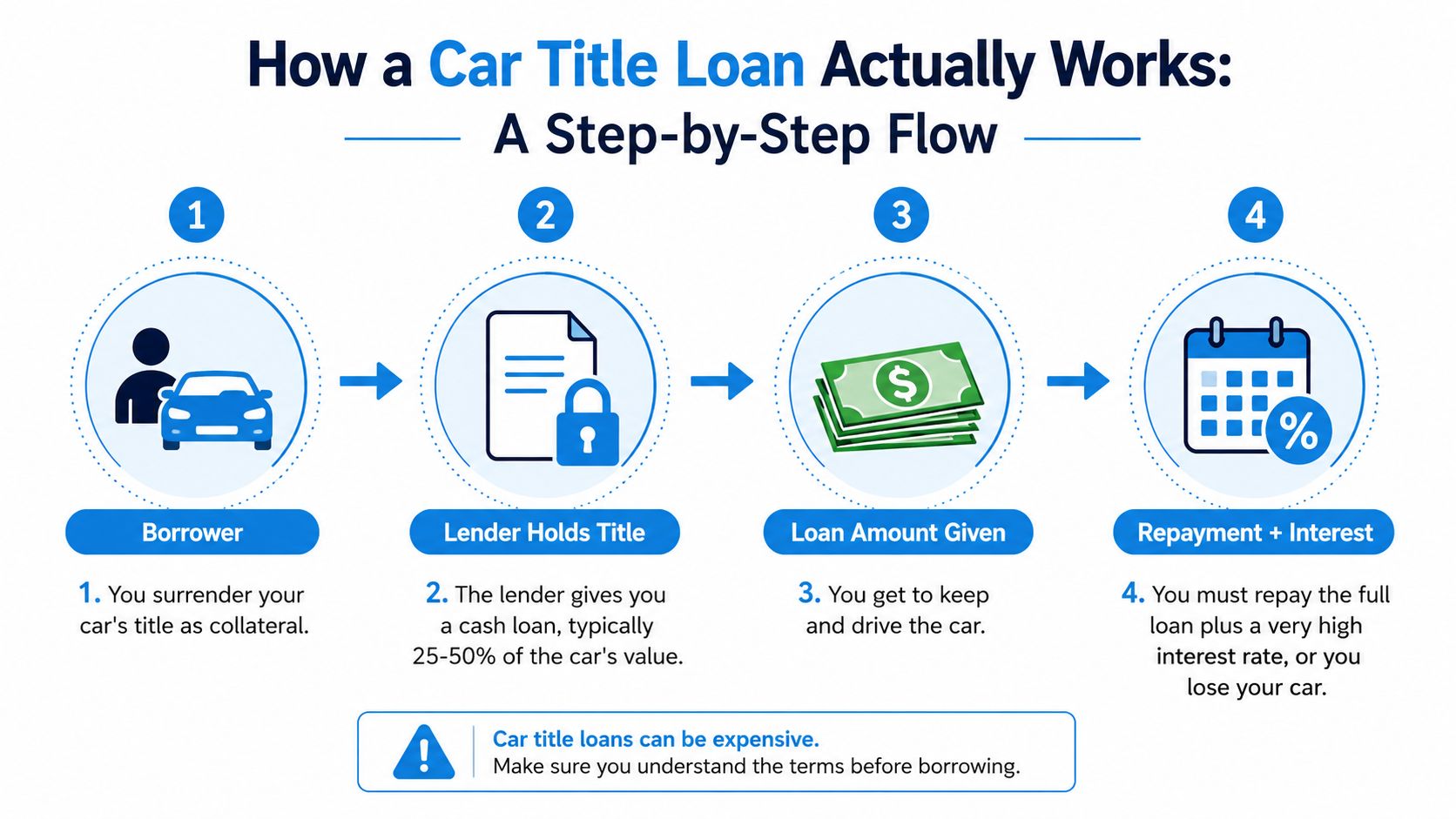
In a title loan, the lender records a lien against your vehicle while you keep driving it. The car stays with you, but the title gives the lender a legal claim if you do not repay.
What gets surrendered, and what doesn't
What you hand over is control on paper, not the keys. The lender holds the title and places a lien on it, which makes the loan secured even when the cash is fast and the approval standards feel lighter than a bank loan.
That paper claim is the whole trade. You get short-term money, but the car is now exposed if repayment slips. For an older-car owner, that risk is not theoretical. A working car can still be useful every day, and still be weak collateral if the loan balance is too high for its value.
Why title loans are different from unsecured loans
An unsecured personal loan does not use the car as collateral. A title loan does. That shifts the lender's focus away from credit alone and toward the vehicle's resale value, condition, mileage, and market demand. Older cars can still qualify, but only if they have enough remaining value to support a real advance.
That is the part borrowers need to think about first. The lender is funding against your car's remaining value, not your emergency. A clean older sedan might support a modest loan, while a worn-out high-mileage car may only justify a small advance, or nothing worth taking. If the value is thin, the offer will be thin too.
Which Older Cars Qualify
A lender looks at an older car for one reason, collateral value. If the title is clean, the car is owned outright or close to it, and the vehicle still has enough resale value, it can qualify. Age alone does not decide it.
The broader title loan market has long included older vehicles. A court-record study cited by the Cato Institute found pledged cars averaged 11.4 years old and 90,823 miles. Another research summary reported a median car value of $3,150, a median loan size of $845, which works out to a 26% loan-to-value ratio, and a median APR of 300%. These figures reflect the broader title loan market; older-car-specific cutoffs vary by lender and state. Cato Institute's money-go discussion
The four gates lenders usually care about
Older-car underwriting usually comes down to a few hard questions.
- Clean title in your name: If the title is not yours free and clear, the lender has a problem.
- Paid off or strong equity position: The lender wants enough collateral coverage to make the deal worthwhile.
- Mileage and condition: High mileage, damage, or mechanical problems lower value fast.
- Roadworthy status: A car that cannot reasonably be driven or resold has weak collateral value.
Each lender sets its own cutoff, so two borrowers with similar cars can get very different answers. One lender may accept an older model if it is clean and maintained. Another may turn it down because the value is too thin or the resale risk is too high.
What gets declined fastest
A car with a salvage history, clear mechanical trouble, or title problems is usually a poor candidate. So is a vehicle that looks fine from the curb but has mileage and condition issues that slash its market value. Older does not automatically mean no, but older and worn out often does.
Do a quick self-check before you apply. If the title is messy, the car is barely holding together, or the value is too low to justify a loan, skip the application. The lender is looking at resale value, not sentiment.
What an Older Car Is Worth to a Lender
Many borrowers read the car emotionally. A lender reads it as collateral. What matters is loan-to-value, the share of the car's appraised or wholesale value the lender is willing to advance.
For older cars, the practical ceiling is usually about 25% to 50% of value. Age, mileage, and condition push that number down because they shrink resale protection. A $4,500 older sedan may only support about $1,125 to $2,250 in borrowing. A cleaner older vehicle with stronger demand can support more if its value holds. TitleLo's car title loan value guide
Loan size is value, not age
Two 12-year-old cars can produce very different offers. One may be a high-mileage commuter with little demand. The other may be a clean truck or well-kept SUV that still draws buyers in the wholesale market. Same model year, very different loan amount.
| Older-Car Title Loan Estimates by Vehicle Scenario | Estimated Wholesale Value | Loan Size at 25% LTV | Loan Size at 50% LTV |
|---|---|---|---|
| High-mileage sedan | About $3,200 to $5,000 | About $800 to $1,250 | About $1,600 to $2,500 |
| Clean older commuter car | About $5,000 to $8,000 | About $1,250 to $2,000 | About $2,500 to $4,000 |
| Well-kept older truck | About $8,000 to $12,000 | About $2,000 to $3,000 | About $4,000 to $6,000 |
What the numbers show
If your car is worth only a few thousand dollars, the loan will be a fraction of that. That is why older-car borrowers often run into a bad match. The collateral is too small to solve a large emergency, but the loan still carries high-cost short-term pricing.
A worn car with weak resale value can still get approved, but the dollar amount may be too small to matter. A cleaner older truck or SUV gives the lender more protection, so the offer can be meaningfully higher. That is the whole game here. Older-car title lending is a loan-size question first, a yes-or-no approval question second.
The Cost of Borrowing Against an Older Car
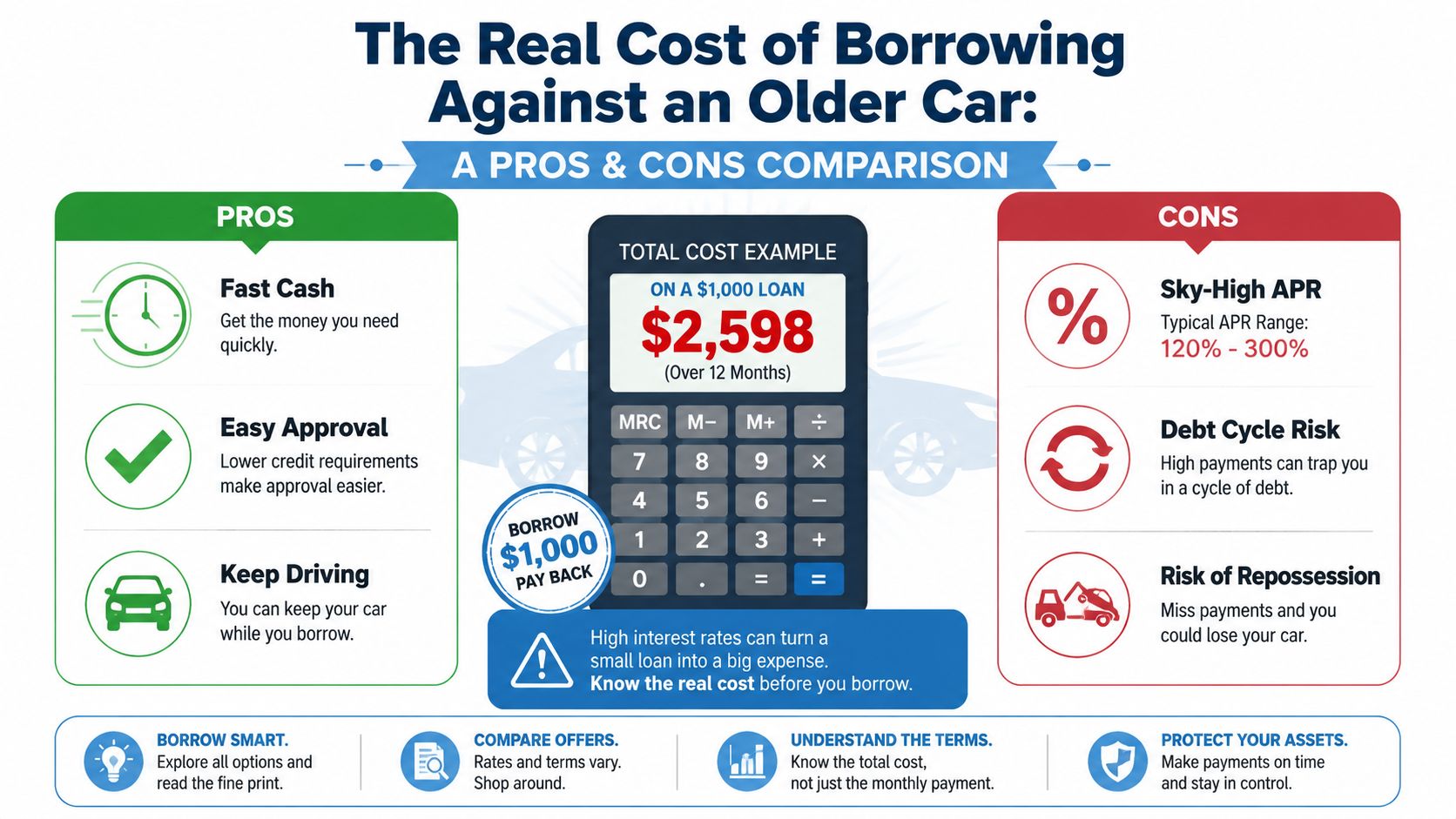
A borrower with an older car can get approved and still make a bad deal. The price is the problem. The FTC says monthly finance fees can reach 25%, and that can turn a short loan into a very expensive one fast. Consumer guidance also commonly puts title-loan APRs in the 120% to 300% range. FTC guidance on payday and car title loans
The payment structure is the trap
Many title loans demand a balloon payoff. You get the cash now, then the full balance plus finance charges comes due all at once. There is no slow reduction of principal unless the loan is structured that way, and many are not.
If the borrower cannot pay on time, rollover pressure begins. Each extension adds more fees while the title stays tied up, and the car can still be repossessed if the loan turns delinquent. That is how a short-term fix turns into a long, expensive problem.
Why a small loan can still be a bad deal
A $1,000 loan sounds manageable until you run the numbers. At 25% monthly fees, one rollover adds $250. Three rollovers push the balance to about $1,953. The borrower did not borrow anywhere near that much, but the fees kept stacking.
That is the trap with older-car borrowing. The loan amount is often modest because the vehicle is worth only a few thousand dollars, yet the finance charges are still priced like emergency credit. A clean older truck may justify a larger offer than a worn sedan, but the repayment math does not improve just because the car is older. It only works if you can clear the balance fast.
The older the car, the harsher the mismatch can feel. The lender may offer a small amount, but the cost structure stays aggressive. Borrowers should treat title lending as a last resort, not a convenience option.
When the Title Loan Is the Wrong Tool for an Older Car
An older-car title loan is usually the wrong tool when the amount you need is small relative to the car's value and the repayment date is too tight for your actual cash flow. That's the core problem. The loan may be available, but the economics still don't work.
The other options are often more sensible. An unsecured personal loan can avoid putting the car at risk. A credit union loan may be slower, but the structure is usually more forgiving. If you're comparing online marketplaces, one option is NextStopLoans, which routes consumer loan requests to independent third-party lenders rather than making the credit decision itself. That matters because the marketplace can surface alternatives without forcing you to bet the title on the first offer.
Match the tool to the problem
If the issue is a temporary gap and you have decent credit access, a personal installment loan is usually cleaner. If you need a very small amount and can repay over time, an installment structure beats a single balloon. If the car is your only reliable vehicle and the loan would barely cover the emergency anyway, a title loan is a poor trade.
- Personal installment loan: Better when you need predictable payments.
- Credit union loan: Better when you can wait and want more reasonable terms.
- Title loan: Only worth considering when the car has enough value and you can repay fast without risking default.
- Family or asset-based help: Sometimes smarter if it avoids turning one crisis into two.
Don't confuse approval with suitability
Older cars can make approval easier because lenders know how to price collateral. That doesn't mean the loan fits your situation. If the car is old, the loan may be too small to solve the problem, yet the repayment risk is still full-size. That's the mismatch I see most often, borrowers accept a bad structure because the title loan is available now.
A Practical Checklist Before You Apply
Start with the title itself. If the title isn't clean or isn't in your name, stop and fix that first. Lenders care about proof of ownership, current registration, insurance, and the car's actual market value, not just its age.
What to do before you hand over the title
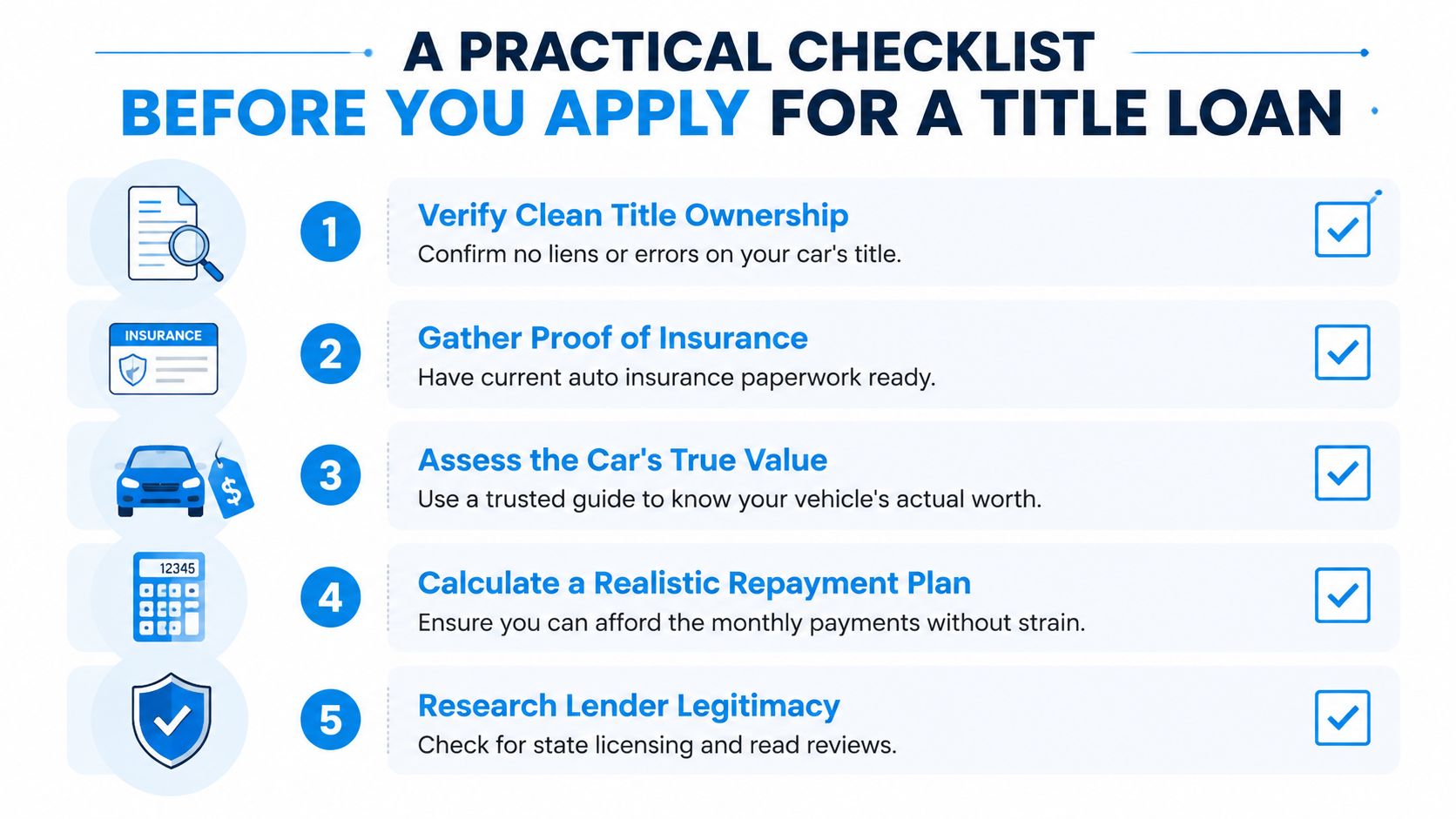
- Verify clean title ownership. Make sure there are no hidden liens or title errors.
- Gather proof of insurance. Have current paperwork ready before you apply.
- Assess the car's true value. Use a trusted guide or appraisal source so you know what the collateral is really worth.
- Calculate a repayment plan. Be honest about whether you can cover the full payoff when it comes due.
- Research lender legitimacy. Check licensing, state rules, and lender reputation before signing anything.
The state rules matter too. Arkansas, New York, Vermont, and West Virginia are excluded from the NextStopLoans service, and several states limit or ban title lending outright, so don't assume a lender can operate where you live. If you're comparing offers through a marketplace, read the lender disclosures carefully, because the participating lenders set the terms and make the credit decisions.
What to ask before you sign
Ask how the lien works, what happens if you miss a payment, and whether the vehicle can be repossessed quickly once delinquent. Ask for the full repayment amount, not just the cash advance. If the answer is vague, that's your answer.
The cleanest move is to compare more than one offer, then walk away if the payoff math looks ugly. A title loan should feel like a short bridge, not a permanent detour.
A Clear Decision Rule for the Driveway
Here's the decision rule I'd use. If the older car has enough value to cover the exact cash need at a manageable loan-to-value ratio, and you have a credible plan to repay the full balance on time, the title loan can be a workable short-term fix. If the loan is small, the APR is still punishing, and the car is the household's only dependable vehicle, the math usually fails.
The safest answer is the boring one. Use the title only when the collateral is strong enough, the repayment date is realistic, and the emergency is short-term. If any one of those pieces is missing, you're better off looking at an installment loan, a credit union option, or another funding source that doesn't put your transportation on the line.
Older cars can still provide cash. That doesn't mean they should.
If you're comparing options for an older car and want to see what different lenders may offer, NextStopLoans routes a single request to participating lenders so you can review terms before deciding. If you're facing a title-loan decision this week, submit one request, compare the offers carefully, and don't sign anything unless the repayment plan works on paper first.